
Clearing the tableau in golf solitaire
Golf Solitaire is a fast card game with one rule: play a card that is exactly one rank above or below the pile. This guide covers the layout, the wrapping rule, and the strategic thinking that turns a random-looking deal into a winnable one.
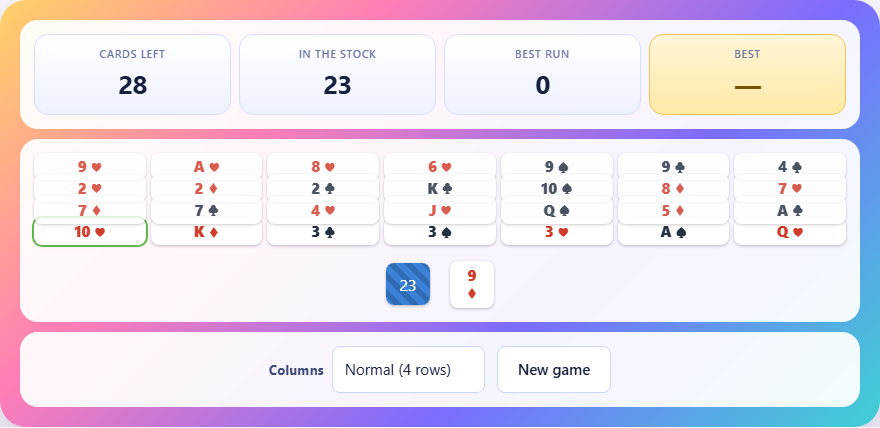
How the cards are laid out
The deck is dealt into seven columns. On the default Normal setting each column has four cards, making 28 on the table. All of them are face up. One card is turned over to start the waste pile, and the remaining cards form the stock.
Only the bottom card of each column can be played. The cards above it are locked until the ones below them are removed. This means the order you clear cards in matters. You cannot reach a card in the middle of a column just because it is the right rank.
Below the columns sit two piles side by side. The waste pile on the right shows the card you need to match. The stock on the left is a face-down stack you can tap to draw a new card when you are stuck.
The one rule: one above or one below
Tap any bottom card in a column and it moves to the waste pile, but only if its rank is exactly one higher or one lower than the card already showing. Suits do not matter at all. A five of clubs plays on a four of hearts just as happily as on a six of spades.
Ranks wrap around in this version of the game. A king can be played on an ace and an ace can be played on a king. This wrapping rule keeps chains alive that would die under strict rules. Without it, a king at the top of the waste pile would be a dead end half the time.
Using the stock
When no bottom card in any column is one above or one below the waste pile, tap the stock. The top card is turned over and placed on the waste pile. You now have a new target rank to match against.
Turning a stock card breaks your current chain. The game tracks your longest unbroken run of played cards, and that counter resets each time you draw from the stock. But the real cost is that every stock card you use is one fewer safety net for later. If you burn through the stock early, the end of the game gets much harder.
The game ends when either all columns are empty, which is a win, or the stock is empty and no playable card remains, which is a loss.
Controls and settings
Tap the bottom card of any column to play it. Tap the stock pile to draw. That is the entire interface. On a phone the cards and piles are sized for thumbs.
A dropdown labelled Columns offers three settings. Easy deals five rows per column, Normal deals four, and Hard deals three. Fewer rows means each column is shorter and easier to clear, but every setting uses the full 52-card deck. Press New game at any time for a fresh deal.
The stats bar shows how many cards are left in the columns, how many are left in the stock, and your best unbroken run so far in this hand.
Think in chains, not single cards
The key to winning is building long chains. A chain is a sequence of plays made without drawing from the stock. If the waste shows a six, and you play a five, then a four, then a three, then a two, that is a chain of four. Chains of five or six cards can clear an entire column in one sweep.
Before you play the first card, scan all seven columns. Look for cards that connect in sequence. If one column ends in a seven and another ends in an eight, playing the seven first lets you play the eight next. Plan these sequences before you tap.
The longer the chain, the more cards you clear without spending stock. Stock cards are finite. Chains are not. Every card you clear through a chain is a card you did not need the stock for.
Clear whole columns, not random cards
A column with one card left is almost as much trouble as a column with four. It still holds a card you might not be able to play. The real gains come from emptying a column entirely, because that removes every card in it from the problem.
When two cards are both playable, ask yourself which one is closer to emptying its column. If one column has two cards and the other has four, clearing the two-card column is usually better. You remove a column from the board and uncover no new problems.
Skimming one card off every column feels productive but achieves little. You end up with seven short columns and no columns gone. Concentrate your effort on the columns closest to being empty.
When to use the stock
Save the stock for when you are truly stuck. If any card on the board is playable, play it first. Every playable card is one step closer to clearing a column, and playing it costs nothing.
Some players draw from the stock the moment they see a gap in the chain. That is often too early. Scan every column again. The card you need might be at the bottom of a column you overlooked. Only draw when you have checked all seven.
Late in the game the stock becomes precious. If you have three columns left and five stock cards, each draw must unlock a chain or you are finished. At that point, consider which stock draw is most likely to land on a useful rank. You can see every card in the columns, so you know what ranks would help.
The wrapping rule and how to use it
Because king and ace connect, the rank circle has no dead end. A chain can run through ace, king, queen, jack and keep going. Chains that climb from low to high or drop from high to low can reverse direction at any time.
This changes strategy in a subtle way. In a non-wrapping game you would avoid playing a king because nothing can follow it. Here, a king is just another link. Do not hesitate to play kings when they fit a chain. The ace will follow just as a two follows a three.
Common mistakes and how to fix them
- Playing the first playable card you see. Always scan all seven columns first. The second playable card might start a longer chain.
- Drawing from the stock too early. Exhaust the board before you draw. The stock is a limited resource.
- Ignoring column length. A four-card column is harder to clear than a two-card column. Prioritise the shorter ones to remove them entirely.
- Forgetting the wrap. Kings and aces connect. That link saves chains you might think are dead.
- Playing from the longest column out of habit. Length does not decide which card to play. The chain it starts does. A one-card column that extends a five-card chain is far more valuable than taking a random card off a long column.
Difficulty settings explained
Easy deals five rows per column, putting 35 cards on the table and leaving 16 in the stock plus the starting waste card. With five cards per column, chains need to be longer to clear a column, but the stock is ample.
Normal deals four rows, putting 28 cards on the table and leaving 23 in the stock. This is the standard layout. Columns are shorter so they empty faster, but you have more columns competing for the same stock.
Hard deals three rows, putting only 21 cards on the table and leaving 30 in the stock. Each column is short and easy to clear, but you will need the stock to bridge gaps between playable cards, and with 30 cards to burn through, a bad run of draws can end the game quickly.
Nothing is sent off your device
The deck is shuffled in your browser. No card data leaves your machine, there is no account, and your best run is stored in local storage on this device only. The game works offline once the page is loaded. Close the tab and everything is gone.