
Solving symmetry puzzles one mirror at a time
Galaxies asks you to carve a grid into regions that are perfectly symmetric about their dots. This guide walks through the rules, the controls, and the reasoning tricks that make even the larger boards solvable without guessing.
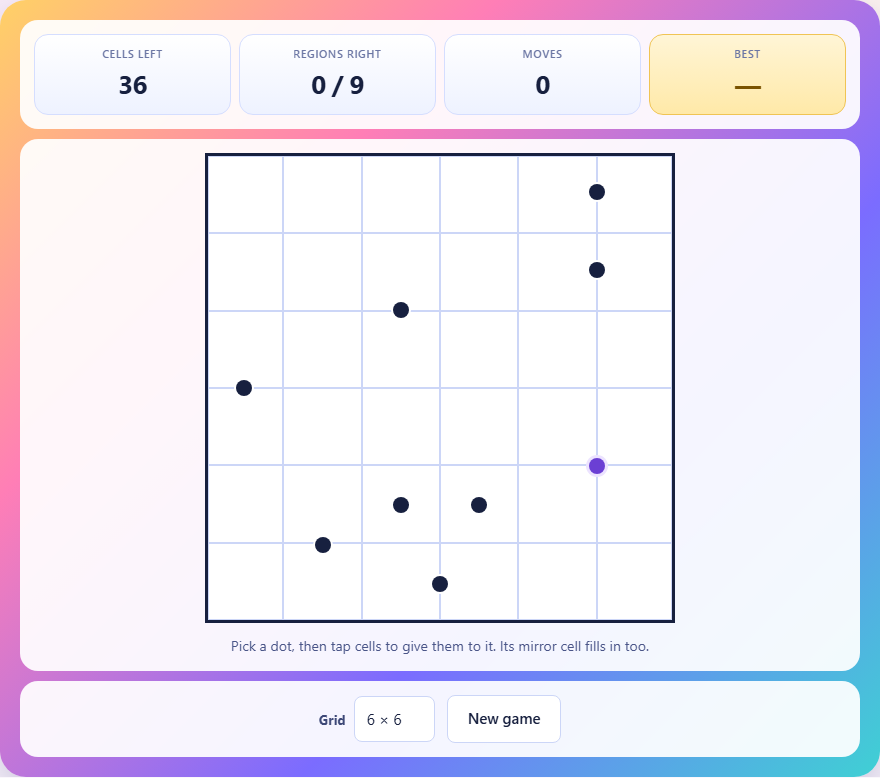
What the puzzle asks of you
You are given a grid of squares. Scattered across it are dots. Your job is to divide the entire grid into regions so that each dot belongs to exactly one region, and each region has exactly one dot. The catch is symmetry: if you were to spin a region half a turn around its own dot, it would land on itself perfectly. Every square must end up in a region, and every region must be one connected piece.
That sounds abstract, so here is a concrete way to think about it. Pick any square in a finished region. Measure how far it sits from the dot, and in what direction. Now go the same distance in the opposite direction. You will land on another square in the same region. Always. If you cannot, the region is wrong.
Where the dot sits matters
A dot can appear in three places. It can sit in the centre of a square, on the line between two squares, or on the corner where four squares meet. Each position tells you something before you place a single claim.
A dot in the centre of a square means that square is its own mirror. The region around it will have an odd number of squares in both width and height. A single square by itself is a legal region if the dot is in its centre.
A dot on a line between two squares means those two squares are already partners. The region will have an even count in one direction. A dot on a corner belongs to the four squares around it, giving an even count in both directions. Reading the dot position is free information. Use it.
Controls and how to play
Tap a dot to select it. That dot becomes your active brush. Now tap any square on the grid. Two things happen at once: the square you tapped is claimed for that dot, and its mirror square on the other side of the dot is claimed too. Tap the same square again to release both.
If you tap a square whose mirror would fall off the edge of the grid, nothing happens. The game is telling you that square cannot belong to that dot at all. This is a useful signal, not a bug.
A dropdown labelled Grid lets you pick 5 by 5, 6 by 6, or 7 by 7. The default is 6 by 6. Press New game for a fresh puzzle at the chosen size. The stats bar shows how many cells are still unclaimed, how many regions are correctly formed, and how many moves you have made.
Start at the edges and corners
Corner and edge squares have fewer possible owners than squares in the middle. A square in the very corner of the grid can only belong to a dot whose mirror of that corner is also inside the grid. Most dots fail that test, leaving just one candidate. Claim it.
Work outward from the edges. Once you fill in the border squares, the squares next to them become constrained too. This chain of forced moves is the backbone of a clean solve. Many players stare at the middle of the board first and get stuck. The edges are almost always more productive.
Think in pairs, not singles
Every time you place a square, you place two. That is the engine of the whole puzzle. If a dot is three squares to the right of an unclaimed cell, claiming that cell also claims the cell three squares to the left of the dot. Before you tap, look at where the partner will land.
This also works in reverse. Suppose the partner square is already taken by a different dot. Then the first square cannot belong to your dot either, because its partner slot is occupied. Noticing these blocked pairs early saves you from building a region that can never close.
A good habit is to scan every dot and fill in the squares immediately touching it. Those squares are always partners of each other, so they are free claims. Do this across the whole board before you start reasoning about the harder placements. It is quick and it shrinks the problem.
Regions must stay connected
A region that is symmetric but split into two separate chunks is wrong. Every square in a region must be reachable from every other square by stepping through shared sides. Diagonal neighbours do not count.
This rule catches a subtle mistake. You might claim a square far from the dot because its partner works out nicely, but if neither square touches the rest of the region yet, you have created an island. The game does not stop you from doing this mid-solve, but it will not accept a disconnected region as finished.
When you suspect a region might be splitting, trace a path from the dot to each of the squares you have claimed. If you have to leave the region to get there, the region has a gap.
Common beginner mistakes
- Starting in the middle of the board. The centre has the most options and the fewest constraints. It is the hardest place to begin. Start at the edges instead.
- Forgetting that one tap places two squares. If you are not watching where the partner lands, you will accidentally block a neighbouring region.
- Ignoring the dot position. A dot on a corner means you need four squares around it at minimum. A dot in a cell centre can be a one-square region. Skipping this check means guessing when you do not have to.
- Trying to make all regions the same size. There is no rule about size. A region can be one square or a dozen. Let the dots and their positions tell you how big each region needs to be.
- Building disconnected pieces and hoping they will join up later. They usually do not. Keep every region in one piece from the start.
- Not using the region counter. The stats bar tells you how many regions are complete. If the number stops going up, something is wrong.
A worked example of a forced move
Picture a 6 by 6 grid. A dot sits on the line between the top-left corner square and the square to its right. That dot owns both of those squares as its seed. Now look at the corner square itself. Its mirror through that dot is the square to the right. Both are already claimed. What about the square directly below the corner? Its mirror through the dot lands one row below and one column to the right. If that landing square is free, you can claim the pair. If it is off the grid or taken, you cannot.
Walk through this check for every square touching the seed. Most of them will resolve to exactly one answer. After three or four of these steps, the region is finished and you move to the next dot. That is the rhythm of solving: claim the seed, check the neighbours, expand what is forced, and move on.
Difficulty levels and what changes
The 5 by 5 grid is the gentlest. With only 25 squares and a handful of dots, most placements are forced by the edges alone. It is a good place to learn the mirror rule without pressure.
The 6 by 6 grid is the default and offers a real challenge. The extra row and column give dots more room, so you will need to reason about pairs rather than rely on edge constraints. Most puzzles take a few minutes.
The 7 by 7 grid is the hardest option. With 49 squares the board has enough room for larger, oddly shaped regions. The number of dots tends to be lower, so each region covers more ground and the mirror distances grow. Expect to spend more time checking partners.
Every puzzle has exactly one answer
The grids are not drawn at random and left to chance. The generator builds regions symmetrically from the start, growing them two squares at a time. Once the grid is full, a solver checks that the partition really is the only legal one. If a second answer exists, the grid is thrown away and a new one is built.
This means guessing is never needed. Every grid can be solved by logic alone. If you feel stuck, you have missed a forced placement somewhere, not reached a fork that requires a coin flip.
Everything stays on your device
The puzzle runs entirely in your browser. No moves are sent to a server. There is no account, no login, and no tracking of your solve times beyond what your own browser stores. Your best scores live in local storage on this machine and nowhere else. Close the tab and nothing is left behind.