
Making a border with exactly the right symmetries
What the four kinds of border symmetry are, how to build the one you need, how to break the ones you do not, and why there are exactly seven possible types and never an eighth.
The puzzle at a glance
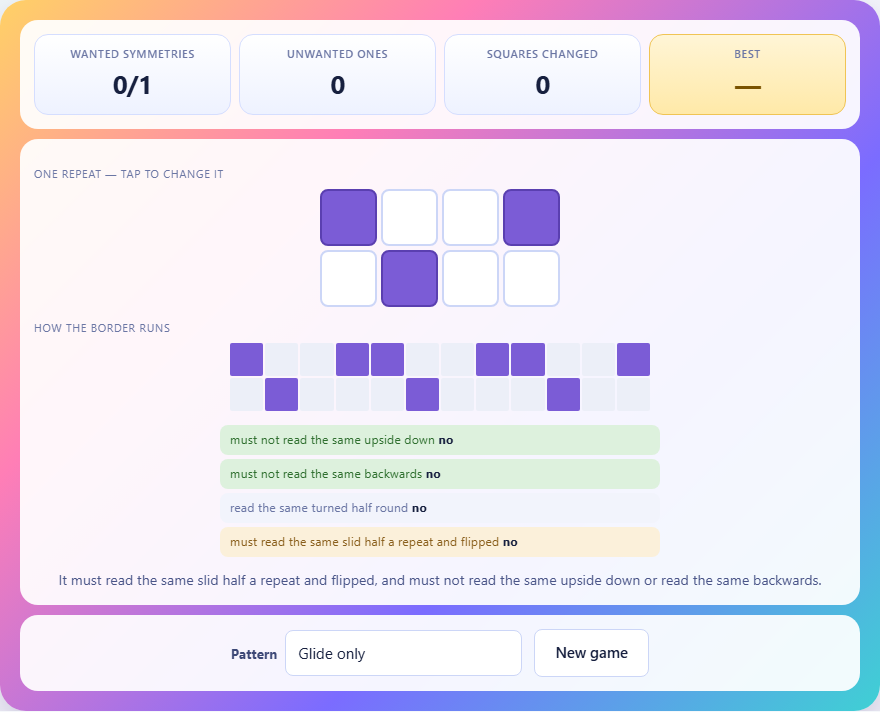
You see a small grid, four squares wide and two tall. That grid is one repeat of a border that goes on forever. Below the grid a strip shows what the border looks like when the pattern is repeated three times in a row. Below the strip, a list of four symmetry types tells you which ones your pattern currently has.
The goal is to fill and clear squares in the grid until the border has every required symmetry and none of the forbidden ones. Each level tells you what must be present and what must be absent. Tap a square to toggle it. The strip and the symmetry list update immediately.
The four kinds of symmetry a border can have
A repeating border always has translation symmetry by definition. It repeats. Beyond that, there are four other symmetries it might or might not have.
Flip means the border reads the same upside down. Imagine picking the strip up, turning it over top to bottom, and laying it back down. If it looks the same, it has flip symmetry. A row of squares filled at both the top and the bottom of the grid, with the middle left empty, will read the same when flipped.
Mirror means the border reads the same backwards. Slide it left to right and it looks identical. A pattern that is symmetrical around its own vertical centre line will produce this when repeated.
Turn means the border reads the same after a half turn, a rotation of one hundred and eighty degrees. If you spin the strip around its centre and it looks unchanged, it has turn symmetry.
Glide is the strange one. Slide the pattern along by half a repeat and then flip it upside down. If that combined operation leaves the border looking the same, it has glide-reflection symmetry. Neither the slide alone nor the flip alone works. Both must happen together.
Why symmetries arrive uninvited
The central difficulty of this puzzle is that symmetries are easy to add by accident. A pattern built to read the same upside down very often reads the same backwards as well. That gives you both flip and mirror when you only wanted flip.
The reason is mathematical. Flip combined with mirror produces turn. So if your pattern has flip and mirror, it automatically has turn as well. You cannot have both reflections without getting the rotation. And two reflections plus a rotation tend to bring glide along for the ride.
This means the real work is not adding the symmetry you need. That is usually the easy part. The hard part is breaking the extra symmetries that come with it, without losing the one you just built.
How to add the symmetry you need
Start by ignoring the forbidden symmetries. Focus only on the required one. Look at its definition and arrange your squares so the pattern satisfies it.
For flip, make the top row of the grid a mirror of the bottom row. Whatever is filled at the top, fill in the same column at the bottom.
For mirror, make the left half of the grid a mirror of the right half. If the grid is four wide, columns one and four should match, and columns two and three should match.
For turn, the pattern must look the same rotated half a turn. The top-left must match the bottom-right, and the top-right must match the bottom-left.
For glide, shift the pattern two squares to the right and flip it vertically. The shifted-and-flipped version must match the original. This usually means the top row is a shifted copy of the bottom row.
How to break a symmetry you do not want
Once you have the required symmetry, check the list below the strip. If any forbidden symmetry shows a yes, you need to break it without losing the one you need.
The trick is to change just one square. A single filled square in the right place will break most unwanted symmetries. Start with a square that sits in the middle of the grid, toggle it, and watch the list. If the forbidden symmetry turns to no and the required one stays at yes, you are done.
Sometimes one change breaks two symmetries at once. Sometimes it breaks the wrong one. If toggling a square loses your required symmetry, toggle it back and try a different square. The grid is only eight cells. There are not many to try.
The three puzzle levels
The first level asks for flip and forbids mirror. You need the border to read the same upside down, but it must not read the same backwards. This is the easiest because flip is simple to build and a single off-centre square usually breaks mirror.
The second level asks for glide and forbids both flip and mirror. Glide is harder to see because it combines two operations. You need to slide half a repeat and flip at the same time. Most people find this one takes a few attempts before the right shape clicks.
The third level asks for turn and forbids flip, mirror, and glide. A half turn without any reflection is the most constrained. You must place squares so the rotation works, but neither reflection does. This is the hardest because turn often brings flip along with it.
Why there are exactly seven frieze groups
A repeating border can have translation, flip, mirror, turn, and glide. But these five symmetries are not independent. Some combinations force others. Flip plus mirror forces turn. Mirror plus glide forces flip. Working through all the possible combinations, and ruling out the ones that are forced to include extras, leaves exactly seven distinct types.
This is not an observation about what humans have drawn. It is a mathematical proof. No amount of creativity can produce an eighth type. Every border pattern that has ever been painted on a pot, carved into a temple, or woven into a rug belongs to one of these seven groups.
The same counting argument in two directions gives exactly seventeen wallpaper groups. In three dimensions it gives exactly two hundred and thirty crystal groups. These numbers describe every regular structure that can exist in the physical world.
Why blank and full borders are not allowed
A blank strip has every symmetry. So does a strip where every square is filled. Both read the same flipped, mirrored, turned, and glided. That would make the answer trivial. To prevent this, each level requires a minimum number of filled squares. You cannot solve the puzzle by clearing the grid or filling it completely.
This minimum is typically three or four squares. It forces you to create a genuine pattern, one where some squares are on and others are off, and where the arrangement produces exactly the symmetries asked for.
Scoring and improving your count
The game counts how many squares you changed. Each tap adds one to your total. A lower number is better. The scoreboard tracks your best count for each level.
To keep your count low, think before you tap. Look at the starting grid and figure out which squares need to change. If the starting pattern already has the required symmetry, you might only need one or two taps to break the forbidden ones. If it does not, plan the fewest changes that build it.
Experienced players can often solve the easy level in two or three taps. The glide level usually takes four to six. The turn level might take five to eight, depending on what the random starting pattern gives you.
Common traps and how to avoid them
- Adding too many squares at once. Each tap changes the symmetry picture. Check the list after every tap rather than making several changes and hoping the result is right.
- Forgetting that two reflections make a rotation. If you build flip and accidentally create mirror, you now have turn as well. One unwanted symmetry has become two.
- Judging symmetry from the small grid instead of the strip. The grid is one repeat. The symmetries are properties of the repeating border. A pattern that looks asymmetric in the grid can still have glide symmetry when repeated. Watch the strip.
- Trying to toggle many squares to force a solution. Start from the fewest changes possible. Most puzzles can be solved with two to five taps from a random start.
- Ignoring glide because it is unfamiliar. Glide is the hardest symmetry to visualise, but it follows a clear rule. Shift half a repeat and flip vertically. Practice recognising it in the strip and it becomes second nature.
The whole puzzle stays in your browser
Every symmetry check runs on your own device. There is no server, no account, and no data about your patterns sent anywhere. Your best score is stored locally in this browser. The page works offline once it has loaded, and closing the tab is all the cleanup required.