
Winning at solitaire when every card is already showing
The layout, the stacking rules, why empty columns matter more than free cells, how the clock changes the game, and the thinking process that clears a board before time runs out.
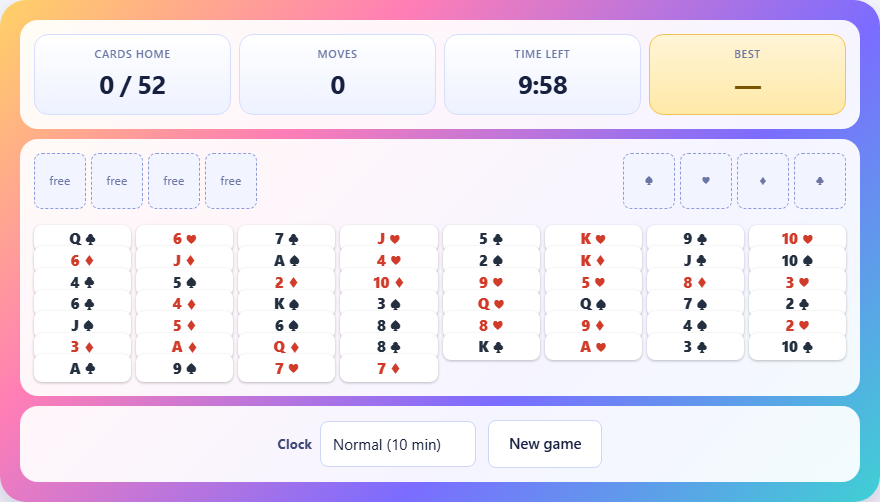
The board and what sits where
A full deck of fifty-two cards is dealt face up into eight columns. The first four columns get seven cards each. The last four get six. Every card is visible from the start. There is no hidden information and no luck left after the deal.
Above the columns sit two areas. On the left are four free cells, each able to hold one card. On the right are four foundation piles, one per suit. The goal is to move every card onto the foundations, built up by suit from ace to king. When all fifty-two cards are home, you win.
Stacking rules in the columns
Cards in the columns stack downward in alternating colours. A red six goes on a black seven. A black five goes on a red six. You can only add to the bottom of a column, and only the bottom card of a column can be moved individually.
If several cards at the bottom of a column form a proper descending alternating-colour run, you can move them as a group. But there is a limit to how many you can shift at once. That limit depends on how much room you have elsewhere on the board.
An empty column can hold any card or any valid run. That makes empty columns extremely valuable. They act as extended workspace, far more useful than a single free cell.
How multi-card moves are counted
Moving a run of cards is really several single-card moves done in sequence, using free cells and empty columns as temporary storage. The game handles this automatically, but the limit is strict. You can move at most one card plus one for each empty free cell, and that total doubles for each empty column.
With all four free cells empty and no empty columns, you can move five cards at once. With three cells empty and one empty column, you can move eight. With two cells empty and two empty columns, you can move twelve. The formula is straightforward: count your free cells, add one, then double for each empty column.
This means filling up all four free cells leaves you able to move only a single card. That is the state where most games are lost. Keep at least one cell open whenever you can.
The foundations and auto-play
You can move a card to its foundation pile at any time by tapping the card and then tapping the foundation. Aces go first, then twos, then threes, and so on up to king. Each suit builds independently.
The game also moves certain cards to the foundations on its own. Aces and twos go up automatically. Beyond that, a card is sent home when both opposite-colour foundations have reached one rank below it, meaning the card can no longer be useful as a stacking target in the columns. This auto-play saves you the effort of moving cards that are clearly finished.
You do not need to worry about cards being auto-played too early. The rule is conservative. It only sends a card home when keeping it in play would serve no purpose.
The clock and the three time settings
Every deal in this version is timed. Almost every deal can be won, so the challenge is not whether you can solve it but whether you can solve it fast enough. The time is shown in the stats bar above the board.
Relaxed gives you fifteen minutes. That is enough time to think carefully and still finish most deals. Normal gives you ten minutes, which requires steady play without long pauses. Fast gives you seven minutes and demands that you see the right moves quickly.
When the clock runs out, the game ends. Your move count is not recorded because you did not finish. The message that appears suggests emptying a column early, which is the single most effective way to speed up your play.
Empty columns are worth more than free cells
A free cell adds one to the number of cards you can move. An empty column doubles it. That difference is enormous. Clearing a short column early in the game gives you more room to reorganise the longer columns throughout the rest of the deal.
Look for the column with the fewest cards. If it has only three or four cards and the bottom few can be played elsewhere, spend a couple of free cells to strip it bare. The doubled capacity you gain will pay for itself within a few moves.
On the other hand, filling an empty column carelessly throws away that advantage. Only place a card in an empty column if you are starting a run you plan to build on, or if you need the space to unpack another column right now.
Dig out the aces early
An ace buried under several cards blocks its entire suit. Nothing from that suit can go home until the ace does. Getting to a buried ace is almost always worth spending free cells on, even if it means temporarily filling cells you would rather keep open.
At the start of a deal, scan all eight columns and note where the aces are. If one sits near the bottom of a long column, plan your first few moves around uncovering it. The sooner it reaches the foundation, the sooner the twos and threes of that suit can follow.
A similar logic applies to twos. Even after the ace is home, the two needs to follow quickly or the rest of the suit piles up in the columns taking space you need.
Planning the whole unpick before you start
Before you move anything, look at the column you want to reorganise and count the moves. How many cards need to come off? Where will each one go? Do you have enough free cells and empty columns to finish the entire sequence?
Half an unpick is worse than none. If you pull three cards out of a column and then realise you cannot move the fourth, those three are now sitting in free cells doing nothing. You have less room than before and the column is no better.
Good players mentally walk through a full sequence before they touch the first card. It takes a few extra seconds but prevents the most common way to lock up the board.
Nearly every deal has a solution
Of the thousands of classic numbered FreeCell deals that have been catalogued and tested, only one is known to be impossible. Every other deal can be won with the right sequence of moves. That is a remarkable property for a card game. It means that when you lose, the fault is almost always in the play, not in the cards.
This is also why the clock works as the main challenge. If the deal were frequently unsolvable, a clock would feel unfair. Because a path to the solution exists in nearly every case, the question becomes whether you can find it quickly enough. The relaxed timer gives you plenty of room to think. The fast timer asks you to see the solution almost immediately.
Knowing that a solution exists can change how you play. When you hit what seems like a dead end, step back and look at the board again. The path is probably there. You just have not spotted it yet.
Mistakes that lose more games than bad luck
- Filling all four free cells. With every cell taken you can only move one card at a time. Keep at least one cell open, two if you can.
- Ignoring short columns. A two-card column is a clearing opportunity. Strip it early and use the empty column as workspace.
- Building long runs without a plan. A beautiful descending run of ten cards is useless if the card underneath it is an ace you need to get out.
- Sending cards to the foundation too soon by hand. Let auto-play handle what it can. If you force a card home before its time, you might need it as a stacking target later. The auto-play rule already guards against this.
- Panicking when the clock is low. Faster clicking leads to worse moves. A calm sequence of five good moves clears more cards than fifteen frantic bad ones.
Your cards never leave this device
The deal is shuffled in your browser. The timer runs locally. Nothing about your game is uploaded. There is no account, no login, and no server tracking your moves. Your best score stays stored in this browser on this device. Once the page loads, it works offline. Close the tab and everything is gone.