
Trapping a fox with four hounds that cannot turn back
How the board works, why the hounds can always win, the wall-building strategy that makes it happen, and the mistakes that let the fox slip through every time.
The setup and what each side can do
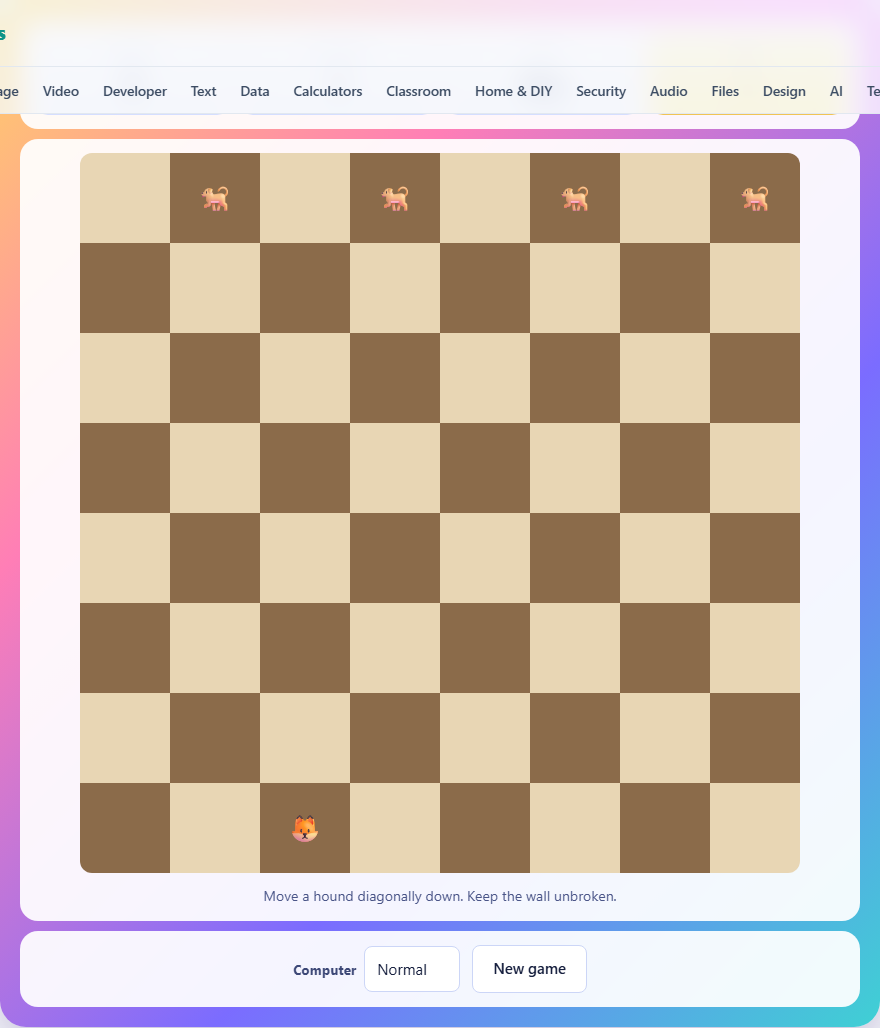
The board is an eight-by-eight checkerboard, the same size as a draughts board. Only the dark squares are used. You control four hounds that start along the top edge. The computer controls a single fox that starts on one of the dark squares at the bottom.
Hounds move one square diagonally, but only forwards. They can go down-left or down-right. They can never go back. The fox moves one square diagonally in any direction. It can go forwards, backwards, left, or right. There are no captures in this game. Nothing is ever taken off the board. The contest is entirely about controlling space.
How each side wins
You win by trapping the fox so that it has no legal square to move to. The fox sits surrounded by hounds or board edges and cannot go anywhere. The game ends immediately.
The fox wins by reaching your back row, the top edge of the board where your hounds started. If the fox gets past your line and touches that row, the game is over and you have lost. The fox also wins if your hounds run out of legal moves, which happens when all four have reached the bottom edge and can go no further.
There is also a move limit. If the game goes on too long without a result, it ends as a loss for the hounds. This prevents the kind of stalemate where both sides shuffle endlessly.
Controls on a click and on a tap
Tap one of your hounds to select it. Legal squares are shown with a ring around them. Tap one of those squares and the hound moves there. To deselect a hound, tap it again. If you tap a square that is not legal, nothing happens.
On a phone the board scales to your screen. The pieces and target squares are large enough to hit with a thumb. On a desktop you click rather than tap, but the flow is the same: pick a hound, then pick where it goes.
After you move, the computer takes its turn as the fox. It thinks for a moment, moves, and then it is your turn again. The scoreboard above the board counts how many moves you have taken and which row the fox is on.
Why the hounds can always win
This game is solved. From the starting position the hounds have a winning strategy no matter what the fox does. That might sound surprising because the fox can move in four directions while each hound can only move in two. But four hounds together, advancing in a coordinated line, cover every diagonal the fox might use to slip through.
The proof does not mean winning is easy. It means a path exists. Finding that path under pressure, without making the one mistake that opens a gap, is what makes the game worth playing. Every loss tells you there was a move that would have held your line.
The wall and how to advance it
The winning idea is simple. Keep all four hounds in a diagonal line, side by side, and push that line down the board one row at a time. A solid diagonal wall has no gap the fox can pass through. The fox can run left and right below the wall, but it cannot get above it.
To advance the wall, move the rearmost hound forward so that it stays connected to its neighbours. If the four hounds sit on a staircase of dark squares, each one diagonal to the next, the wall is complete. Moving one forward and then waiting for the next turn to move the next keeps the chain unbroken.
The key is patience. You do not need to rush. The fox cannot pass a solid wall no matter how many moves it has. Push the wall forward steadily and the fox runs out of room.
Move the hound behind the gap, not the one in front
When the fox finds a weak point in your line, the natural reaction is to move the nearest hound toward the threat. That is almost always wrong. The nearest hound is probably part of the wall somewhere else. Moving it opens a new gap while closing the old one.
Instead, look for the hound that is furthest behind. Move that one forward into the line. It closes the gap without breaking the chain elsewhere. Think of the wall as a net. You repair it from behind, not by pulling the front edge apart.
This feels counterintuitive the first few times. Your instinct says to chase the fox. But the hounds are slower directionally than the fox. Chasing leads to the fox running around the end of a broken line. Repairing leads to the fox running out of room.
What the fox is actually doing
The computer plays the fox by searching ahead several moves using the same kind of tree search that chess programs use. On Easy it looks four moves ahead. On Normal it looks six. On Hard it looks eight. It scores each position by how close the fox is to the top row and how many squares it can reach.
A fox near the bottom with plenty of open squares is happy. A fox hemmed in with the wall close is not. The computer picks the move that leads to the best outlook for the fox, even if that means retreating temporarily to keep its options open.
Knowing this helps you predict what the fox will do. If you leave two gaps in your wall, it will head for the wider one. If you leave one gap, it will sprint for it. If you leave none, it will bounce along the wall looking for one to open.
The three difficulty levels
Easy sets the search depth to four. The fox plays short-sighted moves and often walks into corners you did not even set up. It is a good level for learning the board and practising wall movement without punishment.
Normal sets the depth to six. The fox starts to anticipate your advances and positions itself where gaps are likely to open. You need a solid wall and careful ordering of your moves to win.
Hard sets the depth to eight. The fox exploits every hesitation. If you advance one hound out of order and leave a gap for even a single turn, the fox is through it. This level demands that you plan two or three hound moves ahead, not just the next one.
Reading the scoreboard and improving over time
The stats bar above the board shows three numbers. Moves counts how many hound moves you have made this game. Fox row tells you how far from the top the fox is, with eight being the bottom and one being one step from your back row. Turn says whose move it is.
When you win, the game records your move count. A lower count is better. Your best score stays in the browser for next time. If you trap the fox in twelve moves on Easy, try to do it in fewer. Then step up to Normal and see if you can hold the wall without the extra margin that a weaker fox gives you.
The progression from Easy to Hard is steep. Easy lets you recover from one or two sloppy moves. Hard punishes the first mistake. Playing Normal until you can win reliably is the best bridge between the two.
Mistakes that let the fox escape
- Pushing one hound far ahead of the others. An isolated hound is a door, not a wall. The fox walks around it.
- Moving the wrong hound to close a gap. Check which hound can reach the gap without breaking the line somewhere else. Usually it is the one furthest back.
- Chasing the fox sideways. The fox moves in every direction and you do not. If you chase, it goes around. If you wall, it has nowhere to go.
- Forgetting that hounds cannot retreat. Every forward move is permanent. A hound that reaches the bottom row is finished. Make sure each advance is part of the plan.
- Letting a hound reach the edge column. A hound on the board edge covers only one diagonal instead of two. Keep the wall centred when you can.
No data leaves your browser
The fox's search runs on your own device. There is no server doing the thinking, no account to sign into, and no data about your game sent anywhere. Your best score stays in your browser on this device only. Once the page has loaded, the game works offline. Closing the tab is the only cleanup needed.