
Solving a crafting chain when every pour costs you
How the recipe tree works, why duplicates are the real puzzle, and the thinking process that turns a messy shelf into the exact item you need without running out of pours.
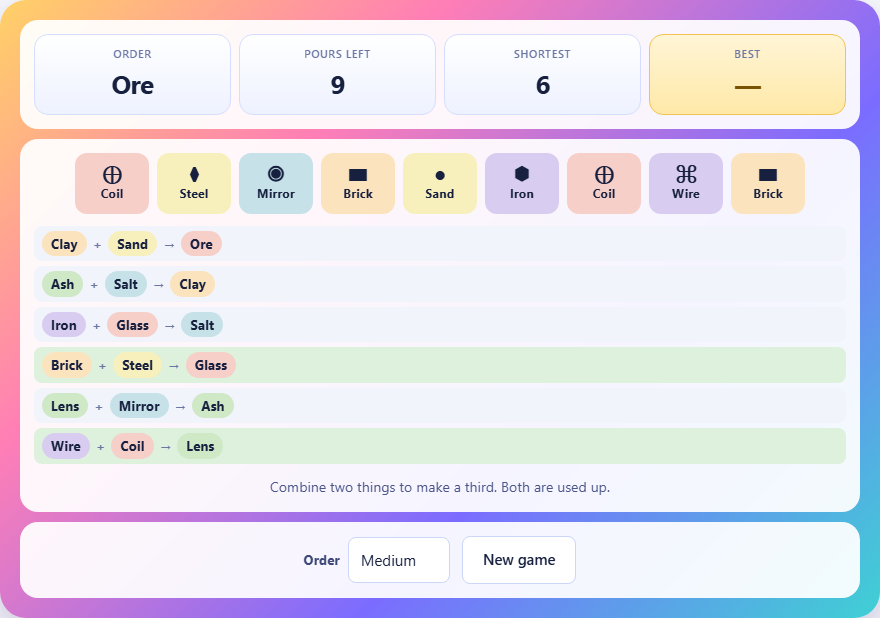
What Foundry actually asks you to do
You open the page and see two things: a shelf of raw materials and a recipe sheet. Each recipe takes two items and turns them into a third. The scoreboard at the top names the item you have to produce and shows the smallest number of pours that can get you there.
The catch is that every combine uses up both ingredients. If a recipe asks for Ore and Clay, you lose both and get whatever they make. That single rule is why this is a puzzle and not a checklist. You cannot just work down the list. You have to think about which materials you will need later and make sure they still exist when you need them.
There are three order sizes. Small gives you three or four recipes. Medium gives you five or six. Large goes up to seven or eight. The bigger the order, the more recipes on the sheet, the more intermediates you have to juggle, and the more chances you have to spend something too early.
How the recipe tree is grown
Every game builds its recipes fresh. The generator starts with the target item and splits it into two ingredients. Then it picks one of those and splits that into two more. It keeps splitting random leaves until it has enough recipes for the chosen level.
Because it always picks a random leaf rather than splitting everything evenly, the tree comes out lopsided. One branch might be deep while another stops at a single raw material. That is why no two games feel the same, even at the same difficulty. The shape of the tree decides how many pours the shortest path needs.
The raw materials on your shelf are whatever sits at the bottom of the tree, plus a couple of extras thrown in to fill it out. Those extras are not needed. They exist to make the shelf feel less obvious and to tempt you into wasting a pour.
Controls and how combining works
Tap one item on the shelf, then tap a second. If those two appear together in a recipe, both vanish and their result takes their place. The recipe sheet highlights any recipe you can make right now with what you are holding.
If the two items you picked do not match any recipe, nothing happens and nothing is spent. You can tap the wrong pair as many times as you like without penalty. Only a real recipe costs a pour.
To deselect an item you already tapped, just tap it again. There is no undo for a completed pour, but a failed attempt costs you nothing.
Scoring and the par number
The scoreboard shows how many pours you have left and what the shortest solution is. That shortest number is exact. The game runs a full search over your starting shelf before it offers the puzzle, so it knows the answer is reachable and it knows the fewest pours required.
Your budget is the par plus a few spare pours. Small orders give you two extra. Medium and large give you three. That slack means you do not have to find the perfect path. You just have to avoid wasting too many moves on things that lead nowhere.
When you finish, the game tells you how many pours you used and reminds you what the shortest was. A lower number is better. Getting exactly par means you found the fastest route through the tree.
Working backwards from the order
The strongest way to approach any puzzle is to start from what you need and trace backward. Look at the recipe sheet and find the one recipe that makes your target. Note which two ingredients it requires. Then find the recipes that make those two ingredients. Keep going until you reach items already on your shelf.
This gives you a mental map of every pour you will need to make. It also shows you which raw materials matter and which ones are spare. If a material does not appear anywhere in that map, it is a decoy. Spending a pour on it wastes one of your limited moves.
Suppose the order is Engine, and Engine comes from Core plus Wire. Core comes from Ore and Sand. Wire comes from Iron and Glass. If Ore, Sand, Iron, and Glass are all on your shelf, you need exactly three pours. Make Core, make Wire, then combine them into Engine.
Why duplicates are the real puzzle
The tricky part is when an intermediate appears twice in the tree. Say both Wire and Lens need Glass, but Glass itself has to be made from Sand and Ash. You need to make Glass twice before you use it. If you make Glass once and combine it into Wire, that Glass is gone. When you later need Glass for Lens, it is not there.
This is the most common way to run out of pours. You see a recipe that works right now, you combine, and then realize the result was needed somewhere else first. The fix is to count how many times each intermediate is consumed in your plan and make sure you build enough of each before you start using them.
On larger orders the duplication can stack. An item might feed three different recipes, each needing its own copy. Walk the whole tree on paper before you pour anything.
The highlighted recipes are not a to-do list
The recipe sheet marks every recipe you can make right now in a brighter style. That is helpful, but it is also misleading. A recipe being possible does not mean it belongs in your solution. Some recipes on the sheet combine materials into things you do not need at all.
Before you tap a highlighted recipe, check it against your backward trace. Does its result feed into the chain that leads to the order? If not, making it wastes a pour and removes two materials from your shelf that might have been useful elsewhere.
Think of the highlighting as information, not instruction. It tells you what is available. You decide what is wise.
Common mistakes and how to sidestep them
The first mistake most players make is combining things the moment they light up. Slow down. Just because Sand and Ash make Glass right now does not mean this is the right time to make Glass. Check whether you will need Sand or Ash for something else first.
The second mistake is ignoring the spare materials. Two or three items on the shelf are not part of any path to the target. If you see a recipe that uses one of them, that recipe is almost certainly a dead end. Count which materials appear in your backward trace and leave the rest alone.
The third mistake is not counting duplicates. Before your first pour, walk the full tree. Every time you see the same intermediate consumed in two places, mark it. That intermediate must be made twice. Forgetting this leaves you one pour short at the worst possible moment.
A worked example on a medium order
You start a medium game. The order is Beacon. The recipe sheet has five lines. Beacon comes from Prism plus Coil. Prism comes from Glass plus Lens. Coil comes from Wire plus Iron. Glass comes from Sand plus Ash. Wire comes from Ore plus Salt.
Your shelf holds Sand, Ash, Ore, Salt, Lens, Iron, and a spare Clay. Trace backward. Beacon needs Prism and Coil. Prism needs Glass and Lens. Coil needs Wire and Iron. Glass needs Sand and Ash. Wire needs Ore and Salt. That is five pours. Clay appears nowhere in the tree, so it is a spare.
Build bottom-up. Pour Sand plus Ash to make Glass. Pour Ore plus Salt to make Wire. Pour Glass plus Lens to make Prism. Pour Wire plus Iron to make Coil. Pour Prism plus Coil to make Beacon. Five pours, matching the par exactly.
Adjusting difficulty and trying again
The Order dropdown below the game area sets the size. Small is a gentle introduction with only a few recipes. Medium is where the puzzle starts requiring real planning. Large adds enough recipes that even experienced players sometimes run out of pours.
Because every game builds a fresh tree, you can play the same difficulty repeatedly and never see the same puzzle. The material names are labels, not fixed substances. Iron does not always come from the same two things. The names are just there to help you tell items apart.
If you get stuck, press New game for a fresh order. There is no penalty for restarting, and a new tree might be shaped in a way that suits how you think.
Everything stays on your own device
The entire puzzle runs in your browser. The recipe tree is built locally, the search for the shortest path runs locally, and no data about your game is sent anywhere. There is no account, no login, and no server involved. Once the page has loaded you could disconnect from the internet and keep playing. Closing the tab is all the cleanup there is.