
Folding a numbered strip into the right pile
How the paper-folding puzzle works, why folding reverses the order of what it carries, what the fold budget and par mean, and a set of strategies for thinking backwards from the finished pile to the opening moves.
The puzzle in one paragraph
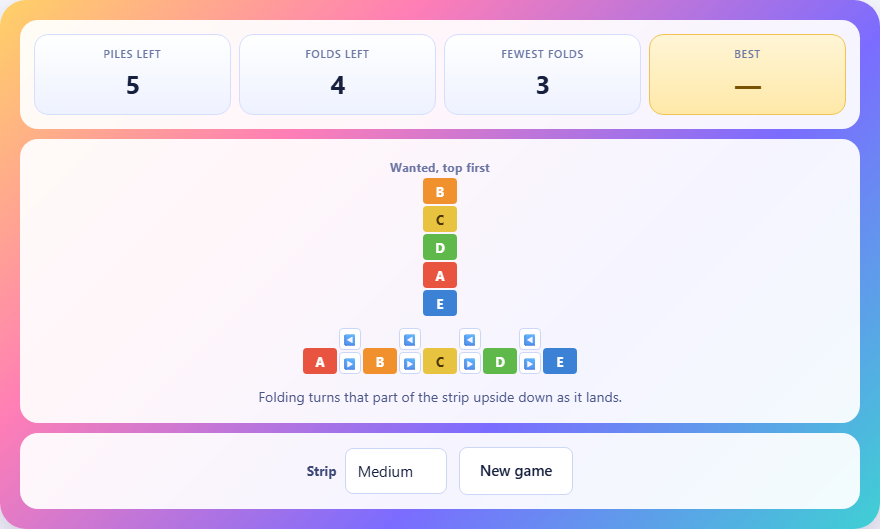
A strip of numbered squares lies flat in front of you. Each square is labelled with a letter: A, B, C, and so on. A crease sits between every pair of squares. At the top of the screen is the target: a pile of those same letters in a specific order, read from top to bottom. Your job is to fold the strip until it becomes a single pile, and that pile must match the target order. You have a limited number of folds to get there.
How folding works
Between every pair of squares there are two small arrow buttons. The left arrow folds everything on the left side of that crease over to the right. The right arrow folds everything on the right side over to the left. Whichever side folds, it flips over and lands on top of whatever is already on the other side.
The critical detail is that folding reverses the order. If squares A, B, and C are lying flat and you fold them to the right, C lands first, then B on top of it, then A on top of B. The run arrives upside-down. This reversal is what makes the puzzle hard. A pile that looks like it should be easy to build often requires an indirect sequence of folds because each fold flips what it carries.
When part of the strip has already been stacked into a pile, folding that pile moves the entire stack as a unit. The whole pile flips over, so the square that was on top ends up on the bottom, and it lands on top of whatever was at the destination.
Three strip sizes
The dropdown below the board offers Small, Medium, and Large. Small is a four-square strip. Medium is five. Large is six.
These sound like tiny numbers, but the difficulty grows fast. A four-square strip has a manageable number of possible fold sequences. A six-square strip has enough combinations that guessing your way through it rarely works. Each added square roughly doubles the number of ways the strip can end up, so the jump from four to six is steeper than it sounds.
The fold budget is the minimum number of folds needed plus a little slack. On small and medium, you get one extra fold beyond the par. On large, you get two extra. This means a perfect run is possible, but a few wasted folds are tolerable.
What the stats bar shows
Three numbers appear above the board. Piles left counts how many separate stacks remain. You start with as many piles as there are squares, because each square begins as its own pile. Every fold reduces this count by combining piles. The game ends when piles left reaches one.
Folds left is your remaining budget. It counts down each time you click a fold arrow.
Fewest folds is the par: the true minimum number of folds needed to produce this particular target pile. The game finds this by searching every possible sequence of folds, so it is not a guess. If you match the par, you solved it in the most efficient way possible. Beating it is not possible because it is the proven minimum.
Scoring and records
Your score is the number of folds used. Lower is better. When you produce the correct pile, the game shows your fold count alongside the par, so you can see how close you came. Your best score for each strip size is saved in your browser.
If the pile is one stack but in the wrong order, the round ends as a loss. There is no partial credit. The game tells you that it could have been done in the par number of folds, so you know the puzzle was fair.
Start from the bottom of the target
Look at the target pile and find the letter at the very bottom. That square must be in position early and then never move again. Every fold after it just stacks more on top. So ask yourself: which fold or sequence of folds puts that letter at the bottom of a stack and keeps it there?
Next, look at the letter on top of the target pile. That square is the one carried by the final fold. It is the last thing to land. So the final fold must move that letter onto the top.
Working from both ends of the target narrows the possibilities quickly. The bottom square tells you what to do first. The top square tells you what to do last. The middle is where the real puzzle lives.
Small folds versus big folds
Folding just one square across changes the least. It moves a single letter and leaves the rest undisturbed. This is the cautious choice: it commits you to one small decision and keeps future options open.
Folding half the strip commits you to an order for everything in that half. All those letters arrive reversed, locked into a sequence. If that sequence is wrong, you have spent a fold and made the problem harder.
On the small strip, big folds are often right because there are only four squares and the budget is tight. On the large strip, mixing small folds and big folds tends to work better. Use a big fold when you are sure of the reversal it produces, and a small fold when you need to place one letter precisely.
Why two folds the same way differ from alternating
Folding left twice in a row keeps stacking in one direction. The first fold puts a reversed run on top. The second fold takes whatever is on the left, reverses it again, and puts it on top of the growing pile. The result is a pile that grows taller on one side.
Alternating left then right is different. The first fold stacks to the right. The second fold picks up part of what just landed and flips it back the other way. The reversal from the first fold gets reversed again, which puts those letters back in their original order but in a different position.
This is the source of most mistakes in the game. Two folds feel like they should be interchangeable, but they produce very different piles. Thinking through what happens to three or four letters across two folds is worth the effort before you click.
A worked example on a four-square strip
The strip is A B C D lying flat. The target pile, top to bottom, is B A D C.
The bottom letter of the target is C. So C needs to end up underneath everything else. Start by folding D over onto C at the last crease, using the right arrow. Now the strip is A B and a pile of D on top of C.
Next, fold A over onto B using the left arrow at the first crease. Now there are two piles: a pile of A on top of B, and a pile of D on top of C.
Finally, fold the left pile onto the right using the left arrow at the remaining crease. A-on-B flips and becomes B on top of A, landing on top of D-on-C. The result from top to bottom is B A D C. That matches the target, done in three folds.
Common mistakes and how to fix them
Forgetting the reversal is the most frequent error. A player expects A B C to land as A B C, but it lands as C B A. Every fold flips what it carries. Say the reversed order out loud before you click.
Spending the first fold without thinking about the bottom of the target pile is another pitfall. If you fold at random and happen to put the wrong letter at the bottom, it is stuck there. You cannot unfold.
Ignoring the par is a subtle mistake. If the par is three and you have already used three folds without reaching one pile, you know something went wrong. The budget gives you a fold or two of slack, but if you are over par and still have multiple piles, it may be time to click New game and try a fresh approach.
- Always check which letter belongs at the bottom of the target pile.
- Say the reversed order out loud before each fold.
- Use small folds when you are not sure. They leave more options.
- Compare your fold count to the par. If you are far over, restart.
- Remember that the top letter of the target must be the last to land.
A real mathematical puzzle underneath
Counting the number of ways a strip of stamps can be folded into a pile is a well-known unsolved problem in combinatorics. The game gives you a small, playable piece of that problem. Each puzzle is generated by folding a real strip at random and using whatever pile comes out as the target. Target piles that turn out to be simply the original strip in order are discarded as too easy.
This generation method guarantees that every target is reachable. You are never given an impossible pile.
Nothing is sent anywhere
The puzzle is generated, displayed, and solved entirely inside your browser. No data leaves your device. There is no account, no server tracking your games, and no connection needed after the page has loaded. Your best scores live in your browser's local storage on this machine only.
You can play offline. The game works the same with or without an internet connection, because the folding logic has never involved a server.