
Riding an invisible current to collect every orb
How the moving current works, why drifting is free but thrust is not, how to read the coloured streaks on the field, and a practical guide to spending as little fuel as possible while collecting every orb.
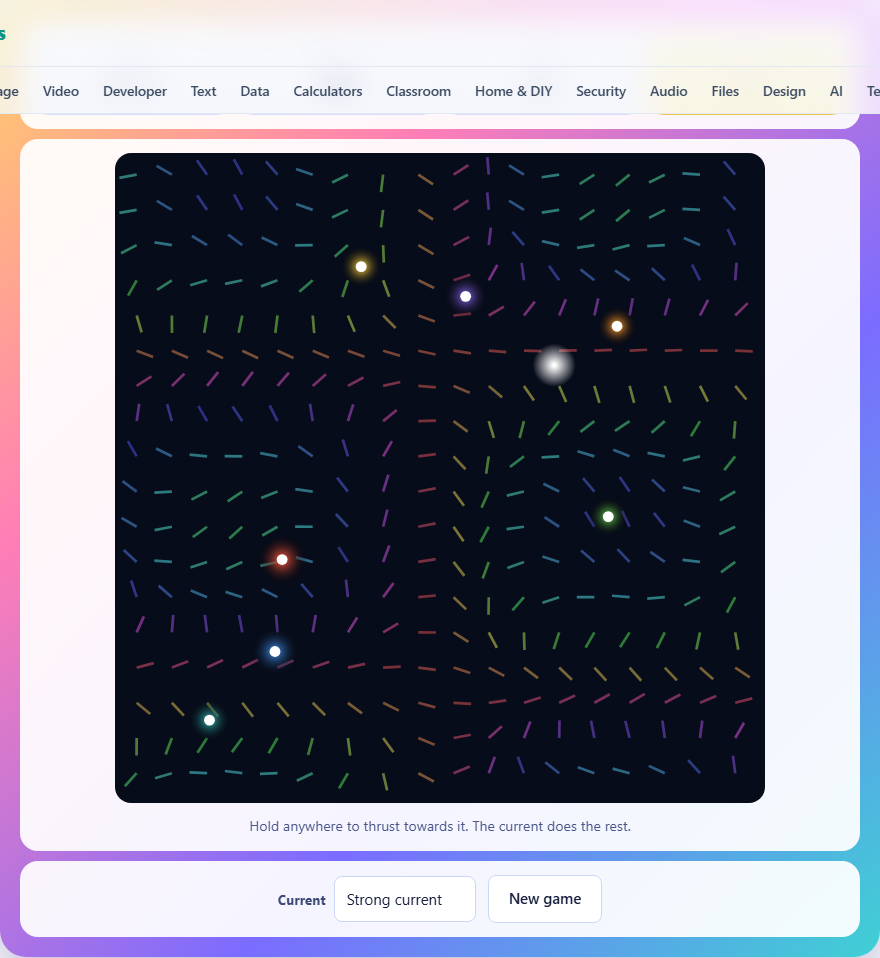
What you are and what you are doing
You are a small glowing dot on a dark field. Coloured orbs are scattered across it. Your job is to touch every orb before your thrust runs out. The field itself is a swirling current that pushes you around whether you want it to or not. You never truly stop. Even when you are not pressing anything, the current is carrying you somewhere.
Thrust is the limited resource. Holding your finger or mouse button down burns thrust and pushes you toward wherever you are pointing. Letting go costs nothing. The game is not about speed or reflexes. It is about reading the current and using it to carry you where you need to go, saving thrust for the small corrections.
Reading the coloured streaks
The field is covered in short coloured streaks. Each streak is a small arrow showing the direction the current is pushing at that exact spot. The colour of each streak changes with its direction, so swirls and curves become visible at a glance.
These streaks are not decoration. They are the current itself. The same force that draws each streak is the same force pushing your dot. If a cluster of streaks near you all point to the right, the current is carrying you to the right. If you see a curve of streaks bending downward ahead, you are about to be pulled down.
The field rotates slowly. A set of streaks pointing left might swing around to point down after a few seconds, then eventually point right. This means a path that looks blocked right now might open up if you wait. Waiting costs nothing because drifting is free.
Controls on desktop and phone
On a desktop, press and hold the mouse button anywhere on the canvas. Your dot accelerates toward where the cursor is. Release the button and the dot stops thrusting but keeps drifting on the current. You can move the mouse while holding to change direction mid-thrust.
On a phone, touch and hold anywhere on the canvas. Your dot pushes toward your finger. Drag your finger to steer. Lift it to drift. The controls are the same idea: hold means thrust, release means coast.
A dashed line appears between your dot and the cursor while you are thrusting, so you can see which direction you are burning fuel toward. When thrust runs out, holding does nothing and the line disappears.
Three current strengths
The dropdown below the canvas is labelled Current and offers three options. Gentle current gives you five orbs to collect and three hundred and forty units of thrust. The current is mild, so you spend more time coasting in a straight line.
Strong current is the default. It has seven orbs and three hundred units of thrust. The swirls are sharper here, which means you get carried off course more often, but it also means a well-placed nudge can hook you into a curve that delivers you to an orb for free.
Wild current has nine orbs and only two hundred and sixty units of thrust. The current is fast and the swirls are tight. Fighting it head-on drains the tank in seconds. This level demands that you read the streaks carefully and let the field do most of the work.
How scoring works
The stats bar shows three figures: how many orbs you have collected out of the total, how much thrust you have left, and your current drift speed.
When you collect every orb, your score is the amount of thrust remaining. Higher is better. A player who finishes with one hundred and fifty thrust left played more efficiently than one who finished with thirty. The game saves your best remaining-thrust score for each difficulty level in your browser.
If you run out of thrust before collecting every orb, the game gives you a short grace period. The current might still carry you into a nearby orb, so it does not end the instant the tank empties. But if nothing changes after a while, the game calls it over and shows how many you collected.
Steer into curves instead of pushing straight
The biggest fuel mistake is thrusting in a straight line toward an orb on the other side of the field. You are fighting the current the entire way, and every frame of thrust drains the tank.
A much cheaper approach is to find a curve in the current that bends toward the orb and nudge yourself into it. One short burst to enter the curve, then release. The current carries you the rest of the way. An orb that is downstream from a favourable curve can cost nothing to reach.
Watch the streaks around your dot and ahead of it. If you see a curve sweeping to the left and the orb you want is to the left, a tiny tap upward or downward to slide into that curve is all you need. Let the current do the heavy lifting.
Planning the collection order
Which orb you go after first has a large effect on how much thrust the whole run costs. Before you start thrusting, take a moment to look at where all the orbs are and where the current is flowing.
Ideally you want to collect orbs in an order that keeps you roughly downstream of the next one. If three orbs sit in a line that follows the current's direction, taking them in that order costs almost nothing. Taking them against the current means three separate burns.
On the wild setting, planning the order is not optional. Nine orbs with only two hundred and sixty thrust means you cannot afford more than a couple of hard burns. Most of the run has to be free drift with occasional course corrections.
Using the walls to turn around
When your dot hits the edge of the field, it bounces. The bounce costs some speed but does not cost any thrust. It also does not hurt you in any way.
This makes the walls a free turning tool. If you need to reverse direction, drifting into a wall and bouncing off is often cheaper than thrusting hard in the opposite direction. A wall bounce followed by one short tap to aim the rebound can send you across the field for just a handful of thrust.
Do not be afraid of the edges. Staying in the middle of the field to avoid the walls is not necessary and sometimes wastes fuel that a bounce would have saved.
Mistakes that drain the tank
Holding thrust the entire time is the fastest way to empty the tank. New players often grip the mouse or hold their finger down constantly, steering like a car. This fights the current at every moment and burns through the budget in seconds. Let go whenever you are heading roughly the right direction. Coast.
Chasing the farthest orb first is another common error. That orb might be straight into the current, costing a long burn. A closer orb in an easier direction might cost nothing and leave you in a better position for the far one later.
Ignoring the fact that the field rotates is a subtler mistake. If an orb is upstream right now, waiting five or ten seconds might make it downstream instead. Patience is literally free.
- Do not hold thrust continuously. Tap and release.
- Take nearby orbs first if they are downstream.
- Wait for the field to rotate before fighting the current.
- Use wall bounces to change direction cheaply.
- Watch the streaks ahead of your dot, not behind it.
What the numbers mean during play
The orbs counter shows collected out of total. The thrust counter counts down from whatever your starting budget was. It drops by one for every frame you spend holding the button.
The drift figure is your current speed. It stays above zero almost all the time because the current is always pushing. A drift of about two or three is typical coasting speed. When you thrust, it can spike to five or six. High drift is not bad by itself, but if you are heading the wrong way at high speed, you will need thrust to correct.
Everything happens on your own device
The game runs entirely in your browser. The current is calculated locally, the orbs are placed locally, and no data ever leaves your machine. There is no server, no login, and no tracking of your runs. Your best score sits in your browser's storage and goes nowhere else.
You can confirm this by playing with your internet connection turned off. The game works exactly the same, because there was nothing to connect to in the first place.