
Laying pipes between dots and filling every square
How the pipe puzzle works, why the shortest path between two dots is usually wrong, how dragging and crossing interact, and a set of concrete strategies for filling the whole board inside the move limit.
The goal in plain terms
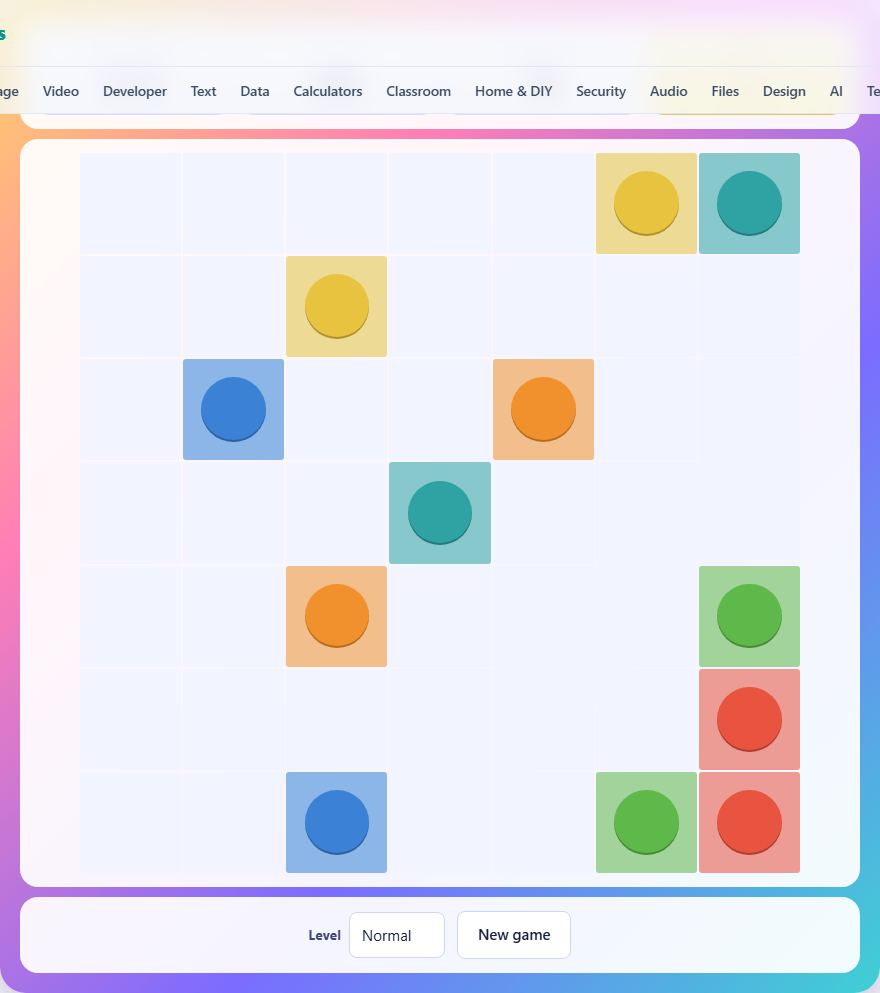
Pairs of coloured dots sit on a grid. Each colour appears exactly twice. Your job is to draw a pipe from one dot to its matching partner, and to do this for every pair on the board. Pipes run along the grid lines: up, down, left, and right only. No diagonals.
But joining all the pairs is not enough. The real win condition is that every square on the board must be covered. No gaps are allowed. A board where all dots are connected but three empty squares remain in the middle is not solved. This is what makes the puzzle hard. The straight-line route between two dots leaves empty squares behind, so pipes have to wander on purpose.
Three difficulty levels
The level dropdown offers Easy, Normal, and Hard. Easy uses a five by five grid with four pairs of dots. Normal is seven by seven with six pairs. Hard is nine by nine with eight pairs.
Every puzzle is built by carving the entire grid into snaking paths first, then placing dots at each end of every path. This means a solution that fills every square always exists. You are never staring at an impossible board.
Each game also has a move limit. A move is counted each time you start drawing a new pipe or restart one from a dot. On Easy the limit is twenty-four, on Normal it is thirty-six, and on Hard it is forty-eight. These are generous enough that running out of moves is rare if you are not constantly redrawing the same pipe.
Drawing, shortening, and crossing
To draw a pipe, press and hold on a dot, then drag along the grid squares. The pipe extends one square at a time in the direction you drag. Release when you reach the matching dot or whenever you want to stop and think.
Dragging backwards along your own pipe shortens it. If you laid a pipe three squares to the right and then drag back to the left, the pipe retracts to wherever you stop. This is the undo mechanism. There is no separate undo button.
Dragging your pipe through a square that belongs to another pipe does not block you. Instead, it cuts the other pipe back to that point. The square becomes yours and the other pipe loses everything from that square onward. This means you can always take a square from another pipe if you need it. The cost is that you will need to redraw the pipe you just cut.
Scoring and your best record
Your score is the number of moves used. Lower is better. The stats bar tracks three things: how many pairs are joined, what percentage of the board is filled, and how many moves you have left.
When you complete a board, the game saves your move count as the best for that level if it is lower than whatever was stored before. That record lives in your browser on this device. It is never uploaded anywhere.
Start with the corners and edges
A dot sitting in a corner of the grid has only two possible directions: the two sides of the corner. One of those is usually taken by the wall or another dot, which means the pipe's first step out of that corner is forced. The same logic applies to a dot on an edge, which has three possible directions instead of four.
Before you draw anything, scan the board for dots in corners or along edges. Their first one or two steps can often be worked out without any guessing. Fill those in first. This pins down part of the board and gives the remaining pipes fewer possible routes, which makes the middle easier to figure out.
Here is a concrete case. On a seven by seven board, a red dot sits in the bottom-left corner. The only exits are up and to the right. The matching red dot is three squares to the right along the bottom edge. The pipe must go up first, then across, then back down to reach its partner, because going straight along the bottom would leave the squares above the corner with no way to be filled.
Why short paths are usually wrong
It is tempting to connect each pair with the shortest possible route. Two dots that are three squares apart could be joined with a three-square pipe. But that pipe only covers three of the twenty-five or more squares on the board. The remaining pipes then have to stretch and curve to reach every leftover square, and they might not be able to.
Instead, think of each pipe as responsible for covering its share of the board. On a five by five grid with four pairs, each pipe should cover about six squares on average. If one pipe takes a shortcut and covers only two, the others have to cover eight or nine, which may not be possible given where the dots are.
Let your pipes meander. A pipe that takes a long winding route through a region of the board is doing useful work, not wasting moves. The goal is full coverage, and every square a pipe passes through is one fewer square the other pipes have to worry about.
Filling the awkward middle
After the corners and edges are partially filled, the middle of the board often has a few unclaimed squares that no pipe seems to want. This is normal. The fix is to rework one or two existing pipes so they detour through those squares.
Pick the pipe that passes closest to the empty region. Drag it back a few squares to shorten it, then redraw it so it loops through the empty area before continuing to its dot. The crossing mechanic helps here: if you need a square that belongs to another pipe, just draw through it. The other pipe shrinks, and you can redraw it later to take a different route.
On the hard board, this back-and-forth reworking is common. The first solution you lay down rarely covers every square. Getting to ninety percent is easy. The last ten percent is where the real solving happens.
Mistakes that cost extra moves
Starting a pipe, drawing two squares, then deciding it was wrong and starting over counts as two moves. On easy boards the budget is generous and this does not matter. On the hard board, repeatedly restarting the same pipe eats into the budget fast.
A better habit is to think before you draw. Look at both dots of a pair and the empty space around them. Sketch a rough route in your head. If you are not sure, start with a different pair whose path is clearer and come back to the tricky one later.
Another common mistake is connecting a pair with a short path early and forgetting about it. Later you discover that those squares were needed for another pipe's detour, and you have to cut the short pipe and redraw both. Starting with longer, space-filling routes avoids this.
- Do not rush the first pipe. Look at the whole board before drawing.
- Connect constrained dots first. Corner and edge dots have fewer options.
- Let pipes wander. Short connections leave orphan squares.
- Use crossing deliberately. Cutting another pipe is a tool, not a mistake.
- Save the most flexible pair for last. The pair with the most room to move should fill whatever gaps remain.
How the puzzles are generated
The game builds each puzzle by starting with a completely empty grid and carving it into random snaking paths that together cover every square. The two ends of each path become a pair of dots. Because the grid is carved from a full-coverage solution, you know that at least one arrangement of pipes fills every square.
This means you are never solving an unfair board. If you are stuck, the answer exists. The question is whether you can find it inside the move budget.
Playing on a phone
The board scales to your screen width. On a phone you press and drag with your finger. The squares are large enough that precision is not a problem on the easy and normal boards. On the hard nine by nine board the squares are a bit smaller, so a stylus can help if you have one, though it is not required.
Dragging back to shorten a pipe works the same way on touch as it does with a mouse. Press on the pipe and drag backward along it, and it retracts to wherever your finger stops.
Your board never leaves your device
The puzzle is generated and solved entirely inside your browser. No data is sent to any server. There is no login, no account, and no cloud save. Your best score for each level is kept in your browser's storage on this machine. Loading the page with no internet connection works just fine, because the game was never talking to anything on the other end.
Closing the tab is all the cleanup there is.