
Spreading one colour across a grid from a single corner
How the flood fill mechanic works in practice, what each difficulty level changes, why the obvious colour choice is almost always wrong, and how to read the edges of your blob instead of the middle of the board.
What the puzzle asks you to do
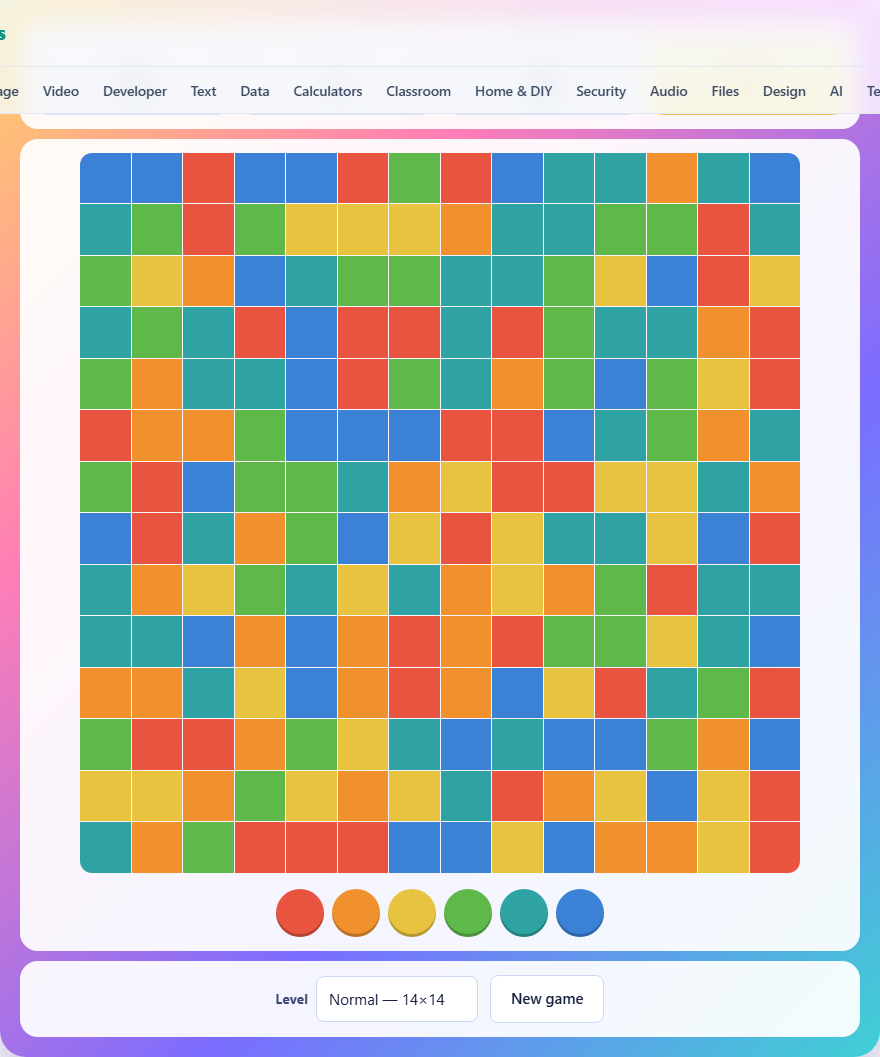
A grid of coloured squares sits in front of you. Every square is one of five or six colours, placed at random. You own exactly one square at the start: the top-left corner. Your job is to spread that single square until it covers the entire board, and you have to do it inside a fixed number of moves.
Each move is simple. You pick a colour from the swatch row underneath the board. Your whole blob - every square you already own - changes to that colour at once. Any square on the board that is both next to your blob and already that colour joins in. That is the only way squares get added: they have to be touching your blob and they have to match the colour you just chose.
The game ends in one of two ways. Either your blob covers every square on the board, in which case you win and your score is the number of moves you used, or you run out of moves and the board stays partly unfilled.
The three board sizes
A dropdown labelled Level sits below the board. It offers three choices, and the board rebuilds when you change it.
Easy is a ten by ten grid with five colours and a budget of twenty moves. Five colours on a hundred squares means each colour shows up roughly twenty times, so there are big patches of the same colour and the flood reaches corners fast. Twenty moves is generous enough that you can afford a few wasteful picks and still finish.
Normal is fourteen by fourteen with six colours and twenty-five moves. Adding a sixth colour breaks up the big patches. The board has nearly twice as many squares as the easy one, so each move has to capture more ground on average.
Hard is eighteen by eighteen with six colours and thirty moves. Three hundred and twenty-four squares with only thirty moves means every pick has to count. A careless opening that gains only a handful of squares per move will not recover. This is where the distinction between a good colour and the right colour becomes sharp.
Controls on desktop and phone
On a desktop you click one of the coloured swatches beneath the board. On a phone you tap it. There are no keyboard shortcuts and no drag gestures. The game refuses to accept the colour your blob already is, because that move would change nothing and burn one of your limited turns. When that happens a brief message appears explaining why.
The New game button deals a fresh random board at whatever level is currently selected. Changing the level in the dropdown also starts a new game immediately.
How scoring works
Your score is the number of moves it took to fill the board. Lower is better. The stats bar above the board shows three figures: the percentage of the board your blob currently covers, the number of moves you have used, and the number you have left.
When you finish a board, the game saves your best score for that difficulty level in your browser. That record stays on your device and is never sent anywhere. If you clear your browser data, it goes with it.
Why you should count the border, not the board
The most natural instinct is to pick whichever colour has the most squares on the board. That is almost always the wrong choice. A colour can have sixty squares on the far side of the grid and not help you at all, because none of them are touching your blob.
What matters is the perimeter. Look at the squares sitting right next to your blob. Count how many of each colour are there, along that border. The colour with the highest count along the edge is the one that adds the most squares this turn, regardless of what the rest of the board looks like.
Here is a concrete example. Suppose your blob is a rough L shape hugging the top and left edges. Orange has thirty squares scattered across the bottom-right corner, but only two of them touch your blob. Green has twelve squares total, but seven of them are pressed against your blob's right edge. Picking green gains seven squares. Picking orange gains two. The board-wide count is misleading because those distant orange squares cannot join until later turns bring the blob to them.
Growing diagonally towards the far corner
Your blob starts in the top-left corner and needs to reach the bottom-right one before your moves run out. If you let it creep along the top edge first and then down the right side, it stays narrow and touches fewer squares per turn. A thin blob has less border, which means fewer candidates to absorb each move.
Instead, push the blob diagonally. A blob that expands both downward and to the right at the same time covers more perimeter and touches more colours. Early diagonal growth compounds: each new square you gain becomes part of the border, which means next turn there are even more neighbours to consider. A strong opening with five or six squares gained per move sets up a finish with moves to spare. A weak opening that gains only two or three per move leaves you fighting an uphill battle on the last few turns.
On the easy board this barely matters because twenty moves is forgiving. On the hard board it is often the difference between finishing comfortably and running out at ninety percent.
Making big early moves pay twice
Every square absorbed in the early turns becomes part of your blob's edge for every turn after it. Gaining eight squares on move two means eight more border cells on move three, which usually means a better choice is available on move three than there would have been otherwise. Early gains compound the way interest does.
This is why the first three moves of a game set the tone. If the top-left corner has a large patch of one colour touching it, that free pickup is worth taking immediately even if it does not point towards the far corner. After that, steer the next two picks toward diagonal expansion. By move four, a well-started blob should cover at least fifteen to twenty percent of the board on the normal setting.
Common mistakes beginners make
The first mistake is picking the most common colour on the board. As covered above, distant squares do not help. Only the border matters.
The second mistake is ignoring direction. Two colours might each touch five of your blob's squares, making them look equal. But if one set of five leads deeper into the middle of the board and the other just extends the blob along an edge it already controls, the deeper choice is better because it opens fresh border on both sides.
The third mistake is using moves late in the game to clean up isolated single squares that should have been picked up earlier. If a lone square of one colour is sitting in the path of your flood, it costs an entire move to absorb it. Had you taken that colour a few turns earlier when the square was still part of a cluster, it would have come for free.
The fourth mistake is panicking when the percentage stalls around eighty. The last twenty percent often comes in three or four big moves because by then your blob's border is enormous. Stalling in the middle is normal.
A worked example on the normal board
The top-left square is red. Three red squares touch it to the right and below, so the blob starts at four squares. The border shows five green, two blue, three purple, and one yellow.
Move one: pick green. Five squares join, blob is now nine. The border now shows six blue, four purple, two yellow, three red.
Move two: pick blue. Six join, blob is fifteen. Already past seven percent. The blob has spread down and to the right.
Move three: pick purple. Four join, blob is nineteen. Nine percent does not sound like much, but the border is long now.
By move eight the blob covers about forty percent of the board. By move fourteen it is at seventy-five. The last five moves mop up the corners. Final score: nineteen moves out of twenty-five, which leaves six to spare and sets a best that will be hard to beat without rethinking the opening.
When to start on the small board
If the game feels overwhelming, begin with the ten by ten. It uses only five colours, so the patches are large and the flood spreads quickly. Twenty moves is generous enough that you can experiment with different opening strategies and still win. Once you consistently finish with five or more moves to spare, switch to the normal board. The thinking is the same, but the margin for error shrinks.
The hard board is worth trying once you regularly finish the normal one in under twenty moves. The move budget is tight and the grid is large, so mistakes compound. It is the board where counting the border honestly rather than guessing pays the biggest reward.
Everything stays on your own machine
The game runs entirely inside your browser. No data leaves your device. There is no account, no login, and no server keeping track of your scores. Your best results are stored in your browser's local storage on this machine only, and they stay there until you clear your browsing data.
You can verify this by loading the page, turning off your internet connection, and playing a game. Everything works exactly the same, because there was never a server involved in the first place.