
Scoring five dice in thirteen rounds without wasting a box
How each scoring box works, why the upper bonus decides more games than any lucky roll, which boxes to sacrifice when the dice go cold, and the keep-or-throw decisions that matter most.
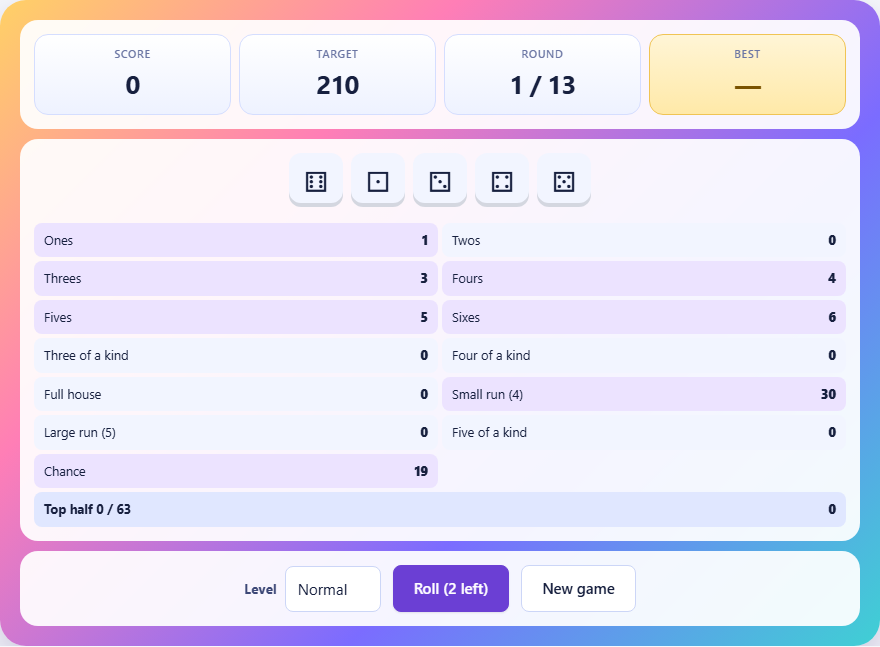
The face tally every box is scored from
Before any box shows a number, the game sorts your five dice by face. It keeps a small count for each face: how many ones, how many twos, and so on up to six. Every box on the sheet is a question put to that count. A number box asks how many of its own face turned up, then multiplies. Four twos in the Twos box is 4 times 2, which is 8.
Three of a kind asks whether any face turned up at least three times. Four of a kind asks for at least four. When the answer is yes, the box pays the sum of all five dice, not just the matching ones. Full house wants one face counted exactly three times beside another counted exactly two, and pays a flat 25. Five of a kind wants the same face on all five dice and pays 50.
The two run boxes work off a different test. The game walks the faces in order from 1 up to 6 and measures the longest unbroken stretch that shows up at all. Repeats do not spoil it, because the test only asks whether a face is present. A stretch of four pays 30 and a stretch of five pays 40. So 1, 2, 3, 4, 4 still counts as a run of four and pays 30 in the Small run box. Chance skips every test and simply adds the five dice together.
After each round the six number boxes are added up on their own. Reach 63 there and 35 points are added to your total. A spare in one box can cover a gap in another. Ones 2, Twos 6, Threes 9, Fours 12, Fives 20 and Sixes 18 comes to 67, so the bonus lands even though the Ones box fell a point short of three ones. The line under the sheet tracks this while you play, then swaps to a bonus note once the top half is safe.
Take a finished roll of 5, 5, 5, 2 and 1. The count is one 1, one 2 and three 5s, and the dice add up to 18. This is what each box offers:
So the best number on that sheet is 18 and the next is 15, a gap of only three points. Taking the 18 leaves Fives empty and puts you 15 behind on top half pace. Taking the 15 keeps the pace and leaves Three of a kind open for a bigger total later. That is the trade the game keeps asking you to make.
One rule here is looser than you might expect. Five of a kind also fills the Full house box. Roll 5, 5, 5, 5, 5 and the sheet offers 25 in Full house, 25 in Three of a kind, 25 in Four of a kind, 25 in Fives, and 25 in Chance too, because five 5s add up to 25. The Five of a kind box pays 50, so that is plainly where it belongs.
- Fives pays 15, because three 5s at 5 each is 15.
- Three of a kind pays 18, the whole total, since a face turned up three times.
- Chance pays 18 as well, for the same total.
- Twos pays 2 and Ones pays 1.
- Full house pays 0. There is a triple, but no other face appears exactly twice.
- Small run and Large run both pay 0. Only the 1 and the 2 sit next to each other, a stretch of two.
- Four of a kind and Five of a kind pay 0, since no face reaches four.
Fair dice, no hints, and one control that wipes the sheet
Each throw redraws only the dice you have not held. A held die keeps its face and its place in the row. The rest are drawn one at a time from the browser's own random number source, and all six faces are equally likely on every die. Nothing is weighted, nothing is carried over from the last throw, and a bad round earns you no make up roll.
The dice are not seeded either. A game cannot be replayed and cannot be handed to a friend to try. Two people opening the page get different dice, and so do you on your next game.
A round gives you three throws and spends the first one for you. By the time you see the dice, five of them have already landed and the button reads Roll (2 left). You may also stop early. Tap a box straight after that opening throw and the round ends there, with the throws you did not use simply gone.
Nothing is checked before a box is filled. There is no confirmation and no way back. Tapping a box writes that number at once, even when the number is 0. The sheet is at least honest in advance: every open box shows exactly what it would pay for the dice in front of you, zeros included, so the damage is on screen before you commit to it.
The running score counts every empty box as 0, so your total climbs as the sheet fills rather than appearing at the end. The 35 point bonus is not added until the top half truly reaches 63, and until then the line under the boxes shows the gap, such as 41 out of 63. The last check is simple. Your total has to be at least the target, so landing exactly on 210 on Normal counts as a win, not a near miss.
One control deserves a warning. Changing the level starts a fresh game right away, with no prompt and no route back to the sheet you were filling. Pick Easy, Normal or Hard before your first throw. The New game button acts the same way.
The game offers no advice at all. It will not rank your options, will not warn you that a lone six is a poor thing to put in Sixes, and will not work out your chance of filling a run with two throws in hand. The number on a box is what that box pays for the dice you have now, never what it might pay after another throw. Judging which choice is worth more across the rest of the game is the whole puzzle, and that part is left to you.
Some house rules are left out on purpose. A second five of a kind earns no extra bonus here, and there is no joker rule that lets one fill a run box. Beyond Full house accepting it, a repeat five of a kind has to be scored somewhere else on its own merits. All thirteen boxes get filled, so the game always ends on the thirteenth round, win or lose.
Your best score is only written down when a game reaches that ending. Quit halfway and nothing is kept. It lives in this browser alone, under a key for this game, and only a higher score replaces it.
Thirteen rounds, thirteen boxes
Five Dice gives you five dice and thirteen rounds. Each round you roll up to three times, keeping any dice you like between rolls. After your final roll, you must place the result in one of the thirteen scoring boxes on the sheet. Every box can only be used once. Thirteen rounds, thirteen boxes, and every box gets filled by the end.
Your total score at the finish is compared against a target. Beat the target and you win. The targets are one hundred and seventy on Easy, two hundred and ten on Normal, and two hundred and fifty on Hard. A typical game with average luck and reasonable choices lands somewhere around two hundred, so Normal is a genuine test and Hard requires sharp play.
The upper section and the bonus
The top six boxes on the sheet are the number boxes: Ones, Twos, Threes, Fours, Fives, and Sixes. Each one scores the total of all dice showing that number. If you roll three fours and place them in the Fours box, you score twelve. If you roll only one four, you score four.
If your six number boxes add up to sixty-three or more, you earn a thirty-five point bonus. Sixty-three is exactly three of each number: three ones plus three twos plus three threes, and so on up to three sixes. The math works out to three plus six plus nine plus twelve plus fifteen plus eighteen, which is sixty-three.
That thirty-five bonus is the single most important factor in the game. It decides more games than any full house or five of a kind. Players who ignore it and dump bad rolls into the upper section routinely fall short of the target. Players who protect it have a cushion that covers two or three weak rounds.
The lower section box by box
Three of a kind scores the total of all five dice, but only if at least three show the same face. Four of a kind works the same way but needs four matching dice. In both cases the score is the sum of all five dice, not just the matching ones. So four sixes plus a three scores twenty-seven, not twenty-four.
Full house needs three of one number and two of another. It scores a flat twenty-five points regardless of which numbers are involved. Three ones and two sixes scores the same twenty-five as three sixes and two ones.
Small run requires four dice in a sequence. It scores thirty points. A run of one through four, two through five, or three through six all qualify. The fifth die can be anything. Large run needs all five in a row. That scores forty points. Only one through five and two through six qualify.
Five of a kind is all five dice on the same face. It scores fifty points. Chance is the safety net. It scores the total of all five dice with no conditions at all. Whatever you rolled, Chance accepts it.
The controls on each roll
At the start of each round, all five dice roll automatically. You see the result and the Roll button shows how many rolls remain. Tap any die to keep it. Kept dice turn green and sit still on the next roll. Tap a kept die again to release it back into the rolling pool.
You cannot keep dice on the very first roll of a round because nothing has been rolled yet at that point. After the first roll, you choose what to keep and press Roll for your second attempt. After the second, you choose again and press Roll for your third. After the third roll, you must place the result somewhere. The sheet shows what each box would score with your current dice. Tap a box to use it.
Protecting the upper bonus
The key to reaching sixty-three in the upper section is to score at least three of each number. If you roll three sixes, put them in Sixes for eighteen. If you roll four fives, put them in Fives for twenty. Every time a number box gets three or more of its number, you are on track for the bonus.
When a round gives you nothing useful for the lower section, look at the upper section first. Two fours is eight points in the Fours box. That is below the target of twelve, but it is better than zero. Dumping a bad round into Ones and scoring two points is a popular move because the loss is small. A zero in Ones costs you at most five points toward the bonus. A zero in Sixes costs you eighteen.
If you are above the pace for the bonus midway through the game, you can afford to sacrifice one upper box. If you are below pace, every upper box matters and you need to throw bad rounds into a lower section box instead.
Saving Chance for the worst round
Chance accepts any roll and scores the total. It is tempting to use it early when you roll a high total like twenty-five that does not fit anywhere else neatly. Resist that temptation.
Chance is your insurance policy. Late in the game, you will face a round where nothing works. The dice give you scattered numbers that score zero in every remaining box except Chance. If Chance is gone, you have to put a zero somewhere that matters. If Chance is still open, you dump the bad roll there and protect everything else.
The average roll of five dice totals about seventeen or eighteen. Spending Chance on a roll of twenty-five gains you only seven or eight more than average. Keeping Chance for a disaster prevents a zero in a box that might have scored thirty or forty points. The math almost always favors waiting.
What to keep and what to throw
When you see a pair after your first roll, keep the pair and roll the other three. Two more rolls give you a reasonable shot at three of a kind, which scores the total of all five. If you already have three of a kind, keep them and try for four or five of a kind, or look at whether the other two dice are close to a pair that would give you a full house.
When you see four dice in a row, keep the run and throw the odd one out. A small run is worth thirty and a large run is worth forty. You have two rolls to fill the gap. The odds are better than most people expect. If you hold two through five and need a one or a six, that is twelve chances out of thirty-six possible outcomes for a pair of dice, which is one in three.
When you have nothing useful after the first roll, look at which number appears most. Keep those and try to build three of a kind. If nothing appears twice, look at which upper section boxes still need filling and keep any dice that match.
Mistakes that sink your score
- Spending Chance early on a decent roll. Save it. You will need it more later.
- Ignoring the upper bonus. Thirty-five free points is worth more than a lucky full house in most games.
- Putting a zero in Sixes. If you must take a zero in the upper section, put it in Ones where the damage is smallest.
- Chasing five of a kind too long. It scores only fifty and the odds of hitting it from two of a kind in two rolls are low. A three of a kind scores the total of all dice, which is often close to fifty anyway.
- Filling boxes in order. There is no rule that says you must fill Ones first. Fill whatever fits the roll you got.
The whole game stays in your browser
All the dice rolls, scoring, and target checks happen on your own device. Nothing is uploaded. There is no account and your best score lives only in your browser. Close the tab and there is nothing left on any server. The page works offline once it has loaded.