
Five Card Swap: Which Cards to Keep and Which to Throw
A guide to the rules of Five Card Swap, what every combination on the score chart is worth, and how to pick the keep that scores most over a whole game.
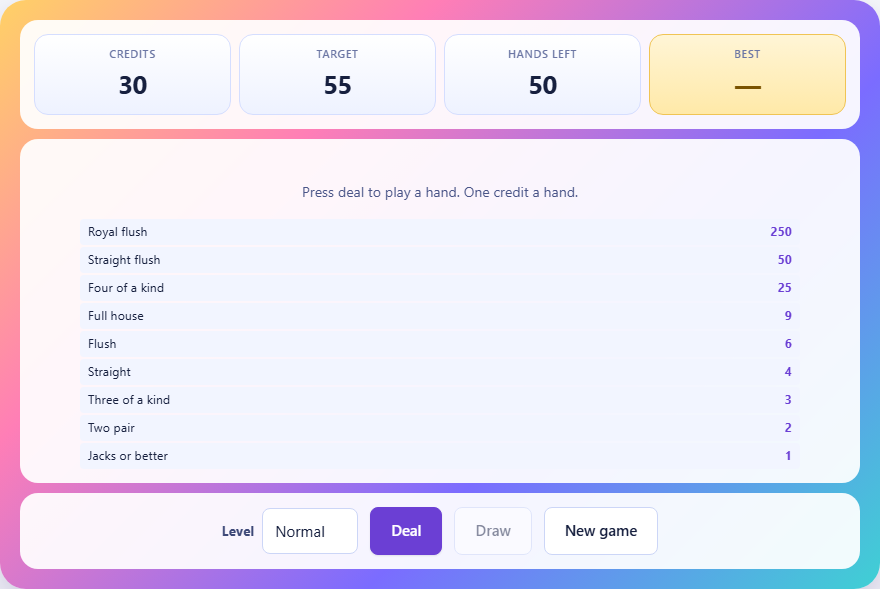
What happens in a round
Press Deal. Five cards land face up from a deck that was shuffled a moment ago. Look at them and decide what stays. Tap a card and it gains a green ring and the word HELD. Tap it again and the ring goes. When the ones you want are held, press Swap. Every card you did not hold is thrown out, and a new card takes its place off the same deck. Those new cards are final. The five you are left with are read against the score chart, and whatever they make is added to your total.
So a round is short: deal, hold, swap, score. There is no second swap, and nobody sits across the table from you. All you do is choose which cards stay. That one choice is the whole game.
Where the cards come from
Every round starts with a full fifty-two card deck, shuffled from scratch. Five come to you, which leaves forty-seven you have not seen. The cards you throw away do not go back in. Your new cards come off the top of that same deck.
This is why every count on this page is out of forty-seven. Nine cards of a suit left, one card that finishes a run, three cards that match your king: all of them are counted against the same forty-seven. Once you get used to that number, working out a keep in your head takes a couple of seconds.
The score chart
The chart sits under the cards and never moves. Ten to ace in one suit is the top line, at five hundred points. Any other five in a row in one suit is worth a hundred. Four alike is worth fifty. Three alike with a pair is worth twenty. Five cards of one suit in any order is worth twelve. Five in a row across mixed suits is worth eight. Three alike is worth six. Two pairs is worth four. A high pair, meaning two jacks, two queens, two kings or two aces, is worth two. Anything else is worth nothing.
That last line matters more than it looks. A pair of tens counts the same as five stray cards, which is to say nothing at all. So a small pair is never an easy keep. It is a real choice, and often a close one.
Rounds, the target and the three levels
The target is forty points on all three levels. What changes is how many rounds you get to reach it. Easy hands you twenty-five. Normal hands you twenty. Hard hands you sixteen.
A round played with care is worth about two points on average. Most rounds score nothing at all, and then one lot of four alike drags the average back up. That is why the round count is the real difficulty dial. Easy asks for a bit over one and a half points a round. Normal asks for two, which is level. Hard asks for two and a half, so you are leaning on at least one large combination turning up.
Hit forty and you win on the spot, rounds to spare or not. Run the rounds out below forty and the game closes there. Picking a new level from the dropdown starts a fresh game straight away.
The buttons and the counters
Deal and Swap are the two you use. Deal wakes up at the start of a round and sleeps once the cards are out. Swap wakes up only when there are cards on the table. Whichever one is not yours to press is greyed out, so you cannot fire the wrong one by accident.
Tapping a card flips it in and out of being held, with a small sound each way. New game clears the score and gives you the full set of rounds again for the level you are on. The counters above the cards show your score, the forty you are aiming at, and how many rounds you have left. Your best is the highest total you have ever ended a game on, and it survives a refresh.
With a pair, let the spare cards go
Say you hold two sevens and three cards that have nothing to do with them. Throw all three. Newcomers like to keep an ace next to the pair, just in case the ace finds a friend. It is a poor trade. Every card you keep is one fewer card you draw, and drawing is how a pair grows into something worth points.
Here is the size of it. Hold the pair on its own and take three new cards, and about one round in eight comes back with three alike or something above it. Hold the pair plus a spare and take only two, and that drops to about one in twelve. The spare has to match itself to be worth a thing, and even then two pairs is only four points.
The same goes for a high pair. Two kings and a stray nine should be played as two kings. The nine is not helping, and the third new card might.
Four of one suit against a small pair
This is the decision that turns up most, and the one most people read wrong. You hold four hearts and a fifth card that is not a heart, and that fifth card happens to match one of the hearts. So you have a small pair sitting inside a four card suit.
Count what each keep gives you. Nine hearts are still among the forty-seven you cannot see. So about one round in five, the new card is a heart and you have five of one suit for twelve points. Spread over every round, keeping the four hearts is worth a little over two points, before you count any run or high pair the new card throws in by accident.
Now the pair. It scores nothing where it stands, so all of its value lies in what it might become: six points for three alike, twenty for three alike and a pair, fifty for four alike, four for two pairs. Weigh each of those by how often it lands and the pair comes out under two points. The hearts take it.
If the pair is jacks or higher, the sums flip. That pair is already worth two, and three fresh cards can push it up from there. Keep the pair and let the suit go.
When to break a finished hand
Most finished hands should be left alone. If you already hold five of one suit for twelve points, throwing a card away is usually throwing away a sure thing for a maybe.
There is one clean exception. If four of your five cards are the ten, jack, queen, king and ace of the same suit, break whatever you have and go for the fifth. One card in forty-seven lands the top line and five hundred points. Counting all the times you miss, that swap is still worth around sixteen points on average, because the near misses hand you a suit, a run or a high pair instead. Sixteen against a sure twelve is not a hard call.
Three of the five top cards is another matter. Then two exact cards have to arrive together, which happens about once in a thousand tries. Keep what you have and take the points.
A round played out card by card
You press Deal and get the queen of hearts, the jack of hearts, the nine of hearts, the four of hearts and the four of spades.
Two keeps are worth weighing here. The four hearts, or the pair of fours.
Take the hearts first. Nine hearts are unseen, so about one round in five brings the suit home for twelve points. On top of that, a queen or a jack from another suit gives you a high pair for two. Add both together and the keep is worth about two and a half points.
Now the fours. As they stand they score nothing. Three new cards might bring three alike, four alike, three alike and a pair, or a second pair. Weigh each by how often it turns up and the keep is worth about one and three quarters.
So hold the four hearts and throw the four of spades. That is the play every time, even though it misses far more often than it lands. In one round the pair may well have done more for you. Over twenty rounds it will not.
One more thing worth spotting: the queen and jack of hearts are two of the five top cards. Holding them takes nothing away here, because you were keeping them for the suit anyway.
The habits that cost the most points
Breaking two pairs to go after three alike is the costliest one. Two pairs already scores four. Keep both, throw the fifth card, and one card in twelve turns it into three alike and a pair for twenty. That keep is worth over five points a round. Dropping one of the pairs leaves you under two.
Holding three to a suit or three to a run comes next. Two cards have to arrive in exactly the right shape, and that is far too much to ask of a single swap. Four to a suit or four to a run is a real draw. Three of anything is a wish.
Last is not reading the chart. It is right there under the cards. A glance at it reminds you that a run of five is worth eight while five of one suit is worth twelve, and that gap is exactly the sort of thing a close keep turns on.
What is saved and what is not
The game runs inside the page, on your own device. Nothing is uploaded and there is no account to make. Your best score is written to this browser's local storage, on this computer or phone alone. Clear your browsing data and it goes with it. Open the page somewhere else and you start again from nothing.
Once the page has loaded it keeps working with the network off, so it is a fair way to fill a train journey. The deck, the shuffle and the scoring all happen in front of you, in a few dozen lines of plain code that came down with the page.