
Fishing for points with arithmetic and nerve
How this two-hand fishing card game works from the first deal to the final count, what every action does, how the eleven points are scored, and the specific plays that separate a player who counts from one who guesses.
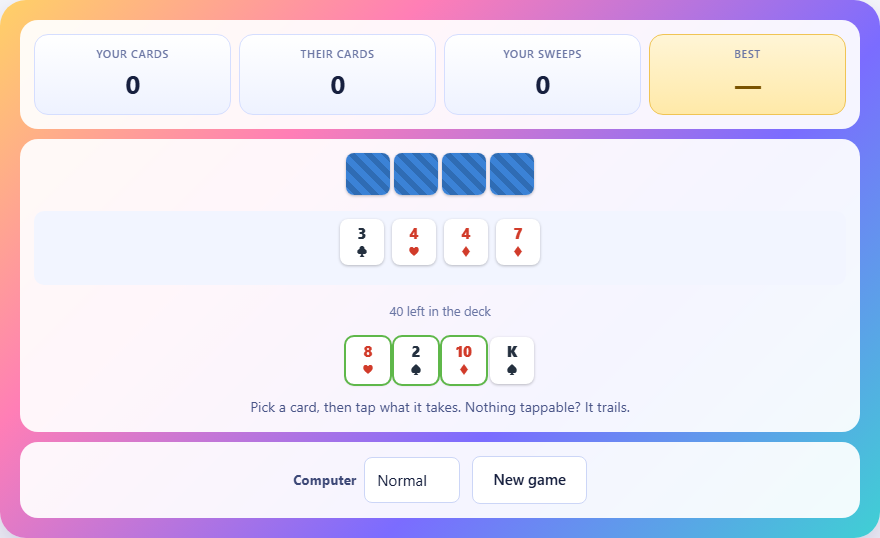
What sits on the table and what sits in your hand
A standard fifty-two card deck is shuffled. Four cards are dealt face up onto the table and four go into your hand. The computer gets four of its own, face down. On each turn you play exactly one card from your hand and decide what it does. When both hands are empty, four more cards are dealt to each side from the deck. This continues until the deck runs out and every card has been played.
The table is shared ground. Every card lying there is available to both players. What you hold in your hand is private, and what the computer holds is hidden from you. The tension comes from the fact that both sides are looking at the same table but planning different things with it.
The three things a card can do
When you pick a card from your hand, the game shows you what it can do. There are three possible actions.
Take means your card captures one or more cards from the table. They go into your pile and count toward your score at the end. Build means your card joins one or more table cards into a pile with a total you can collect on a later turn. Trail means your card is simply placed on the table with nothing else happening. You leave it there and hope it survives until your next turn.
Every turn must use exactly one of these three actions. You cannot hold a card back, and you cannot play two cards at once.
How capturing works
A card captures by matching rank or by adding up to its value. A seven takes any seven on the table. It also takes any group of table cards whose values add to seven, such as a three and a four, or an ace, a two and a four. If both a matching seven and a three-four pair are sitting there, a single seven can take all of them at once in one play.
Aces count as one. Number cards two through ten carry their face value. Picture cards - jacks, queens and kings - have no numerical value at all. A jack can only capture another jack, one at a time. The same goes for queens and kings. They cannot be part of any sum.
When you pick a card from your hand, the table cards it can capture light up. Tapping a lit card captures the largest group that includes it. Action buttons also appear if there are several different capture options.
Builds and what they cost you
Building is the riskiest move in the game and the one that separates careful play from reckless play. You drop a card from your hand onto one or more table cards to form a pile with a specific total. That total must be a number you still hold in your hand.
For example, you hold a three and a nine. A six is on the table. You play the three onto the six to make a build of nine. Next turn, if nobody takes it first, you play your nine to capture the build and the cards inside it.
The catch is that a build announces what you are holding. The computer now knows you have a nine. If it also holds a nine, it can take your build before you get to it. Worse, you cannot trail while you own a build. Every card you play must either take the build, add to it, or do something else legal. You are locked in.
This version uses single builds only. You can raise a build by adding another card to increase its total, as long as you hold the new total in your hand. Multiple builds, where two separate groups carrying the same value are stacked together, are not part of this version.
The eleven points and where they hide
Points are not awarded for taking cards in general. Specific cards and counts earn points at the end of each deal, and they add up to eleven before sweeps.
Three points go to whoever captured the most cards out of fifty-two. One point goes to whoever captured the most spades. Two points go to whoever holds the ten of diamonds. One point goes to whoever holds the two of spades. Each ace is worth one point, and there are four of them. A sweep, which means clearing the entire table in a single play, earns one bonus point each time it happens.
In a close game, the ten of diamonds alone is worth two points and often decides the outcome. The two of spades is easy to overlook because it looks like an ordinary low card, but it carries a point of its own on top of counting toward the spade majority.
Sweeps and why they matter more than they look
A sweep happens when your play takes every card on the table, leaving it completely empty. You earn one extra point for each sweep. More importantly, your opponent now has nothing to capture on their turn. They are forced to trail a card, which puts a free target on the table for you.
Sweeps are rare in normal play, but they become possible when the table has only one or two cards left. A well-timed capture that clears the table is worth both the point and the positional advantage of forcing a trail.
Controls and how a turn flows
Tap a card in your hand to select it. The table cards it can interact with light up. An action bar appears with buttons for every legal play: take buttons showing how many cards each capture option collects, build buttons showing the total, and a trail button if trailing is allowed.
You can also tap a lit table card directly to take the largest capture group that includes it. After you play, the computer takes its turn. A short message tells you what it did. The deck counter at the bottom shows how many cards remain to be dealt.
Three computer levels are available. Gentle plays without building and does not chase the high-value cards. Normal builds when it helps and tracks the ten of diamonds. Sharp plays every advantage and treats the two of spades with the respect it deserves.
Strategy for the cards that carry points
The most common mistake is treating every capture the same. Taking a two and a three feels productive, but it earns nothing unless those cards tip the most-cards count in your favour. The ten of diamonds, on the other hand, is worth two points by itself. If you see it on the table and hold a ten, take it immediately. If you can build toward ten using cards in your hand, that is worth the risk.
The two of spades is the sneaky one. It counts toward the spade majority and carries its own point. Letting it go to the computer costs you two points at once if you also lose the spade count.
Aces are individually worth a point each. When an ace is on the table and you hold an ace, take it. You get both the point for capturing it and the captured ace itself toward the most-cards total.
When to build and when to trail quietly
Building is strong when you hold two cards of the same value or when the computer has few cards left in its hand. The fewer cards the opponent holds, the less likely they are to have your number.
Building is dangerous when the computer has a full hand and you have just dealt. Four cards give it a reasonable chance of holding whatever total you announce. In that situation, trailing a small card and hoping to capture something next turn is often safer than building a pile the computer will steal.
Never build just because you can. Ask whether the cards in the build are worth more than the card you are spending to make it. A build of three using two cards is rarely worth the risk. A build of ten using the six and the four, when you hold a ten, is almost always worth it because the ten of diamonds might come into play.
Common mistakes and how to avoid them
- Taking one big card when two small cards are available. Most cards is the largest single award at three points. Volume matters more than value unless one of the scoring cards is on the table.
- Forgetting that you cannot trail with a build on the table. Once you build, every card you play must deal with that build until it is taken. Getting locked with a weak hand is painful.
- Ignoring the two of spades. It looks like nothing, but it is a point and a spade. Letting it go cheaply can cost the game.
- Building early in a round when the opponent has a full hand. Four hidden cards mean a decent chance they hold your total.
- Sweeping without noticing it. When you clear the table, the next player must trail. If you do not plan for that free card, you waste the advantage.
The last round and who gets the leftovers
When the final cards have been played and no more deals remain, any cards still sitting on the table go to whoever made the last capture. This does not count as a sweep and earns no bonus point. It simply adds those cards to that player's pile for counting.
This rule makes the last capture of the game important. If you can time your plays so that your final move is a capture, you pick up whatever is left. Planning two or three turns ahead near the end of the deck is where experienced players pull ahead.
Everything stays on your device
The game runs entirely in your browser. No cards are sent to a server, no account is needed, and your best scores are saved locally on your machine. Close the tab and nothing remains anywhere else. You can even play after disconnecting from the internet, because the whole game loaded when the page opened.