
Getting everything across when certain pairs cannot be left alone
How the river crossing puzzle works, why an empty boat trip is not a mistake, the strategy of finding the troublemaker, and the twelve-hundred-year-old idea behind every puzzle the board gives you.
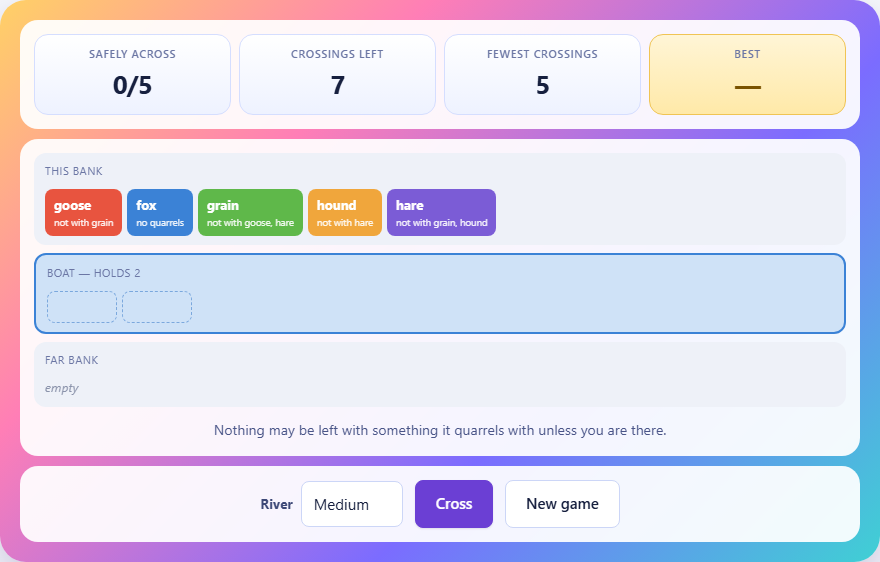
A puzzle about what you leave behind
Ferry is a river crossing logic puzzle. A collection of things sits on one bank of a river. You need to move all of them to the far bank using a boat that only holds a limited number at a time. The catch is that certain pairs quarrel. If you leave two quarreling things alone on a bank without you there to keep the peace, you lose.
Every puzzle is generated fresh. The things, their quarrels, and the number the boat can carry all change from one game to the next. There is no fixed route to memorize. You have to read the relationships each time and work out a new plan.
How the board and controls work
The board shows two banks and a boat between them. Each thing is a colored chip with a name and a line underneath listing what it quarrels with. Tap a thing on your bank to load it into the boat. Tap it in the boat to unload it. When you are ready, press Cross to send the boat to the other side.
The boat moves with you in it. You can only load things from the bank you are standing on. After a crossing, you are on the far bank. To go back, press Cross again. The boat can cross empty. You do not need to carry something every trip.
The stats bar at the top shows how many things are safely across, how many crossings you have left, and the fewest crossings the puzzle can be solved in. That last number is exact. The board searches every possible state of the river to find it.
The three puzzle sizes
Small puzzles have four things and a boat that holds one. These are close to the classic riddle and usually need around five to seven crossings. Medium puzzles have five things and a boat that holds two. The larger boat does not always make things easier, because more things mean more quarrels and more chances to leave a bad combination behind. Large puzzles use six things with a boat of two, and the solutions can stretch past ten crossings.
Each size gives you a budget of crossings that is a few more than the minimum. The slack is small. On a Medium puzzle you might have two extra crossings beyond the best possible solution. That is enough to recover from one wrong move but not two.
Why crossing empty is necessary
New players often feel that crossing with an empty boat is wasting a move. It is not. It is the core trick that makes river crossings solvable at all.
Consider the classic problem with three things where one quarrels with both others. You take the troublemaker across first. Now you need to bring a second thing over, but when you come back, the third thing is alone on the near bank, which is fine because it only quarrels with the troublemaker who is already across. You deliver the second thing. But now the second thing and the troublemaker are on the far bank together, and they quarrel. So you bring the troublemaker back. You deliver the third thing to the far bank. Then you go back empty and collect the troublemaker one last time.
That sequence uses an empty return trip and a trip where you bring something backwards. Both feel wrong at first. Both are essential.
Finding the thing with the most quarrels
The first thing to look at is which thing quarrels with the most others. Every chip on the board lists its quarrels underneath its name. The thing with the longest list is usually the troublemaker. It needs special handling because it cannot be left with most of the others.
Often the troublemaker needs to go across first, come back, and cross again later. Sometimes it needs to go last. The right order depends on who else quarrels with whom. But the troublemaker is always the bottleneck. Start by figuring out when it can safely be on each bank, and the rest of the plan follows from there.
If two things share the same number of quarrels, look at whether they quarrel with each other. If they do, they can never be on the same bank without you. That pair is even harder to manage than a single troublemaker. In larger puzzles, quarrel chains are common. Thing A quarrels with B, and B quarrels with C, which means moving B to a safe bank requires that both A and C are somewhere else or that you are present. Tracing these chains before you start moving anything saves a great deal of backtracking.
Checking the bank you are leaving
Every time you press Cross, the game checks the bank you are leaving. If anything on that bank quarrels with something else on it, the crossing is refused with a message. You keep the peace on whichever bank you are standing on, so only the unattended bank matters.
This means you need to think one step ahead before every crossing. It is not enough to check that the boat is loaded correctly. You need to check what is left behind. A good habit is to mentally list everything that will be on your departure bank after you leave, and scan for quarrels among them.
The far bank can also become a problem when you are bringing something back. If the far bank already has a pair that only coexists because you are there, leaving to fetch something else will trigger a quarrel.
Worked example with four things
Suppose you have a goose, a fox, a grain, and a hound. The goose quarrels with the fox and the grain. The fox quarrels with the goose. The grain quarrels with the goose. The hound has no quarrels. The boat holds one thing.
Start by taking the goose across. It quarrels with two things, so it is the troublemaker. The fox and grain are fine alone on the near bank because they do not quarrel with each other or the hound. Now go back empty and take the fox across. The far bank now has the goose and the fox, who quarrel. So bring the goose back. Take the grain across. The fox and the grain are fine together. Go back empty and collect the goose. Then go back for the hound.
That takes seven crossings. The board might find a shorter path depending on the exact quarrels, and a different set of quarrels could change which thing is the troublemaker entirely. But the process is always the same: isolate the thing that causes the most problems, shuttle it back and forth, and fill in the others around it.
Mistakes that strand you
- Sending the easiest thing first. The thing with no quarrels does not need careful handling. Send it later. The troublemaker needs to go when you have the most room to maneuver.
- Forgetting the far bank. You check the near bank before leaving, but the far bank matters too when you arrive and then depart from it on a return trip.
- Refusing to bring something back. Moving something backwards feels like wasted effort, but it is often the only way to break a quarrel on one bank so you can deliver something to the other.
- Using all your slack on experiments. With only two extra crossings beyond the minimum, every wrong move matters. Plan a full sequence before you start pressing Cross.
- Ignoring the quarrel labels. Every chip lists its quarrels in small text underneath. Reading them all before your first move saves crossings later.
The puzzle runs entirely in your browser
The puzzle generator, the quarrel rules, and the shortest-path solver all run on your own machine. Nothing about your game is sent anywhere. There is no account, no leaderboard on a server, and no data leaving the page. Once it has loaded, you can disconnect and play as many puzzles as you like. The solver uses a breadth-first search through every possible arrangement of things on both banks, which is why the fewest crossings figure is always exact rather than an estimate.