
Winning a tug of war played one card at a time
How the rope moves, why losing on purpose is a real tactic, what the drifting hand sizes tell you, and how to read the position before you play your card.
The maths that loads the opponent's choice
The computer does not follow a rule. It gives each card it still holds a weight, then draws one at random in proportion to those weights. The recipe has three steps and only two tuning numbers, 0.35 and 0.7, and both sit in plain sight in the code.
First it measures the rope. Pressure is the rope value divided by the target, and the rope is counted from your side. So pressure is 0 in the middle and climbs toward +1 as the computer nears defeat. Second, every card is given a rank from 0 to 1, worked out as (card minus 1) divided by (top card minus 1). On the Medium deck the one has rank 0, the four sits at 0.5, and the seven has rank 1. Third, it sets a target rank: want equals 0.5 plus pressure times 0.35. A card's weight is 1 minus 0.7 times the gap between its rank and that target, with a floor of 0.35.
Put real numbers in. Medium deck, full hand of one to seven, rope in the middle. Pressure is 0, so the target rank is 0.5. The four lands exactly on it and scores a weight of 1. The three and five are 0.1667 away, so each scores 1 minus 0.1167, which is 0.8833. The two and six score 0.7667. The one and seven, a full 0.5 away, score 0.65. Add them up and the total is 5.6. Divide each weight by 5.6 and you get the real odds: the four at 17.9 percent, the three and five at 15.8 percent each, the two and six at 13.7 percent, and the one and seven at 11.6 percent. The favourite is only about half again as likely as the outsider.
Now push the rope to +6 on Medium, one notch from your win. Pressure is 6 over 7, so want moves to 0.8. The weights shift, and the six becomes the top pick at 18.8 percent. Here is the part worth knowing: the seven is not second. The five is, at 17.4 percent, with the seven third at 16.5 percent. A target rank of 0.8 sits closer to the six's rank of 0.833 than to the seven's rank of 1. Chasing a rank is not the same as playing big. The one falls to 8.5 percent. At rope minus 6 the whole picture flips: the two peaks at 18.8 percent and the seven drops to 8.5 percent.
- The 0.35 floor never fires. The rope always stops short of the target while play continues, so the widest gap possible gives a weight of about 0.44 on Medium, 0.45 on Small and 0.43 on Large. All three sit above the floor.
- The choice is made from two inputs only: the cards it still holds and the rope value. Your card, your hand size and every earlier round are all absent from the calculation.
- It has no idea that only the winner pays. Nothing in the weighting rewards holding a card back to save it.
- It does not watch the clock either. Round 39 is weighted exactly like round 2.
- Because the pick is random each time, the same position will hand out different cards. Sitting on one line and repeating it does not train a pattern you can then beat.
Six rounds counted out, and where the model stops
Here is a whole Medium game, deck one to seven, target seven notches. Round one: your 3 meets their 6. They win by 3, so their 6 is spent and you keep your 3. The rope goes to minus 3, and you hold seven cards to their six. Round two: your 7 meets their 2. You win by 5, your 7 is gone, and their 2 stays where it is. Minus 3 plus 5 puts the rope at plus 2, six cards each. Round three: your 1 meets their 1. A tie, so both ones burn and the rope does not shift. Still plus 2, five cards each.
Round four: your 6 meets their 3. You win by 3 and the rope reaches plus 5. You are down to four cards while they still hold five, because losers pay nothing. Round five: your 5 meets their 4. You win by 1, so the rope sits at plus 6, one short of the line. Round six: your 4 meets their 2. You win by 2. The rope lands on plus 8, past seven, and the game ends there.
Count what that cost. You won four of the six rounds and spent five cards doing it. They spent two. You end up holding a 2 and a 3 while they still have five cards, including the 7 they never had to play. That is the game in one picture: winning is what empties your hand.
The number kept on the Best chip is the rope value at the finish, not the round count. This game records 8, because the last win carried the rope two notches past the target. A careful win that lands on exactly 7 would score less. A loss or a draw hands nothing to the scoreboard, so no number is written for either. The Best value is held by your own browser on this device.
One effect of the deck settings is easy to miss. On all three decks the target matches the top card: five and five, seven and seven, nine and nine. The biggest swing one round can make is the top card beating the one, which comes to top minus 1. That is six on Medium against a target of seven. So no game can be won in a single round from the middle. Two rounds is the floor, on every deck.
- The cap is 40 cards from you. It is tested before the winning line is tested, so a rope that crosses on round 40 is announced as "Time called" rather than "Over the line". The win still stands and the rope value is still kept.
- A rope resting on exactly 0 when the cap arrives is called a dead heat. For scoring it is handled like a defeat: nothing is stored.
- The track draws one notch per whole step, from minus the target to plus the target. That is 11 notches on Small, 15 on Medium and 19 on Large. Overshoot the end, as with the plus 8 above, and no notch matches, so the knot is missing from that last frame.
- The message printed when a new game begins still claims both cards are spent every round. That wording is left over from an older build and does not match the rule. The round by round lines after it are right.
- Changing the Deck menu restarts the game at once. There is no undo, and a card cannot be pulled back once tapped.
- The settings are fixed. You cannot pit a one to seven deck against a target of twelve, shorten the 40 round cap, or turn the opponent's lean up or down.
A duel with hidden choices
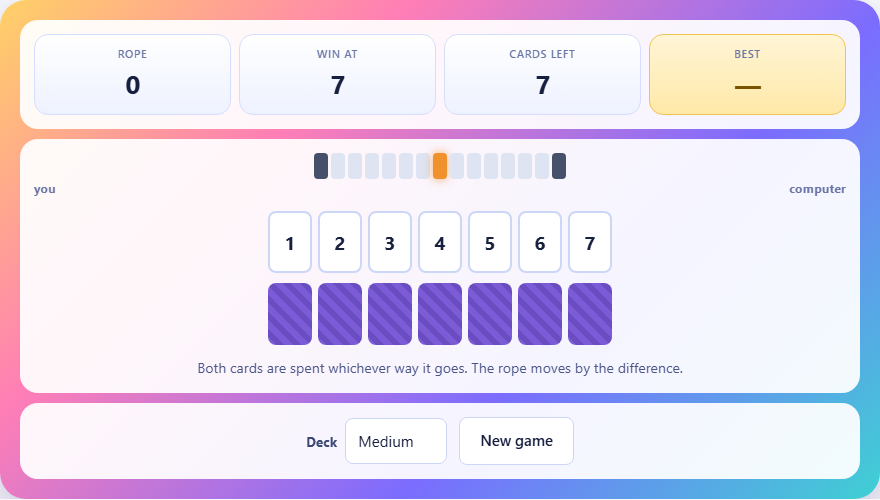
Feint is a card game played face down against a computer opponent. Both sides start with the same hand of numbered cards. Each round, you pick one card and the computer picks one at the same time, without seeing yours. Both cards are revealed together. The higher card wins, and a rope on a track moves toward the loser by the difference between the two values.
The goal is to pull the rope all the way to your end of the track. On the Medium deck you hold cards numbered one through seven and the rope needs to travel seven notches in your direction. Small uses cards one through five with a track of five. Large uses one through nine with a track of nine.
The rule that makes it a game
Only the winner's card is spent. The loser keeps theirs. This single rule turns what would be a coin flip into a real contest.
Think about what this means. If you play your seven against their two, you win by five and the rope moves five notches. But you lose your seven and they keep their two. You gained ground on the track but gave up your strongest card. Next round, your biggest card might be a five while they still hold their seven.
A tie is the only case where both cards are spent. The rope does not move and both sides lose a card. That makes ties expensive when you are behind and harmless when you are ahead.
How the hands drift apart
Because only winners pay, the hands stop matching after the first round. The player who has been winning has fewer cards. The player who has been losing still holds a full set.
This is visible on the board. The computer's hand appears as a row of face-down cards above the rope. Count them. If the computer has three cards left and you have six, it has won three rounds and spent three cards doing so. Its big cards may already be gone. That is useful information when you are choosing what to play.
When either player runs out of cards, a fresh hand is dealt to that player alone. The other player keeps whatever they have left. This means an empty hand is not a disaster, but it does reset your options while your opponent may still hold cards they have been saving.
Losing small on purpose
Losing a round costs you nothing. Your card stays in your hand and the rope moves against you, but only by the difference. If you play your one against their seven, the rope moves six notches against you, which is painful. But if you play your one against their two, the rope only moves one notch and you still have your one.
This makes low cards surprisingly useful. They probe what the computer is willing to spend. If the computer burns a high card to beat your one, it wins by a lot but pays the steep price of losing that card. If it plays low to match your low, the rope barely moves and both sides keep their powder dry.
Deliberately losing with a small card to save your big cards for later is one of the core tactics. It is not a mistake. It is how you set up a winning position three or four rounds down the line.
Reading the position before you play
Before each round, look at three things. First, where is the rope? If it is close to your end, you need to win rounds. If it is near the middle or the computer's end, you have room to lose small. Second, how many cards does the computer have? Fewer cards means fewer options and less ability to answer whatever you play. Third, what is left in your own hand? If you still hold your biggest card, you have a bomb you can drop at the right moment.
The computer weighs its cards against the rope position each round. When it is losing, it leans toward playing its bigger cards. When it is ahead, it prefers to spend small ones and keep the big ones in reserve. This bias is gentle and weighted rather than fixed, so you cannot predict its exact choice, but you can expect it to be somewhat aggressive when it is in trouble.
When to play your biggest card
The biggest card in your hand is your most powerful weapon and your most expensive one. Using it guarantees you win the round unless the computer plays the same number, but winning means you lose it forever.
Play it when the rope is close to the computer's end and winning one more round could seal the game. Play it when you are sure the computer has already spent its own highest card and cannot match you. Play it when you are behind and need a big swing before the round limit runs out.
Do not play it early just because it feels strong. A seven played against a one moves the rope six notches and removes the seven from your hand. That is a big move, but if the computer still has its seven, you have no answer to it. Patience with your strongest card is the difference between players who win consistently and those who do not. Consider a worked example. You hold a three, a five, and a seven. The computer has two cards left. If you play the seven and win, the rope moves and you keep the three and five. If you play the three and lose by a small amount, the rope moves slightly against you but you still hold the seven for the next round where it can finish the job.
The round limit and time pressure
The game has a hard limit of forty rounds. If the rope has not reached either end by then, whoever it favors wins. A dead tie at the center is a draw where neither side is credited with a victory.
This matters because a cautious strategy of always playing low cards and waiting for the right moment can run out of time. If you spend twenty rounds trading ones and twos, the rope barely moves and you have burned half the game. The round limit forces action. You need to win big at some point, and the question is when.
On the Large deck, with cards up to nine and a longer track, games tend to last more rounds because each win moves the rope less relative to the total distance. On the Small deck, games can end in just a few rounds because a single big win covers most of the track.
Common traps and how to avoid them
- Always playing your highest card first. This wins the opening round but leaves you without firepower for the rest of the game. The computer still holds its best card and you do not.
- Treating ties as neutral. A tie spends both cards and moves the rope nowhere. When you are behind, that is a wasted round. When you are ahead, it is fine because it runs the clock.
- Ignoring the computer's hand size. The face-down row tells you how many cards remain. If the computer has one card left, you know it is about to get a fresh hand. That is the time to push.
- Playing randomly. Every fixed pattern can be beaten, but pure randomness ignores the position. Good play responds to the score, the hand sizes, and what has already been spent.
- Panicking when behind. A small deficit on the rope is easy to recover. The loss of one card to win one round can swing the position back in a single turn.
No data leaves your device
The cards, the rope, and the computer opponent all run locally in your browser. Nothing is sent anywhere. There is no account and no record of your games beyond what your browser stores on this device alone. Once the page has loaded, it works without a network connection. You can even prove this by disconnecting and playing a full game.