
Finding the truth when one answer might be wrong
How to narrow down a hidden number when the witness can lie once, why repeating a question is not a waste, and the counting argument that tells you exactly how many questions you need.
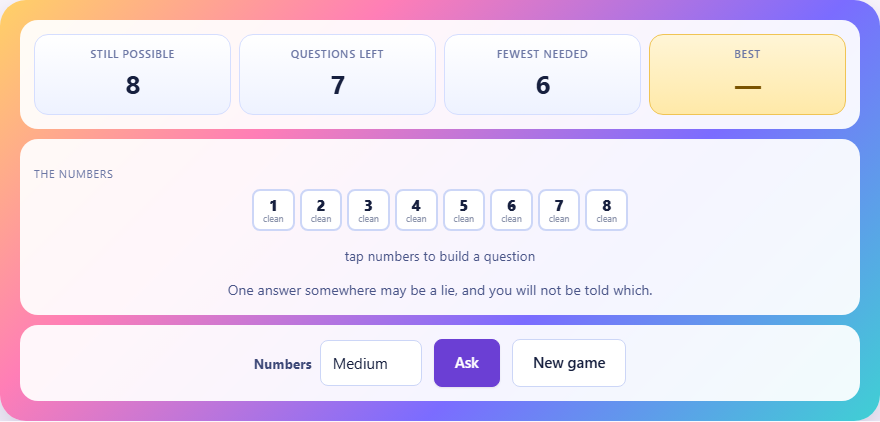
A guessing game with a twist
Fathom is a logic puzzle about asking yes-or-no questions. There is a hidden number. You point at some of the numbers on the board and ask whether the answer is among them. The witness replies yes or no. But somewhere during the game, the witness is allowed to lie to you exactly once. You will not be told when it happens or whether it has happened at all.
Your job is to narrow the field down to a single number before you run out of questions. The lie makes this far harder than it sounds. Without it, you could halve the possibilities with each question and find the answer quickly. With a lie in play, you need extra questions just to check that the answers you already have are honest.
How the board works
The board shows a grid of numbers. Each number has a state: clean, marked with one answer against it, or ruled out entirely. A clean number has no evidence against it yet. A marked number has one answer that says it cannot be the hidden one, but that answer might be the lie, so it is still possible. A ruled-out number has two separate answers against it. Since the witness can only lie once, both answers cannot be wrong, so at least one must be truthful and the number is truly gone.
You build a question by tapping numbers on the board. Each one you tap joins the question set. Tap it again to remove it. When your set is ready, press Ask. The witness answers yes or no, and the board updates. Every number that the answer works against picks up a mark. Two marks and it is crossed off.
The three difficulty sizes
The Numbers dropdown offers three sizes. Small gives you four numbers to search through. Medium gives eight. Large gives sixteen. The number of questions you are allowed rises with the size, but not as fast as you might expect.
Four numbers need only three questions. Eight numbers need five. Sixteen numbers need seven. The reason the count does not simply double is rooted in how the lie interacts with the information each question provides. The game shows the fewest needed at the top of the stats bar, so you always know the target to aim for.
Why the witness is adversarial
The witness does not pick a number in advance and answer truthfully about it except for one lie. Instead, it answers whichever way leaves your job as hard as possible. After each question, it looks at both possible replies and picks the one that keeps more numbers alive in the worst case.
This matters because it means you cannot get lucky. Against a fixed number you might stumble on the right question early. Against an adversary that adapts, every shortcut you think you have found will be punished. The only path to victory is a strategy that works no matter what the witness does.
The half-and-half opening
The strongest opening move is to ask about exactly half of the numbers. If the board has eight numbers, pick any four of them. The witness says yes or no, and either way, four numbers now have a mark against them. You have split the field as evenly as possible.
This mirrors the strategy for twenty questions without lying, where halving is always best. The difference is that the marked half is not gone. Those four numbers still live because the mark might be the lie. But they are weaker than the clean ones. A clean number can absorb one future mark and survive. A marked number cannot.
Repeating a question on purpose
Asking the same question twice sounds wasteful, but it is one of the most useful moves in the game. If you ask the same set again and get the same answer, you have confirmed it. The numbers that were marked by the first answer now have two marks and are ruled out, unless the witness lied both times, which it cannot because it is allowed only one lie.
If the second answer differs from the first, you know one of them was the lie. That is also valuable. You now know the lie has been spent, and every future answer is guaranteed truthful. From that point on the puzzle turns into ordinary binary search.
The cost of repeating is one question. The reward is that you either wipe out half the board or learn that the lie is gone. Both of those outcomes are usually worth the price. Early in the game, when you have plenty of questions left, a confirmation repeat is almost always correct. Late in the game, when questions are scarce, you need to weigh whether confirming old information is more valuable than gathering new information about the remaining candidates.
Balancing clean and marked numbers
After a few questions, the board holds a mix of clean and marked numbers. A good question splits them so that both sides of the answer carry a similar burden. If you lump all the marked numbers into one side of your question, the answer only affects numbers that are already partway to being eliminated. The clean numbers on the other side learn nothing.
The ideal split puts some clean and some marked numbers on each side. That way, no matter what the witness says, progress happens everywhere. The game becomes about managing the gap between the clean numbers and the marked ones, pushing both groups toward resolution at the same rate.
The mathematics behind the question count
The number of questions needed is not a guess. It comes from a counting argument. After you ask q questions, the sequence of answers you received could have come from q plus one different histories. In one history, no lie was told at all. In the other q histories, the lie fell on one particular answer. You cannot tell these histories apart just by looking at the replies.
Each history rules out a different set of numbers, and you need to pin down the answer no matter which history is real. So q questions can sort out at most two to the power of q divided by q plus one numbers. For sixteen numbers, that gives seven. For eight numbers it gives five. These floors are tight. Seven questions are both necessary and sufficient for sixteen numbers.
This idea connects directly to error-correcting codes in communications. The extra questions that protect you from the lie serve the same role as the redundant bits that let a digital message survive corruption during transmission.
Mistakes that burn questions
- Asking about a single number. This costs two questions to confirm or deny one candidate. Splitting the whole field in half costs the same and does far more work.
- Assuming the lie has been used. The witness may lie at most once. It may also never lie at all. If you play as though the lie is gone when it is not, a late lie can undo everything.
- Ignoring marked numbers. A marked number is not dead. It is alive and it needs one more piece of evidence to resolve. Forgetting about it wastes the mark you already spent a question to earn.
- Asking an unbalanced question. Putting fourteen numbers in a group of sixteen on one side tells you almost nothing. The closer to an even split, the more information the answer carries.
- Rushing the endgame. With two clean numbers left, you might think one question settles it. But if one of them is clean and the lie has not been spent, you need two more, not one. The lie turns what looks like a final step into another round of verification.
Your puzzle stays in the browser
The witness, the board state, and all the logic run inside the page on your own device. No question or answer is sent to a server. There is no account, no login, and no record of your games stored anywhere but in your browser on this device. The page works fully offline once it has loaded.