
Playing the odds with six dice and a decision to make
How the scoring works, what the numbers say about your chances of rolling a blank, why banking early is usually wrong, and the turn where greed tips from smart into reckless.
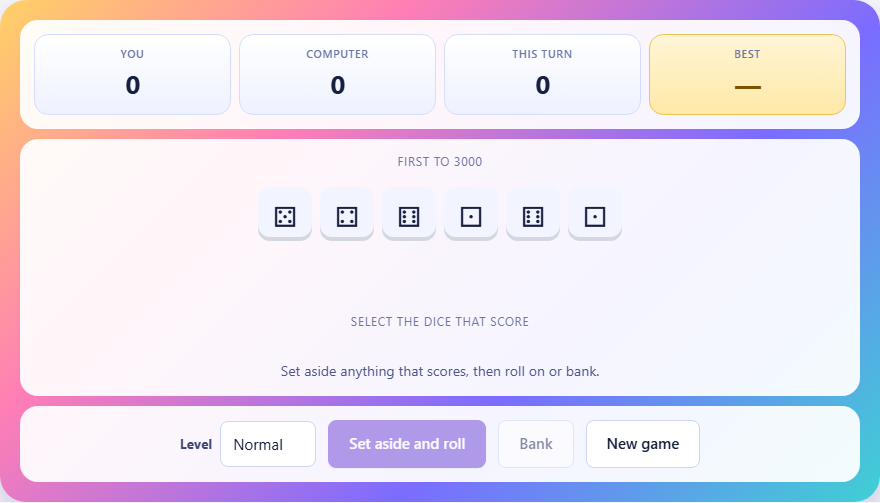
Six dice and a simple bet
Farkle is a push-your-luck dice game played against a computer opponent. You roll six dice, set aside any that score, and then face a choice: roll the rest for more, or bank what you have. If you roll again and nothing scores, the whole turn is lost. That wipeout is called a farkle, and it is the only punishment the game has.
Both you and the computer take turns until one side passes the target score. On Easy the target is two thousand, on Normal it is three thousand, and on Hard it is four thousand. The first to reach it wins outright.
Every way the dice can score
Not every face is worth something on its own. Only ones and fives score by themselves. A single one is worth a hundred points. A single five is worth fifty. The other four faces - two, three, four, and six - score nothing unless they appear in groups.
Three of a kind scores the face value times a hundred. Three twos give you two hundred. Three fours give you four hundred. Three ones are special: they score a thousand rather than one hundred. Four of a kind doubles the three-of-a-kind value. Five of a kind doubles it again. Six of a kind doubles once more.
Two rare combinations use all six dice at once. A straight run from one through six scores fifteen hundred. Three separate pairs also score fifteen hundred. Both are worth watching for, but they happen so seldom that building toward them is rarely a plan.
A turn from start to finish
You roll all six dice. The results land on the board. You tap any dice that score to select them. Selected dice highlight so you can see what you have chosen. The score for your selection appears below the dice.
Every die you select must be part of a valid score. You cannot select a three by itself because a lone three scores nothing. If your selection is not valid, the game tells you so and the roll and bank buttons stay locked.
Once you have a valid selection, two buttons open up. Set aside and roll takes your selected dice off the table, adds their score to the running turn total, and rolls whatever remains. Bank locks in the entire turn total and adds it to your permanent score. Your turn ends and the computer takes over.
Hot dice and the free reset
If you manage to set aside all six dice across one or more rolls in the same turn, something good happens. All six dice come back and you keep rolling with the turn total intact. This is called hot dice.
It does not happen often, but when it does the reward is large. Suppose you have set aside five dice and the last one is a five. That fifty points is small, but taking it means all six dice come back. You now have six fresh dice and whatever you have collected so far. The expected gain from six new dice is far higher than the risk of losing what you had.
The farkle odds that decide everything
The chance of rolling a farkle - a roll where nothing scores at all - changes sharply with how many dice you have left. With six dice the odds of a complete blank are very small. With three dice left, roughly one roll in four produces nothing. With two dice it is close to one in two. With a single die the chance of a blank is two in three, because only a one or a five will score.
These numbers are the entire basis for deciding whether to keep rolling. With four or more dice in your hand, the odds strongly favor rolling again. With three dice, you are still favored but the risk is real. With two dice or one, you are gambling and you need a good reason to do it.
When to bank and when to push
The simplest rule that works well is to bank once you have a decent turn total and three or fewer dice left. Three hundred points with two dice remaining is a reasonable place to stop. Seven hundred points with any number of dice is often enough to bank, unless banking that amount still leaves you far from the target.
The target score changes this calculation. If you need eight hundred to win and your turn total sits at eight hundred, bank immediately. It does not matter that you have five dice left. The win is there and rolling risks losing it.
The computer follows a similar approach. It banks when the risk of losing what it has gathered outweighs the expected gain from one more roll. It also goes all in when the target is within reach in a single turn. You will notice it taking wild risks when it is behind late in the game. That is not a bug. It is playing the only strategy that can still win.
Choosing which dice to keep
Not every scoring die is worth taking. A single five is worth fifty points, but setting it aside costs you one of your remaining dice. If you have four dice left and one of them is a five, keeping it drops you to three dice. Three dice means a one-in-four farkle chance. Sometimes leaving fifty points on the table and rolling four dice instead of three is the better deal.
Ones are almost always worth keeping because they score a hundred each. The only time to think twice is when keeping a one drops you from four dice to three and your turn total is already respectable. But in practice, a hundred points per die is strong enough to justify the cost.
When you roll three of a kind alongside some loose ones and fives, take the three of a kind and think carefully about the loose dice. If the three of a kind uses three of your six dice and you have a stray one and a stray five, taking all five leaves you with a single die. That single die has only a one-in-three chance of scoring. It might be better to take only the three of a kind plus the one, leaving two dice on the table instead of one.
Mistakes that cost games
- Banking too early. A turn total of one hundred and fifty with five dice left is not worth protecting. The odds are heavily in your favor and five dice almost never farkle.
- Taking every five. Fifty points is rarely worth giving up a die. Keep ones, but think before you keep fives.
- Ignoring hot dice. If you have set aside five dice and the sixth one scores, always take it. Getting all six dice back is worth far more than the risk.
- Playing safe when losing. If the computer is about to cross the finish line, banking three hundred points does nothing useful. You need a big turn, and that means pushing further than usual.
- Rolling one die without a reason. A single die farkles two times out of three. The only time to roll one die is when you need a small score to win or when the turn total is so low that losing it costs nothing.
The three difficulty levels
Easy sets the target at two thousand. Games are short and a single hot-dice turn can nearly win it on its own. Normal raises the bar to three thousand, which usually takes several solid turns from each side. Hard pushes to four thousand, where consistency matters more than any single lucky roll.
The computer plays the same way at every level. It does not cheat and it does not peek at your dice. It simply follows its own threshold rule and adjusts for the target. On Hard you will notice it banking more often with moderate totals because reaching four thousand takes more careful accumulation. The level also affects how forgiving a bad start is. On Easy you can recover from an early farkle in a single good turn. On Hard a wasted turn at the wrong moment is difficult to overcome.
Everything stays on your device
The dice rolls, the scoring, and the computer opponent all run inside this page on your own machine. No data leaves your browser. There is no account to create and no server keeping track of your games. Your best score is stored locally in the browser, and closing the tab is all the cleanup there is.