
Capturing whole lines by stepping toward them or stepping away
A thorough guide to Fanorona, the board game from Madagascar where captures work in two directions at once. Covers approach, withdrawal, chain captures, the board layout, compulsory capture, and the positional thinking that keeps your stones alive.
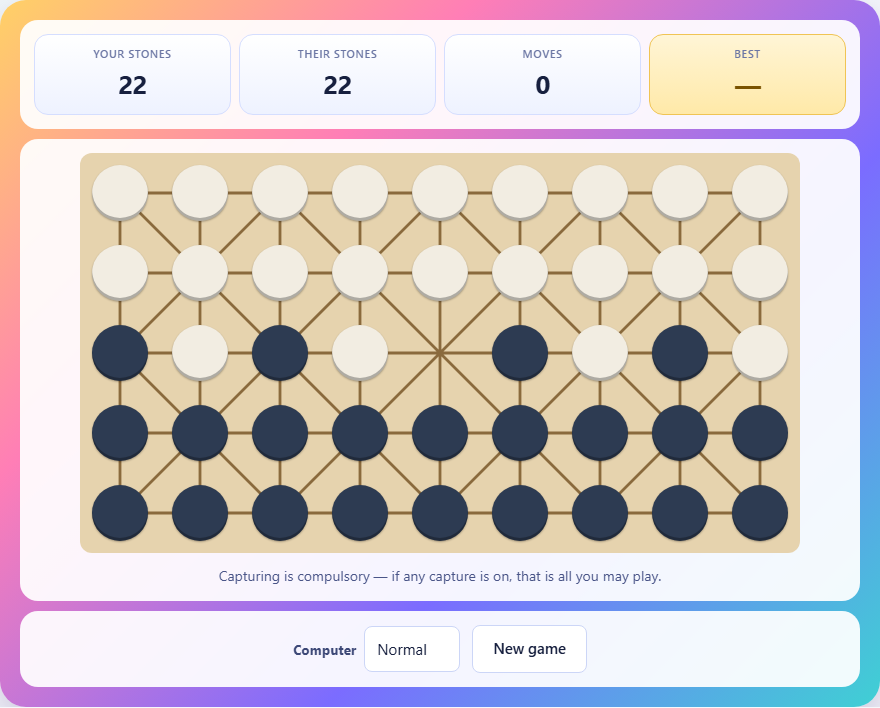
The board and the starting position
Fanorona is played on a nine by five grid of points connected by lines. Twenty-two white stones fill the top two rows. Twenty-two dark stones fill the bottom two rows. The middle row alternates between the two sides, with the centre point left empty. That gives each side exactly twenty-two stones and the board a single gap in the middle.
Not all points connect the same way. Points where the row and column numbers add to an even number sit at the crossing of diagonal lines and have eight neighbours. All other points have only four neighbours, connected by the horizontal and vertical lines only. This means some squares offer more escape routes and attack angles than others.
How movement works
A stone moves one step along a drawn line to an empty point. That is the only kind of move. There is no jumping, no stacking, and no moving more than one step at a time. The lines on the board decide where you can go. If there is no line connecting your point to the one you want, you cannot step there.
Diagonal moves are only possible from the strong points, the ones with eight connections. From a four-connection point you can only go up, down, left or right. This is easy to see on the board because the diagonal lines are drawn between the strong points.
Approach and withdrawal
Capturing is what makes Fanorona unlike any other board game. Nothing jumps over anything. Instead, you capture by stepping in line with a row of enemy stones.
Approach capture happens when you step into the empty point right next to an unbroken line of enemy stones. The direction you moved must be the same direction the enemy line continues. Every stone in that unbroken line is removed at once. If there are four enemy stones in a row and you step toward them, all four come off the board in one move.
Withdrawal capture is the mirror image. If your stone is already touching a line of enemy stones and you step directly away from them, that entire line is removed. You do not need to be facing them at the start. You just need to move in the opposite direction from where they sit.
A single step can sometimes capture in both directions. If enemies sit ahead of you and behind you along the same line, stepping forward would be an approach capture of the ones ahead, and stepping backward would be a withdrawal capture of the ones behind. When this happens, the game asks you which line to take. You cannot take both with one step.
Chain captures
After a capture, the same stone may keep going. It can step in a new direction and capture again, then step again if another capture is available. This chain can remove many stones in a single turn.
The chain has three rules. First, you must change direction from the previous step. You cannot keep walking in a straight line. Second, you cannot return to a point the stone has already stood on during this turn. Third, carrying on is optional. You may press End my turn at any point to stop the chain, even if more captures are available.
Knowing when to stop is important. Taking one more stone might drag your piece to a position where it is surrounded and will be lost next turn. A short chain that leaves your stone safe is better than a long one that leaves it stranded.
Compulsory capture
If any capture is possible anywhere on the board, you must capture. Plain moves are only allowed when no capture exists. The game enforces this by only showing capturing moves when one is available. If you tap a stone that has no capture but another stone does, the game tells you that a capture elsewhere is required.
This rule is not just a formality. It is a tactical weapon. If you arrange the board so that the only capture available to your opponent is a small one that moves their stone to a bad square, they are forced to take it. You can use compulsory capture to pull their stones out of position.
The opening moves are almost always captures, since every stone starts touching an enemy stone. Once the board thins out and some moves are plain slides, compulsory capture becomes the main way to steer your opponent where you want them.
Controls and how to play
Tap one of your stones to select it. The game marks its legal moves. Green dots show where you can step. If captures are available, only capturing destinations appear.
Tap a marked destination to move there. If the step can capture in both directions, two buttons appear asking whether you want the approach capture or the withdrawal capture. Pick one and the stones come off the board.
If a chain capture is possible after your move, the game keeps your stone selected and shows the next set of legal destinations. An End my turn button appears at the bottom. Tap it to stop the chain and let the computer play.
The computer dropdown offers three levels. Gentle plays carelessly and often misses good chains. Normal plays solid moves and looks one step ahead. Sharp evaluates every chain, considers what you can do in reply, and steers toward the strong points on the board.
Strong points and why they matter
A stone on a strong point, where diagonals cross, has eight neighbours. That means eight possible directions to attack from or escape to. A stone on a weak point has only four. All else being equal, a stone on a strong point is twice as useful.
In the opening, the board is packed and movement options are limited. But as stones come off and the board opens up, the difference between strong and weak points grows. A stone on a strong point in the middle of the board can threaten captures in many directions. A stone stuck on a weak point near the edge has few options and is easy to trap.
When you have a choice of where to end a chain, prefer a strong point. When you have a choice of which stone to move, prefer the one that ends up on a strong point. Over many turns, this small advantage adds up.
Watch the computer on Sharp difficulty. It actively steers its stones toward strong points and punishes yours when they land on weak ones. Copying that habit is the fastest way to improve.
Withdrawal captures catch beginners off guard
New players focus on approach captures because they are the more natural idea. You walk toward the enemy and they fall. But withdrawal captures are just as common and often more surprising.
A stone sitting quietly next to an enemy line can remove that entire line simply by backing off in the opposite direction. Because the eye follows attacking motion, withdrawal captures are the ones people miss when scanning the board.
Train yourself to check both directions for every move. Before you step forward to approach a line ahead of you, look behind. Is there a line behind you that would be taken by withdrawal if you moved the other way? Sometimes the withdrawal capture is larger, and sometimes it leads to a better chain.
Mistakes that cost stones
- Continuing a chain into a trapped position. Just because you can take one more stone does not mean you should. Check where you will end up.
- Forgetting compulsory capture. If you want to move a specific stone but a capture exists elsewhere, you cannot. Plan around this rule instead of fighting it.
- Ignoring withdrawal threats. If your stones sit in a line and the opponent has a stone touching the end of that line, a single backward step removes them all.
- Clustering on weak points. Stones with only four connections are easier to trap and less flexible in attack.
- Taking the bigger capture when the smaller one leaves you in a better position. Greed loses games when the board opens up and position matters more than material.
Nothing leaves your device
The game runs entirely in your browser. The board state, the computer's thinking, and your move history all stay on your machine. There is no server involved and no data is sent anywhere. Once the page has loaded, it works without an internet connection. Your best score is kept in your browser's local storage and never shared.