
Bidding, bowers, and the trick-taking game where five cards are all you get
Everything you need to know to play Euchre well, from the twenty-four card deck through the bower system to the scoring that rewards boldness and punishes thin bids. Covers the bidding rounds, trick play, going alone, and how to read your five cards before committing to a trump suit.
How a card is scored the moment a trick is judged
Inside the game every card is just a number from 0 to 23. The suit is that number split into blocks of six, and the rank is what is left over. Spades are 0 to 5, hearts 6 to 11, diamonds 12 to 17, and clubs 18 to 23. Inside each block the order runs nine, ten, Jack, Queen, King, Ace, so a nine has rank 0 and an Ace has rank 5.
Before any two cards are compared, each one is asked a single question about its suit. Is it a Jack, and is it the Jack of the colour that matches trump? Spades pair with clubs, and hearts pair with diamonds. If both are true, the card reports the trump suit and never its printed suit. That one step is used for what you may legally play, for which suit was led, and for who takes the trick. Because it lives in one place, the left bower cannot drift back to its old suit halfway through a hand.
Then each card gets a strength value. A card that is not trump keeps its plain rank, so a nine is 0 and an Ace is 5. Trumps are lifted far clear of that. The right bower is 100. The left bower is 99. Any other trump is 90 plus its rank, which makes the nine of trump 90 and the Ace of trump 95. The gap is wide on purpose, so a high plain card can never be muddled with a low trump.
Two rules then settle the trick. A trump beats anything that is not trump. Two cards of the same suit go by the bigger value. A card of some third suit can never win, because it matches neither the led suit nor trump. When a player is going alone, the trick is finished after three cards rather than four, since the sitting partner never plays.
Follow one trick right through, with spades as trump.
- You lead the Ace of hearts. It is not trump, so its value is 5.
- The next player follows with the nine of hearts, value 0. The Ace is still ahead.
- The third player holds no hearts and drops the Jack of clubs. Here that Jack is a spade, so its value is 99 and it takes the lead.
- The last player plays the Jack of spades, value 100, and wins the trick.
- Now change one thing. You hold the Jack of clubs and no other club. When a club is led, the game looks for clubs in your hand and finds none, so every card you hold is legal.
What the robot seats add up, and what they never notice
A computer player weighs a suit with a short tally over its five cards. The right bower is worth 5. The left bower is worth 4. Any other trump is worth 2, and that 2 becomes 3 if the card is a King or an Ace. Outside trump only two cards count for anything: an Ace adds 1.5 and a King adds 0.5. A plain Queen, Jack, ten or nine adds nothing at all.
The tally is then set against a bar that moves with the Opponents setting. The bar is 7.5 less one and a half times a skill number, and the three skill numbers are 0.35 for Loose, 0.7 for Steady, and 1 for Sharp. So the bar sits near 6.98 on Loose, 6.45 on Steady, and exactly 6 on Sharp. In the first round the dealer counts the turned card as part of its hand, because the dealer would be picking it up.
Clearing the bar is only half of it. A second roll decides whether the bid is really made, and that chance is 0.15 plus 0.85 times the skill number. It works out at about 45% on Loose, about 75% on Steady, and a sure thing on Sharp. When a bot does call, a separate roll of 0.06 times skill sends it alone: about 2% of calls on Loose, 4% on Steady, and 6% on Sharp.
Here is a full count. Say the suit being weighed is spades, and the hand holds the Jack of spades, the Jack of clubs, the Ace of spades, the King of hearts and the nine of diamonds. The Jack of spades is the right bower, so 5. The Jack of clubs is the left bower, so 4. The Ace of spades is a trump and an Ace, which is 2 plus 1, so 3. The King of hearts is a plain King, so 0.5. The nine of diamonds is worth nothing. The total comes to 12.5. That is well past every bar, and a Sharp seat holding it calls spades every time.
In play the bots are plain. Leading, they play their best card. If their partner is already winning, or nothing in hand can beat the trick, they throw their cheapest. Otherwise they win with the smallest card that does the job. Trumps carry a bonus of 50 in that cheapest-card sum, so a seat that is throwing away gives up a plain card before it parts with any trump. A share of every choice is skipped as well: if a random draw comes out above the skill number times 0.9, the seat picks any legal card instead. That is about 68% of plays on Loose, 37% on Steady, and 10% on Sharp. Even Sharp throws one card in ten away.
If nobody bids after two rounds, the dealer is made to choose, and the same tally picks the strongest of the three suits still allowed. So every deal is played out and no hand is thrown in. The rest of the list is what these seats do not do, which is worth knowing before you read too much into their play.
- Nothing is remembered. No seat tracks the cards already played, so a bot cannot work out that the right bower is still loose.
- The bidding tells them nothing either. A bot never reasons that the player who ordered up must be holding strength.
- Shape is ignored. The tally adds up single cards, so being short in a side suit, which is a real advantage at a table, counts for zero here.
- The dealer's throwaway after taking the turned card is simply the lowest card by rank, with trumps pushed out of reach. It never tries to empty a suit on purpose.
- Three cards are never dealt. Twenty go to the players and one is turned face up, so the last three sit out the hand.
- The target is ten points at all three settings. Only the bidding bar, the two rolls, and the random-play rate change with it.
- This is one common rule set. There is no lone defence, no call worth six, and no way to play to a different total.
- One freak corner: when a computer dealer is forced to name a suit and its hand tallies zero in all three suits still allowed, the fallback pick is spades, even in the odd case where spades was the suit just turned down. It needs that dealer to hold five spades with no Jack among them, so you may never meet it.
The deck and the deal
Euchre uses twenty-four cards. Each suit holds six ranks: nine, ten, Jack, Queen, King, and Ace. Four players sit around the table in two partnerships. You and the player across from you are partners. The other two are the opposing team.
Everyone gets five cards. One more card is turned face up in the middle. That card is the starting point for the bidding round, because its suit is the first candidate for trumps. The dealer rotates each hand, and bidding always starts with the player to the dealer's left.
How the bowers work
The bower system is what makes Euchre different from every other trick game. The Jack of the trump suit is the right bower. It beats every other card in the game, including the Ace of trump. The Jack of the other suit of the same colour is the left bower. It is the second strongest card, and for the entire hand it counts as a trump, not as its printed suit.
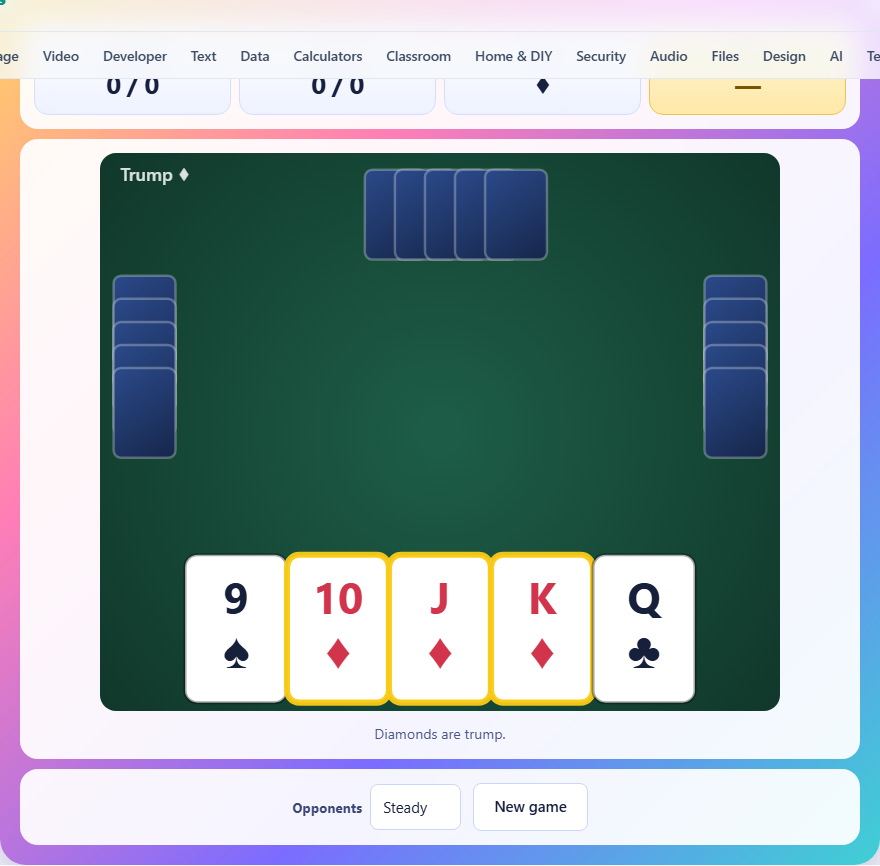
If hearts are trumps, the Jack of hearts is the right bower and the Jack of diamonds is the left bower. The Jack of diamonds is now a heart. If someone leads it, hearts were led. If you hold it and no other diamond, you have no diamonds at all and may throw anything when diamonds are led.
This means there are seven trumps, not six. The six cards of the trump suit plus the Jack that crossed over from the matching colour. Players who count only six are the ones caught off guard when a seventh trump appears in someone else's hand.
The two rounds of bidding
In the first round, each player looks at the turned-up card and decides whether to order up its suit as trump. If you order it up, the dealer takes the turned card into their hand and discards one card. The suit of the turned card is now trump and your side has committed to winning at least three tricks.
If everyone passes in the first round, the turned card is set aside and a second round begins. Now each player may name any suit except the one that was just turned down. The bidding goes around the table. If it reaches the dealer again and everyone has passed twice, the dealer must pick a suit. A hand is always played.
When you are the one who calls trump, your side is the maker. You have promised to take three of the five tricks. Fall short and the other side scores two points for euchring you.
Playing the tricks
The player to the dealer's left leads the first trick. Each player in turn plays one card. You must follow the suit that was led if you can. If you cannot follow suit, you may play anything, including a trump.
The highest trump played wins the trick. If no trump was played, the highest card of the suit that was led wins. The winner of each trick leads the next one. Cards you cannot legally play are greyed out on screen, so you always know which cards are allowed.
Tap a card in your hand to play it. The game draws the cards played by all four players in the centre of the table, and a moment after the trick is complete the winner is determined and the next trick begins.
Scoring and what it means to get euchred
Take three or four tricks and the maker's side scores one point. Take all five and the score is two. Go alone and take all five, and the score jumps to four.
But call trump and take fewer than three, and you have been euchred. The other side scores two points. This is why calling trump on a weak hand is dangerous. One point for making it is a small gain, but two points to the other side for failing is a large loss.
The game is played to ten points. Whoever reaches ten first wins. The stats bar shows both scores, the current trick count, and the trump suit.
Going alone
Before confirming your bid, you can check the Go alone box. Your partner sits the hand out entirely and you play three-handed. If you sweep all five tricks alone, the reward is four points instead of two.
This is a high-risk, high-reward play. With both bowers and the Ace of trump, the odds are decent. You can lead your top trumps, clear out opposition, and run the table. But with anything less, losing one trick means you only score one point, the same as a normal bid, and losing two means the other side gets their euchre bonus.
The computer players occasionally go alone too. When they do, their partner is shown with faded cards and does not play.
Counting trumps and knowing what is out
There are seven trumps in every hand. You can see your own five cards and the turned-up card. That is six pieces of information before a single trick is played. If three of your five cards are trumps and the turned card is a trump, you know four of the seven. Only three are unaccounted for.
As tricks are played, watch what falls. If the right bower has not appeared by trick three, someone is holding it back. If the left bower was played early to win a small trick, it is gone and cannot threaten you later.
On the hard difficulty the computer plays sharply and counts trumps well. On the easy setting it bids loosely and sometimes plays random cards, which makes it more forgiving while you learn the rules.
What to bid on and what to pass
Count your trumps, not your high cards. Three trumps and an outside Ace is a reasonable bid. Four Aces and no trump is not. Trumps win tricks. High cards in plain suits only win if nobody trumps them.
In the first round, if you are the dealer, ordering up gives you the turned card. You will have six cards and must throw one away. Throw the weakest non-trump. That exchange improves your hand, so the dealer can sometimes accept a weaker trump holding than the other players would need.
In the second round, look at which suits you are strong in. If you hold the Jack and Ace of a suit that was not turned down, naming that suit gives you the two best trumps. That is nearly always enough to take three.
Do not beat your partner
When your partner is already winning the trick, throw your lowest card. Every trump you spend beating your own partner is one you do not have later when the opponents lead.
This is the most common mistake in partnership trick-taking games. You hold the King of trump, your partner has already played the Ace of trump, and nobody else has played yet. Playing the King does nothing useful. Your partner is already winning. Save the King for a trick where it matters.
The only exception is when dumping a specific card gives your partner information, but at the level most people play, simply holding back is almost always better. Trumps are scarce in a seven-trump game. Wasting even one on a trick your side already has is a mistake that compounds over the course of a full game.
Three difficulty levels
The Opponents dropdown offers Loose, Steady, and Sharp. Loose opponents bid on weak hands, sometimes play randomly, and rarely go alone. Steady opponents bid on reasonable hands and usually find the right card to play. Sharp opponents count trumps, lead their strongest cards, and go alone when the hand is strong.
All three levels play to ten points. The difficulty changes the computer's decision-making, not the rules. Start on Loose to learn how the bowers move and how tricks flow, then move to Steady once you feel comfortable.
On Sharp, the opponents rarely let a bad bid through and will punish your weak calls with euchres. Beating them consistently takes real card sense and careful trump management.
Everything happens in your browser
The whole game runs on your own device. No cards are dealt on a server and no score is sent anywhere. Your best result is stored in your browser's local storage on this machine only. Once the page loads, the game works offline. There is no account and nothing to sign up for.