
How to play and win at the Russian card game where losing is the only score
A full walkthrough of Durak, the card game where you do not try to win but try not to be the last one holding cards. Covers every rule, every control, the trump system, and the defensive thinking that separates a survivor from the fool.
The sorting rule behind every card the opponent plays
Inside the code a card is just a suit and a number. The jack counts as 11, the queen 12, the king 13 and the ace 14, and the sixes count as 6. Four suits with nine ranks each gives the pack of 36. The shuffle walks the pack from the back, swapping each card with a random card at or before it. Then six cards go to you and six to the opponent, one at a time, so the stock starts at 24.
The trump card sits at the front of the shuffled pack, and every draw comes off the back. That means it never moves until the stock is down to one card. Whoever draws last gets it.
Who opens is settled by trumps. Each hand is checked for its lowest trump. A hand with no trump at all is scored as 99, so it always loses that check. The smaller number attacks. When both come back 99, which is the only way the two can tie, the opening attack is yours.
Beating a card is two tests and nothing else. Same suit, and your number must be bigger. Different suit, and your card must be a trump while the attack card is not. So a trump attack can only be met by a bigger trump, and a plain card from a third suit is never an answer.
Adding a card to an attack that is already running is three tests. The table may not hold six attack cards yet. The cards lying unbeaten must number fewer than the cards in the defender's hand. And the new card's rank must already show on the table, counting beaten cards and beating cards alike. The first card of a round skips all three, which is why anything can open.
The opponent ranks its cards the same way for both of its jobs: trumps go to the back of the list, then the rest run from low number to high. Suits are ignored in that order. To attack it takes the top card of the list, so it leads its smallest plain card. To defend it builds the list of cards that legally beat the attack and again takes the top, so it spends the cheapest card that works and only reaches for a trump when no plain card can do the job.
One brake sits on top of that. If the stock is empty, the attack card is a plain card, and the trump it was about to spend is the only trump left in its hand, it picks up the whole table instead. Holding two trumps switches the brake off, and it plays the lower one.
Here is a deal followed all the way through. Clubs are trumps. The opponent holds the six of diamonds, seven of spades, nine of hearts, king of spades, eight of clubs and jack of clubs. Its lowest trump is the eight of clubs, worth 8. Say your lowest trump is the queen of clubs, worth 12. Since 8 is under 12, the opponent leads.
Its sorted list reads six of diamonds, seven of spades, nine of hearts, king of spades, then the two clubs at the back. It leads the six of diamonds. You beat it with the eight of diamonds. Now only ranks 6 and 8 may be added, and the one card in its hand with either rank is the eight of clubs. So it attacks with a trump. The habit of holding trumps back only orders the legal cards, it never rules one out.
You beat the eight of clubs with the queen of clubs, since 12 tops 8 in the same suit. The table now shows ranks 6, 8 and 12. Its four remaining cards are the seven, nine, king and jack, worth 7, 9, 13 and 11, and none of those match. The attack is finished, the four table cards are thrown away, and you attack next. Both hands are down to four and both fill back up to six, which takes four cards out of the stock and drops it from 24 to 20. The count still works: 12 cards in hands, 20 in the stock, 4 in the discard, 36 in all.
Where this Durak stops short, and what the Best number counts
The opponent cannot see your cards. Its two choices read its own hand, the table, and how many cards are left in the stock. Your hand reaches it as a bare number, used only to work out how many unbeaten cards it is allowed to leave in front of you. It also keeps no record of the cards already played, so it will never work out that a suit is exhausted or that you are out of trumps. Every clever read you make is one it cannot make back.
Several moves from the wider family of Durak rules are simply not here. A defender can beat a card or pick up, and that is all: there is no bouncing the attack back by matching the rank of the attack card. There is no partner and no third player. The cap is six attack cards in a round, so twelve cards is the most that can ever sit on the table. Picking up is all or nothing, never a part of the pile.
When you defend, the game answers the leftmost unbeaten pair first. You do not choose which attack to take on. With one card facing you that changes nothing, but with three waiting it can: the cheap card in your hand may suit a pair further along the row, and you will have to spend on the front one first.
The line above the table gives you the trump suit and the size of the stock. It does not show the face of the trump card, so the card waiting at the bottom stays a secret until somebody draws it. The Deck menu holds a single entry, thirty-six cards, and picking it again just deals afresh. There is no skill setting either. The opponent's pauses are fixed lengths between four tenths and seven tenths of a second, whatever the state of the game.
The Best figure is a card count, and a smaller count is treated as better. Win, and it stores the cards still in the opponent's hand. Lose, and it stores the cards still in yours. The rare draw, where both hands empty on the same round, stores zero, and nothing can beat zero. So a Best of 1 might be a game you won by a mile or a game you lost by one card. The number is only written when a game truly ends, and it lives in your own browser's storage under the name orchidlines-best-durak. Clear your site data and it is gone.
An ending is only looked for once the stock is empty, and only at the close of a round or right after a pick up. While cards remain in the stock, an empty hand means nothing at all. You draw straight back up to six and carry on.
- Nothing is carried from one deal to the next. Each game stands alone, and there is no match score.
- The trump brake only guards defence. Leading a trump is fine by the code whenever that is the only rank it can add.
- The order of your own hand on screen puts trumps last, then groups by suit and runs low to high. The opponent's list is not grouped by suit at all.
- Cards are mixed with the browser's ordinary random number generator. That is plenty for a card game and is not built for anything that needs serious randomness.
- Bluffing, hesitation and table talk are a real part of Durak between people. None of that is modelled here.
What makes this game different
Most card games end when somebody wins. Durak ends when somebody loses. Play goes on until one person is left holding cards, and that person is the durak, the fool. Everybody else is simply safe.
This changes the whole feel of the game. Building a huge hand of powerful trumps is pointless once you are no longer in danger. You only need to last long enough to go out. The moment your hand is empty and the deck is gone, you are done. Whether the remaining player has one card or ten makes no difference to your result.
The version here uses the traditional thirty-six card deck, which is aces down to sixes in four suits. Each player starts with six cards, and the suit of the bottom card in the deck is trumps for the entire game.
The attack and defence cycle
Every round has an attacker and a defender. The attacker plays any card from their hand to open the round. The defender must then beat that card. A card is beaten by a higher card of the same suit, or by any trump when the attack card is not a trump, or by a higher trump when it is.
Say spades are trumps and the attacker plays the eight of hearts. The defender could beat it with the nine of hearts, the king of hearts, or even the six of spades, because any trump beats any plain card. But the seven of diamonds would not work because it is neither the same suit nor a trump.
Once the attack card is beaten, the attacker may add another card, but only if its rank already appears on the table. If the attacker played an eight and the defender beat it with a queen, the attacker can now add another eight or another queen. Each new card must also be beaten. The defender must never have more unbeaten cards on the table than cards left in their hand.
If the defender beats everything, the attacker may press Pass to end the round. All the cards on the table are thrown away and the defender becomes the next attacker. If the defender cannot beat a card, or chooses not to, they press Pick up and take every card from the table into their hand. They lose their next turn to attack.
Controls and what you see on screen
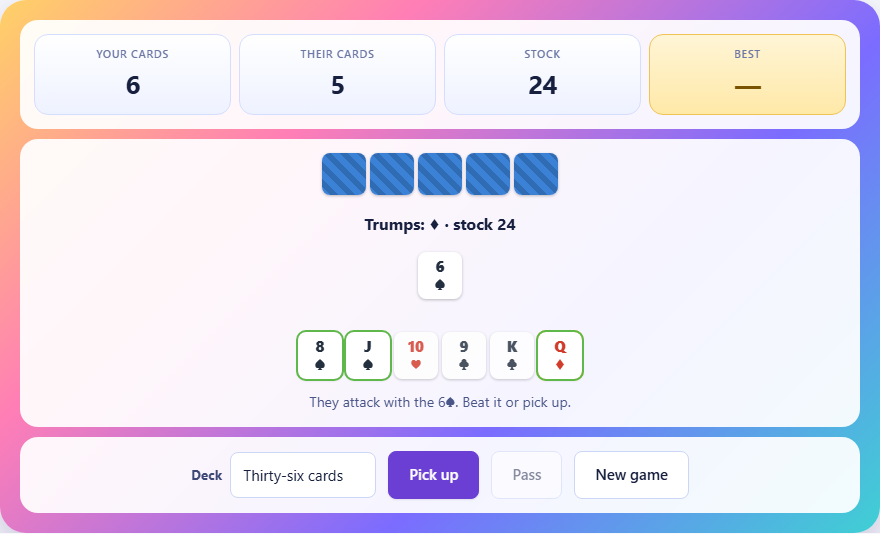
Your cards sit along the bottom of the screen. The opponent's cards appear face down at the top. The table is the space between them, where paired attack and defence cards appear during a round. A line below the table shows which suit is trumps and how many cards remain in the stock.
When it is your turn to attack, tap one of your cards to play it onto the table. Cards you can legally play are highlighted. When defending, tap a card that beats the current attack. Cards that cannot beat it are dimmed.
Two buttons sit below the play area. Pick up takes every card from the table into your hand when you are defending and cannot or will not beat an attack. Pass ends your attack when all cards on the table have been beaten and you have nothing more to add. The New game button starts a fresh deal.
Refilling and the endgame
After each round, both players draw from the stock until they hold six cards again. The attacker draws first. This matters when only a few cards remain, because the attacker may take the last ones and leave the defender with nothing to draw.
Once the stock is empty, no more cards come in. From this point on, every card you spend defending is one you will not get back. The game now becomes a race to empty your hand. The first player to play or defend away their last card is safe. The other player is the fool.
A draw is possible but rare. It happens when both players go out on the same round, which requires both to play their last cards during the same exchange. The game recognises this and reports it.
Why trumps are everything
There are nine trumps in a thirty-six card deck. They are the only cards that can beat an attack in a suit you do not hold, and in the late game they are your only reliable defence.
Early on, you have the stock to fall back on. Picking up a couple of low cards is cheaper than burning a trump to save a six. The stock refills your hand, so the cost of picking up is just a few extra cards, not the loss of your best weapon.
But after the stock runs out, every trump you have already spent is gone for good. If the opponent attacks with a suit you cannot follow, only a trump saves you. Players who spent their trumps early defending minor attacks are the ones who sit helpless while the opponent feeds them card after card in the final rounds.
Attacking well
Attack with your lowest plain cards first. A six of diamonds is useless in your hand at the end of the game, but it forces the defender to spend something better. If they beat your six with their ten, you have traded up.
Pay attention to what ranks are already on the table. When you beat a seven with your queen, the attacker can now add any seven or any queen. If you hold several sevens, the attacker may pile them on and overwhelm the defender with volume.
Do not attack with trumps unless you are certain the defender has none left. A trump attack that gets beaten costs you a trump, and you get nothing in return except one fewer card in the opponent's hand. If they still have trumps, they will beat yours and you will have wasted your best resource.
Defending without waste
The cheapest card that works is almost always the right answer. If the attack is the seven of hearts and you hold the eight and the king of hearts, use the eight. The king might be needed later when the eight would not have helped.
Sometimes picking up is correct. Early in the game, when the stock is still thick, taking two or three low cards costs you almost nothing. You draw back up to six anyway, and you kept your trumps intact. Stubborn defence that spends a trump to block a minor attack is more expensive than it looks.
Count the trumps you have seen. There are only nine in the whole deck. If you have seen seven already and hold the other two, you know the opponent has none. That knowledge tells you whether to defend aggressively or to give up a round that cannot be held.
Mistakes that cost the game
- Spending a trump to beat a six. The six was not dangerous. The trump was.
- Refusing to pick up early. When the stock is full, picking up a few cards is cheap. When the stock is empty, every card in your hand is a liability.
- Attacking with high cards. A king thrown at the defender forces out nothing valuable. Attack with sixes and sevens to drain their low cards first.
- Ignoring what ranks are on the table. The attacker can only add cards of a rank already showing. If you defend with a king, you have just made every king in the attacker's hand playable.
- Forgetting the stock refills the attacker first. When only one or two cards remain in the stock, the attacker draws first and may take them all, leaving you short.
The first attacker and who decides
The player with the lowest trump attacks first. This is the traditional starting rule, and the game follows it exactly. If you hold the six of trumps and the opponent holds the seven, you go first.
Going first is a mild advantage. You set the pace and choose the suit of the opening attack. But it also means you are the first to spend a card, and if the defender beats it cleanly and attacks you back, you are now defending before you expected to.
Everything stays in your browser
The entire game runs inside this page on your own device. No cards are dealt on a server. No score leaves your machine. The page works the same with or without an internet connection once it has loaded, because there is nothing on the other end of the wire that matters to the game.