
Finding the mixture your opponent cannot punish
How to read a payoff table, why committing to one move always fails, what it means to balance the counters, and the theorem that says the right mixture exists for every table the puzzle can show you.
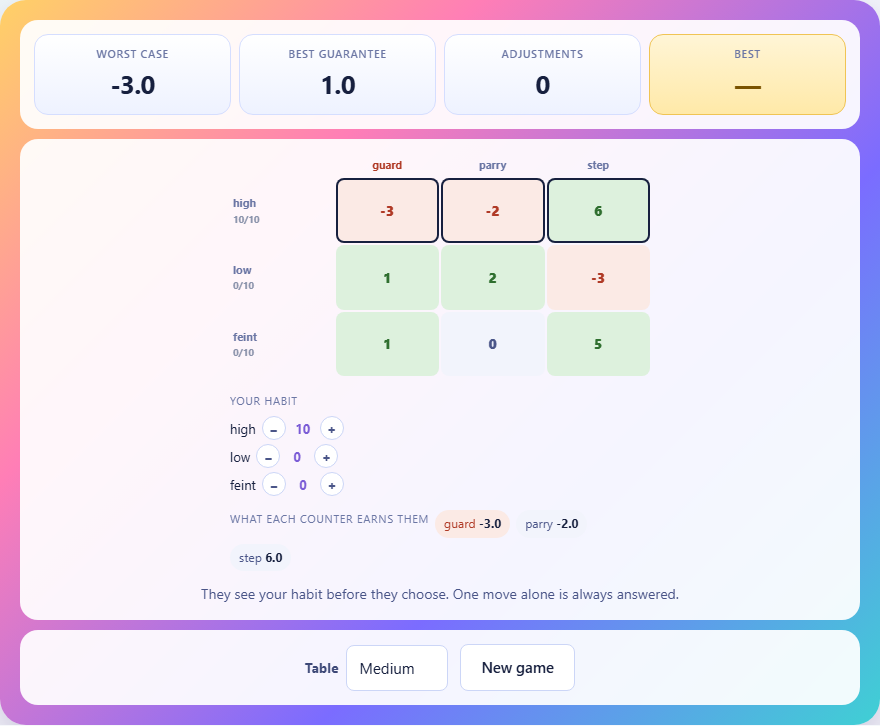
What the table means
The board shows a table of numbers. Your moves are listed down the side. The opponent's counters are listed across the top. Each cell holds a number that says what the exchange is worth to you when you play that move and they play that counter. A positive number is good for you. A negative number costs you. Zero means the exchange was a wash.
You do not pick a single move. You pick a habit, a plan that says how often out of ten you would play each move. Then the opponent sees your plan and picks whichever counter earns them the most. Your score is the worst case, the lowest number across all their possible counters. The puzzle asks you to make that worst case as high as it can go.
Why a single move loses
Try putting all ten parts on one move. Look at the row for that move and find the smallest number. That is what the opponent will answer with, because it hurts you the most. Now try a different move and do the same. On every table served here, the best single move does worse than the best mixture. That is by design. Tables where one move already beats everything are filtered out, because they have nothing to teach.
The reason is simple. When you commit to one move, the opponent knows exactly what is coming and picks the perfect answer. When you mix two or more moves, no single counter answers both at once. The opponent is stuck choosing the lesser evil, and your worst case climbs.
Controls and how to adjust the mix
Each move has a minus button and a plus button beside it, with the current share in between. The share is a number from zero to ten. All the shares must add up to exactly ten. If you try to push the total above ten, the game stops you with a message.
Below the table sits a row showing what each counter would earn against your current habit. The worst counter is highlighted in red. That red number is your score. Your job is to raise it.
The stats bar shows three numbers. Worst case is the red number. Best guarantee is the highest worst case any mixture can achieve, which is the target you are trying to reach. Adjustments counts how many times you have pressed a plus or minus button. Your best score is the fewest adjustments needed to solve the table.
Table sizes
The Small table is two moves against two counters. With only four cells it is easy to read and you can often solve it in a few taps by sliding weight between the two moves until the two counter values match. This is the best place to learn the feel of balancing.
The Medium table is three by three. Now you have three moves to distribute weight among and three counters to worry about. Some of those moves may deserve zero parts, meaning they are too weak to include in the mixture at all. Figuring out which moves to drop is part of the puzzle.
The Large table is three moves against four counters. More counters means more lines to balance, and the red highlight can jump around as you adjust. The target is still reachable in tenths, but finding it takes more deliberate reasoning.
The equalising signal
When you have found the right mixture, the counters that the opponent would actually choose all earn exactly the same amount. Look at the row of counter values below the table. If one counter stands out as worse than the others, the red highlight sits on it and your score is low. Shift weight away from whatever that counter punishes and toward whatever makes it less effective.
You are getting close when the two or three lowest counter values start converging. They do not all have to be equal. Only the counters the opponent would use have to match. Some counters might score higher than the target, but the opponent would never pick those because they are better for you. Ignore them.
On a two by two table the signal is clean. Adjust until both counters show the same number and you are done. On a three by three or three by four table, two or three counters will match at the bottom while one or two sit higher and do not matter.
Working through a small table
Suppose the table shows two moves and two counters. Your first move earns you three against counter one and minus two against counter two. Your second move earns you minus one against counter one and four against counter two. All ten parts start on move one, giving counter values of three and minus two. The worst case is minus two, which is terrible.
Slide one part from move one to move two. The mix is now nine and one. Counter one is nine times three plus one times minus one, divided by ten, which is two point six. Counter two is nine times minus two plus one times four, divided by ten, which is minus one point four. The worst case rose from minus two to minus one point four. Progress.
Keep sliding. At seven parts on move one and three on move two, counter one is one point eight and counter two is minus zero point two. At five and five, both counters are one. That is the match. Your worst case is one, and no other split does better.
Dropping a move entirely
On a three by three table, one move is sometimes dominated. A move is dominated when another move beats it against every counter. If move one earns more than move three against counter one, and more against counter two, and more against counter three, then move three is never worth including. Give it zero parts and work with the other two.
Not every weak move is dominated in the strict sense. A move might lose to one counter badly but win against another. It could still belong in the mixture if the winning column is the one you need to balance. The test is whether including it raises your worst case or not. Try it and see.
Setting a move to zero is a legitimate answer. The puzzle marks it correct if the overall worst case hits the target, regardless of how many moves carry zero weight.
When the target is negative
Not every table favours you. Some tables are stacked so that the opponent has an advantage no matter what you do. In those cases the best guarantee is a negative number. Your job is not to win but to lose as slowly as possible.
A negative target is still solvable. The same method applies. Adjust the shares until the counters line up and the worst case matches the target. The fact that the target is negative does not change the logic, only the outcome it describes.
Look at the best guarantee number in the stats bar before you start tapping. If it is negative, you know from the beginning that the table is opponent-favoured. That saves you the frustration of chasing a positive number that does not exist.
Mistakes that waste adjustments
- Trying every combination at random instead of reading the counter values. Each tap costs an adjustment. Watch the red number and move toward the side that raises it.
- Ignoring the counter values that are above your worst case. They do not matter. Focus only on the lowest one or two and bring them up.
- Thinking that a move with a big positive number in one cell must carry weight. That cell might sit in a column the opponent never picks. A big number in the wrong column does nothing for you.
- Giving all moves equal weight as a starting point. Equal weight is almost never the answer. Start with all ten on the best single move and then slide from there.
- Not reading the column labels. Each column is a different counter. When the red highlight jumps to a new column, the opponent has switched to a different answer because your last adjustment made the old one less appealing.
All the arithmetic happens here
The payoff table is generated on your device. The code checks that the best mixture from your side and the best mixture from the opponent's side meet at the same number, confirming the minimax theorem holds on tenths. No table is served until both sides agree. Nothing about your play is sent anywhere. Your best score is stored in this browser and nowhere else.