
Draw to 21: reading the table hand and picking your moment to stop
Draw to 21 is a card game for one player against a fixed set of rules. Six packs are shuffled together into one pile. You get two cards, the table hand gets two, and you keep drawing until you are happy with your total or you go past 21. A match is a run of rounds, and the side that takes more of them wins it. This guide covers what the cards are worth, how a single round unfolds, which totals decide themselves, how to read the one card you can see, and where new players give rounds away without noticing.
What each card is worth
A number card is worth the number printed on it. A five counts five. A nine counts nine. The jack, queen and king each count ten, so sixteen cards in every pack are worth ten. That is why ten is the value you should expect more than any other.
The ace is the odd one out. It counts eleven while eleven fits, and it drops to one as soon as eleven would carry you past 21. Nothing is decided when the ace arrives; the count simply changes as your hand grows. A hand holding an ace that still counts eleven is called soft. Any other hand is called hard, and that difference matters a great deal once you start choosing whether to draw.
How one round unfolds
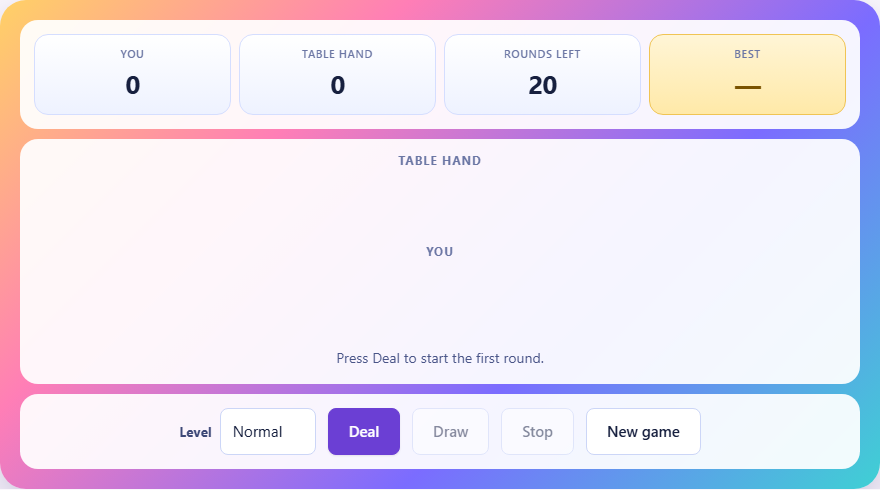
Press Deal. Two cards land in front of you, both face up. Two more go to the table hand, and the second of those stays face down until your turn is over. Your running total sits under your cards, with the word soft beside it while your ace is still counting eleven.
Now you choose. Draw takes one more card, and you may keep drawing as long as you like. Stop ends your turn. Once you stop, the hidden card turns over and the table hand plays itself out a card at a time. Then the two totals are compared. The one nearer 21 takes the round. If they match, neither side takes it and the round is a tie.
The rule the table hand never breaks
The table hand has exactly one rule: draw while the total is under 17, stop at 17 or more. It does not look at your cards. It does not press harder when it is behind or play safe when it is ahead. It just follows the count.
This is good news, because it means you can always work out roughly what is coming. A table hand showing a six has to keep climbing until it reaches at least 17, and plenty of those climbs end past 21. A table hand showing a king is probably one card away from stopping. You cannot see the hidden card, but you can see the rule, and the rule tells you most of what you need to know.
Going past 21 is the expensive mistake
Going past 21 does not simply lose you the round. It loses the round before the table hand has played a single card. On some of those rounds the table hand would have gone past 21 as well, and you would have taken the round without lifting a finger. Draw one card too many and you throw all of those rounds away.
That is the whole reason the game leans very slightly against you, and it is the one habit worth building first. Whenever you are tempted to draw on a total in the high teens, remember that stopping keeps you in the round even when your total is poor. A weak total that survives can still win. A total of 23 never wins anything.
Totals that decide themselves
Some totals need no thought at all. On 11 or less, always draw. No card in the pack can carry you past 21 from there, because an ace would simply count one. You are being handed a free look at another card, so take it.
On a hard 17 or more, always stop. Count the ranks from 17: only an ace, a two, a three or a four leaves you standing. That is four ranks out of thirteen. The other nine send you past 21. Those numbers do not shift because you have lost three rounds in a row. Learn these two edges of the range first and a large slice of your decisions is made for you before you even sit down.
Reading the one card you can see
Everything between 12 and 16 is where the game is really played, and the face-up card is what decides it. Split the ranks in two. A two, three, four, five or six is a weak card. A seven, eight, nine, ten, picture card or ace is a strong one.
Against a weak card, stop. The table hand is starting low and must climb all the way to 17, and it will often overshoot on the way. Let it. Against a strong card, draw. A table hand starting from a nine is heading for 19 or 20, and your 14 will not beat that if you leave it where it is. Drawing feels risky, and it is, but sitting still and losing anyway is worse.
Soft hands and the free card
A soft hand is one where your ace still counts eleven. Soft 17 is an ace and a six. Draw a nine on that and you do not go past 21; the ace quietly drops to one and you land on 16. That is the whole trick.
Because the very next card can never end the round badly, a soft hand is worth pushing further than a hard one of the same size. Stopping on soft 17 is timid, since 17 rarely wins a round on its own and the extra card costs you nothing. Once the ace has dropped to one, the hand is hard again and the ordinary rules take over. Watch the word soft under your cards, because it vanishes the moment that shelter is gone.
Picking a match length
The Level menu sets how long the match runs. Easy is ten rounds, Normal is twenty and Hard is thirty. Nothing else changes between them: the cards, the table hand and the rules are identical at every setting.
What does change is how much room luck is given. Over ten rounds one warm streak can carry you home, so the short match is the forgiving one. Over thirty rounds the streaks cancel each other out and the small built-in disadvantage has time to surface. Take Easy for a quick game. Take Hard when you want to find out whether your habits are actually sound, because thirty rounds is long enough that guessing stops working.
Following the score line
Three counters sit above the board. The first is how many rounds you have taken, the second is how many the table hand has taken, and the third is how many rounds are still to come. A tie moves neither of the first two, so the two counters and the ties together always account for the rounds already played.
The counter marked Best, over on the right, remembers the most rounds you have ever taken in a match you played to the end. It only updates when a match finishes, so walking away halfway through never flatters your record. The line of text under the cards explains the round that has just been settled, which helps on the rounds that end sooner than you expected.
Slips that give rounds away
The first slip is drawing on 17 because the face-up card looks frightening. It does look frightening. Drawing still loses more often than it wins, so take the poor total and hope.
The second slip is stopping on 12 against a ten. Your hand is weak and the table hand is strong. Standing there is a slow loss, while drawing is at least a chance at something better.
The third slip is treating a tie as a defeat. A tie takes nothing from you. It quietly protects a lead, so late in a close match it is a perfectly good result.
The fourth slip is changing how you play because of the last few rounds. The pile holds six packs and has no memory of what it dealt you. A run of cold cards is not a reason to draw on 18.
How the game runs on your device
Everything happens inside this page. The cards are shuffled by your own browser and the rounds are settled by your own browser, so nothing about your play leaves the device. Your best result is written to local browser storage, which means it survives a refresh but stays on this computer. Clear your site data and it goes.
Once the page has finished loading you can lose your connection and still play through to the end of the match. There is no account to make, nothing to install, and no limit on how many matches you start.