
Solving a sudoku where the dots do the talking
How white dots, black dots, and blank edges replace almost every given digit, the elimination steps that crack a grid from a handful of coloured circles, and the special pair that follows both rules at once.
The idea behind the dots
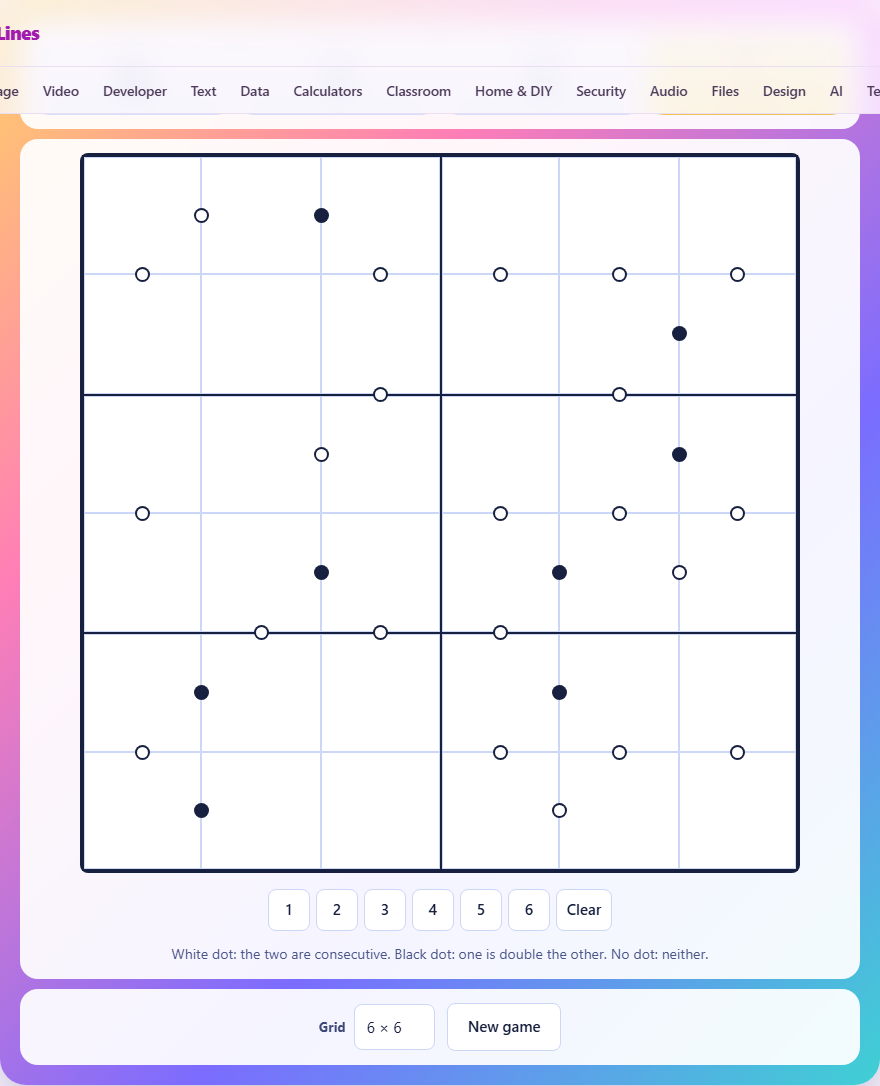
Ordinary sudoku hands you a grid with some digits already filled in. Dot Sudoku takes most of those digits away and replaces them with clues on the lines between neighbouring squares. A small circle sits on the edge between two cells. If the circle is white, the two digits are consecutive, meaning they differ by exactly one. If the circle is black, one digit is exactly double the other. And if there is no circle at all, the two digits are neither consecutive nor double.
That third clause is the one that matters most. A blank edge is not a missing clue. It is a positive statement that rules out every consecutive and every doubling relationship. On a grid that might show six dots and forty blank edges, the blanks carry the majority of the information.
Grid sizes and box shapes
Three sizes are offered. The four by four grid uses two by two boxes and the digits one through four. The six by six uses three by two boxes and digits one through six. The nine by nine uses the familiar three by three boxes and digits one through nine. Every other sudoku rule holds: each digit must appear once in every row, once in every column, and once in every box.
The four by four is a good starting point. With only four digits the dot relationships are few and clear. A white dot can only mean one of three pairs: one and two, two and three, or three and four. A black dot means one and two, or two and four. That small list makes it easy to see how blank edges eliminate candidates.
On the six by six grid the relationships multiply. There are five consecutive pairs and four doubling pairs. On the nine by nine there are eight consecutive pairs and four doubling pairs, because only small numbers can be half of something that still fits in the grid. The doubling pairs on a nine grid are one and two, two and four, three and six, and four and eight.
Controls and feedback
Tap a cell to select it. It highlights. Then tap a digit on the number pad below the board, or press the key on your keyboard. The digit fills the cell. Tap the Clear button or press Backspace or Delete to empty a selected cell. Given digits, the few that the puzzle provides, cannot be changed.
If a digit you enter breaks a sudoku rule or contradicts a dot, the cell turns red. The stats bar shows how many cells are still empty, how many moves you have made, and how many clashes are on the board. Your best score is the lowest move count that fills the grid correctly.
The one-and-two exception
The pair one and two is special. Those two digits are consecutive, because they differ by one, but two is also double one, so they satisfy both rules. The puzzle has to pick one convention, and here the rule is that one and two always get a white dot. A black dot between two cells never means one and two.
This matters because it shrinks the black-dot candidate list. On a nine by nine grid, a black dot means the pair is two and four, three and six, or four and eight. One and two is not on that list. Knowing that cuts your search space every time you see a black circle.
How to read a blank edge
Say you are looking at two cells side by side on a six by six grid. There is no dot between them. That means the two digits are not consecutive and one is not double the other. For a cell that holds a three, the consecutive neighbours would be two and four, and the doubling neighbours would be six. A blank edge beside a three rules out two, four, and six from the next cell. That leaves one, three, and five as candidates.
Repeat this for every blank edge around a cell and the candidate list shrinks fast. A cell with blank edges on all four sides often has only one or two digits left, and the row and column rules finish it off.
Blank edges next to large digits are especially powerful. A five on a six by six grid has four and six as consecutive neighbours and no valid doubling partner at all, because ten is not in the grid. A blank edge next to a five rules out four and six, and the doubling rule is already dead. That one blank edge cuts two candidates at once.
Chains of white dots
A run of white dots between three or more cells in a row forces a run of consecutive digits. On a six by six grid, if four cells in a row are connected by three white dots, they hold four consecutive digits. There are only three such runs in one through six: one-two-three-four, two-three-four-five, and three-four-five-six. The row and column constraints usually pin down which run it is.
Even a pair of white dots in an L shape is useful. The corner cell must be consecutive with both its neighbours, which limits it to digits that sit between two values in the sequence. On a six by six grid the digit one cannot be the corner of a white-dot L because it has only one consecutive partner, two, not two partners on either side.
Black dots and small numbers
Black dots love the bottom of the number range. On a nine by nine grid the only doubling pairs are one and two, two and four, three and six, and four and eight. That means five, seven, and nine never appear on either side of a black dot. If a cell neighbours a black dot, cross those three values off at once.
Two black dots touching the same cell narrow it even further. The cell must have a doubling relationship in two directions. The only digit that appears in two different doubling pairs on a nine grid is two, which doubles with one and with four, and four, which doubles with two and with eight. So a cell with black dots on two sides is almost certainly two or four.
On the smaller grids the list is even shorter. On the four by four grid, the only doubling pair is one and two, since two and four would need both to be present and three and six does not exist. A black dot on a four by four grid is a direct statement that those two cells hold one and two in some order.
A solving sequence for beginners
Start with the four by four grid. Read every dot and every blank edge. Write the candidate lists in your head for each cell. Most cells will have only one or two options, and the row and column rules will finish the rest.
Move to the six by six when the four by four feels easy. The extra two digits add more relationships, but the method is the same. Scan dots first to set up candidate lists, then use blank edges to trim them, then apply the standard sudoku rules.
The nine by nine is a real challenge. The dots are sparser relative to the grid size, and the generator sometimes adds a given digit or two to keep the answer unique. Treat those given digits the same way you would in ordinary sudoku, as anchors that fix the row, column, and box they sit in. Then layer the dot logic on top.
Mistakes that trip people up
- Treating a blank edge as missing information rather than a real clue. Every empty edge is telling you something. Ignoring it is like ignoring a given digit in ordinary sudoku.
- Assuming a black dot means one and two. It might, on a larger grid, but it also might mean two and four, three and six, or four and eight. Check the context.
- Forgetting that the one-two pair always gets a white dot. If you see a black dot, cross one-two off your list immediately.
- Entering a digit without checking every dot around the cell. One unchecked edge can hide a contradiction that only shows up ten moves later.
- Jumping to the nine by nine grid before learning the blank-edge rule on the four by four. The smaller grid teaches the pattern in a few minutes and saves hours of confusion on the big one.
The puzzle stays on your machine
Every grid is generated and solved inside your browser. The dots are computed from a complete solution, and the solution is thrown away once the dots are placed. Nothing is sent to a server, and your best score is stored locally on this device. Close the tab and the puzzle is gone. Open a new game and a fresh one is built from scratch on the spot.