
Rebuilding a scattered set of dominoes
How to read the grid of bare numbers, spot the pairs that can only go one way, and fill a whole domino set back in before the clock runs out.
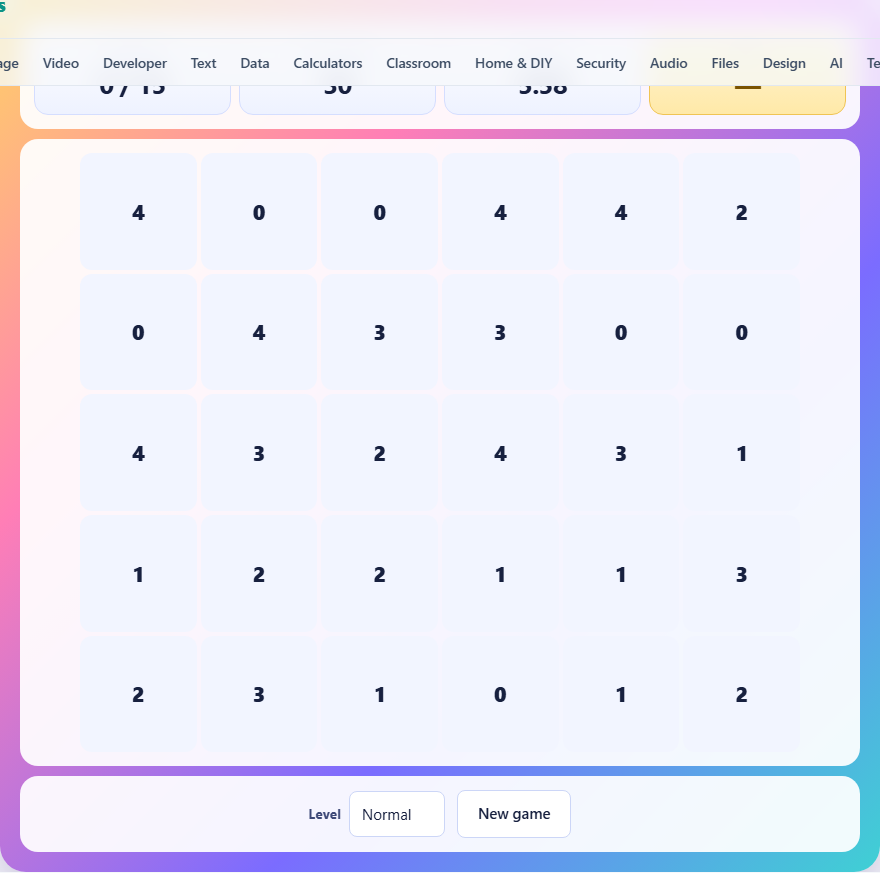
What the puzzle is asking
A complete set of dominoes has been laid out flat on a grid, and then someone rubbed out every dividing line. All that remains is a rectangle of numbers. Your job is to draw the lines back in, pairing each number with one of its neighbours so that every domino in the set appears exactly once.
A domino is a pair of values. The pair three and five is a single domino. So is double two. Every combination from double zero up to double whatever the level allows is somewhere in the grid, and each one appears only once. When you find the right partner for every number, the whole board is covered and you win.
Every puzzle served here has been checked by the generator to have one answer and no more. That means no guessing is needed. If you follow the numbers carefully, each placement either follows from what you already know or can be ruled out by what is left.
How the grid is built
On the Easy level the highest number is three, giving you ten dominoes on a five by four grid. Normal raises the ceiling to four, which makes fifteen dominoes on six by five. Hard goes up to five, for twenty-one dominoes on seven by six. More dominoes means more space to search, and the numbers repeat more often, so the same pair of values might sit beside each other in several places while only one of those pairings is correct.
The grid is generated by first tiling the rectangle with domino-shaped tiles at random, then assigning a domino to each tile. After that a solver counts the number of ways the numbers alone can be split back into a full set. If there is more than one way, the grid is thrown out and a new one is drawn. That process repeats until a grid with a single answer lands.
Controls
Tap any uncovered number to select it. It highlights. Then tap a neighbouring number, horizontally or vertically, and the two join into a domino. The pair is drawn as a single rounded block on the board so you can see where you have placed it.
If the pair you just tried has already been used somewhere else, the game refuses it with a short sound. No damage is done and you can try a different neighbour.
Tap a domino that is already on the board to remove it. Both numbers go back to being loose, and the pair is free to use again. Nothing is permanent until the last piece lands.
The timer and scoring
A countdown runs from the moment the grid appears. Easy gives you four minutes, Normal six, and Hard nine. Running out of time ends the game. The stats bar shows how many dominoes you have placed out of the total, how many loose numbers remain, and how much time is left.
There is no penalty for wrong guesses. Removing a domino and trying again costs nothing but seconds on the clock. The game tracks your best time in the browser, so each replay is a chance to beat your own record.
Start with the pair that fits only once
The strongest move you can make is to look for a domino that can only go in one place on the whole grid. Pick a pair, say two and four. Scan every cell holding a two and check whether a four sits next to it. If only one two in the entire grid has a four beside it, that domino is forced. Place it immediately.
After placing a forced domino, other dominoes often become forced themselves. The pair you placed removes one possible partner from every number it touched, and the numbers around the gap shrink their options. This chain reaction is how strong solvers clear the board quickly.
On the Easy grid this scan is fast because the numbers only go up to three and there are only ten dominoes to track. On Hard, with six values and twenty-one dominoes, the same scan takes more concentration, but the principle is the same. One forced placement leads to the next.
Edges and corners tell you more than you think
A number in a corner of the grid has exactly two neighbours. That means the domino containing it can only go in one of two directions. If one of those two pairings has already been placed somewhere else, the corner cell is settled.
Edge cells have three neighbours instead of the four that interior cells enjoy. Fewer neighbours means fewer candidates, which means edge numbers are easier to pin down than numbers buried in the middle. Sweep the border of the grid early and you will often lock several dominoes in place before touching the interior.
Once the border is fixed, the interior cells that used to lean on those edge numbers lose a candidate. This can trigger another wave of forced placements moving inward.
Watch the doubles
Doubles deserve special attention. The domino double three, for example, needs two threes sitting right next to each other. On a Normal grid with numbers from zero to four, the fifteen dominoes fill thirty cells, and the digit three appears in only six of them: once each in the 0-3, 1-3, 2-3 and 3-4 bones, and twice in the double three itself. Six cells out of thirty is not many, so the chance that two of them happen to sit side by side, in a spot where that pairing has not already been used elsewhere, is often the tightest constraint on the board.
Because doubles require the same value twice in a row, they stand out visually. Scan for any two identical numbers sitting beside each other. If that value pair appears only once on the grid, the double is forced. If it appears in two spots, skip it for now and come back after other placements narrow the field.
What to do when you are stuck
If no domino looks forced, switch from scanning pairs to scanning cells. Pick a single number and list every domino it could still be part of. Cross off the pairs that are already used on the board. If only one pair remains, the cell is settled.
Another trick is the squeeze. When a row of three uncovered cells sits between placed dominoes, the middle cell must pair with one of its two free neighbours. Try one pairing. If the resulting domino has already been placed, the other direction is the answer.
If you placed something early and the board stopped making progress, go back and question it. Removing a domino and trying a different partner for those cells costs less time than staring at a locked grid.
Mistakes that cost beginners time
- Placing a domino that feels right without checking whether that pair is still available. The game blocks the move, but the confusion eats seconds.
- Starting in the middle of the grid where every cell has four neighbours. Begin at the edges where there are fewer options to weigh.
- Ignoring the still-loose counter. If you have placed twelve of fifteen dominoes and the counter says six squares are still loose, you know exactly three dominoes remain. Listing those three and scanning for them is faster than searching blind.
- Panicking when the clock drops below a minute. The last few dominoes are usually forced by what is already placed, so the final stretch often goes quicker than the first.
- Never removing a placed domino. If something looks wrong further along, undo it. The cost is a few seconds, but the cost of building on a bad placement is the entire puzzle.
A worked example
On an Easy grid you see the numbers zero through three laid out on a five by four rectangle. You scan for double zero first. Two zeros sit next to each other near the top left corner, and nowhere else on the grid do two zeros touch. That double is forced. You place it.
Now the one next to one of those zeros has lost a candidate. Check what pairs are left for it. Its only free neighbour on one side is a three. The one-three domino has not been used yet, so that placement is likely. But check elsewhere first. One and three also touch near the bottom row. Two places, so skip it for now.
Next, scan for double three. Only one spot has two threes beside each other. Place it. That fix locks the three at the end of the row into pairing with the two next to it, because the only remaining domino that three can form is with two. Three placements in, and the board is already half solved.
Everything stays on your device
The grid is generated and solved inside your browser. No puzzle is downloaded from a server and no move you make ever leaves the page. Your best time is stored in this browser alone and will not appear on another machine. You can test this yourself by disconnecting from the internet and starting a new game. It works exactly the same way.