
Matching ends and reading what the other hand is hiding
How the draw game works with a double-six set, what the computer is tracking about your hand, how to choose which end to play on, and the habits that separate a lucky player from a skilled one.
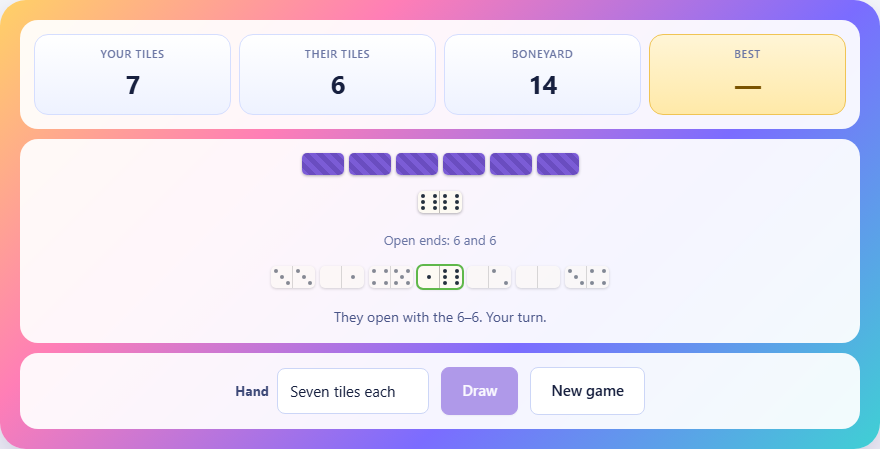
The rank that opens the game, and the points that pick every later move
Before the first tile goes down, the game ranks every tile in both hands. A tile is worth 100 if it is a double, plus the two numbers on its face. The double six ranks 112. A plain six and five ranks 11. Because of the 100, any double beats any tile that is not one. The top ranked tile is laid at once, and the player who did not lay it takes the next turn. Ties go to the tile seen first, and your hand is read before theirs. One quiet effect: whoever opens is a tile lighter from the very first move.
After that the computer works a turn at a time. It draws first if it has to, taking tiles from the boneyard while nothing in its hand fits either end. Then it lists every legal move. A move is one tile plus one end. Each move leaves a number showing at that end, and that showing number drives most of the choice. Four rules add up to a score. A showing number you have already passed on is worth 14. Every tile in its own hand that carries that showing number is worth 2, and the tile being laid is counted too. Each pip on the tile is worth 0.3, so a six and six adds 3.6 and a two and one adds 0.9. A double adds a flat 2 on top.
The biggest total wins. Equal totals go to the move checked first, which favours the older tile in its hand, and the left end ahead of the right. Look at how large that 14 is next to the rest. Pips can never give more than 3.6, because twelve is the heaviest tile there is. So a dead end for you outweighs every other reason it might have.
Here is one full turn with real numbers. The open ends are 3 and 5. The hand is 3-6, 5-5, 5-1 and 4-2. The 4-2 touches neither end, so only three moves exist. The tally of its own numbers is one 3, one 6, two 5s, one 1, one 4 and one 2. Note that the double five adds one to the count of fives, not two.
Take the 3-6 at the left end. The 3 meets the line, so a 6 is left showing. Its hand holds one tile with a 6, which is this tile, and that still counts, so 2 points. Nine pips at 0.3 give 2.7. The total is 4.7. Next the 5-5 at the right end, which leaves a 5 showing. Two tiles carry a 5, so 4 points. Ten pips give 3. The double adds 2. The total is 9. Last the 5-1, also at the right end, leaving a 1 showing. One tile carries a 1, so 2 points, and six pips give 1.8. The total is 3.8.
So it lays the double five and both ends stay as they were. Now change one thing. Say you had passed earlier while an end showed a 6, so a 6 sits on its list. The 3-6 move now scores 14 plus 2 plus 2.7, which is 18.7, and it lays that instead. Same hand, same ends, different move, purely because of what you gave away.
The one gap in its memory, and the rules this table never uses
The list of numbers you cannot match is filled in at a single moment: when you press Draw with an empty boneyard, which is how you pass. Both open ends go on the list right then. Drawing while tiles remain in the boneyard adds nothing to it, even though the draw tells just as much. So through most of a hand that 14 point bonus never fires, and the opponent is really just playing its long suit and shedding weight. The list is wiped clean at the start of each new game.
The conventions it follows are the pub ones. Highest double opens, and the heaviest tile opens if nobody holds a double. A blocked hand goes to the smaller pip count, and a tie goes to you, because the test asks whether your pips are less than or equal to theirs. There is no Pass button of its own. Draw is the pass, and it only comes alive when nothing you hold fits.
The computer never announces a draw. It pulls tiles quietly and the screen only refreshes once its move is done. Watch the two counters instead. If their tile count went up by three and the boneyard fell by three, they missed both ends three times over. That is the same reading you get at a real table, just told in numbers rather than in hands reaching for the pile.
A few things are simply not modelled here, and it is fair to know which:
- The line never forks. A double is not turned across the line, and no arms grow off it, so there are only ever two ends to aim at.
- Nothing is scored for making the ends add up to five. This is the plain draw game, not the fives game.
- One deal is the whole game. There is no running match to a target, and the winner is not handed the loser's pips as points.
- The score kept for you is your own leftover pips, and smaller is better, so going out records a 0. It is saved even when you lose the hand, so a narrow loss can still set your best.
- The Hand setting changes the deal and nothing else. Five tiles each and seven tiles each face the same opponent with the same four weights, so it is not a gentler level.
- It never looks ahead. Each turn is scored on its own, so it cannot see that a strong move now strands its last tile later.
- It never peeks at your tiles. The score reads its own hand, the pips, and your passes, and nothing else.
- It does not track which numbers have run out. Each number lives on seven tiles, and once all seven are on the table nobody can be holding one. A human can count that. The code does not.
- There is no undo and no hint. Once a tile is down the move stands.
- The shuffle uses the browser's own random source with no seed, so a deal cannot be replayed, saved or shared.
The draw game from the deal to the last tile
A standard double-six set has twenty-eight tiles. Each tile shows two numbers from zero to six, one on each half. Every possible pair appears exactly once. The tiles are shuffled face down and each player takes seven. The rest stay in a pile called the boneyard.
The highest double opens. If you hold the double six, you play it first. If neither player has a double, the tile with the most pips goes down. After the opening tile the line extends in two directions. Each turn you add a tile to one end of the line by matching the number on your tile to the number showing at that end. If you cannot match either end, you draw from the boneyard until you get something that fits. When the boneyard is empty and you still cannot play, you pass.
The hand ends one of two ways. Either one player goes out by placing their last tile, or the game blocks because neither side can play and the boneyard is empty. If someone goes out, they win. If the game blocks, the player holding fewer total pips wins.
Controls on the screen
Your tiles sit along the bottom of the play area. Tap a tile to play it. If it matches only one end of the line, it goes there automatically. If it matches both ends, the game asks you which end you meant. Two buttons appear asking you to choose the left end or the right end. Pick one and the tile is placed immediately.
The Draw button lights up only when none of your tiles match either open end. Tap it to pull a tile from the boneyard. You can keep drawing until something fits or the boneyard runs out.
The scoreboard tracks three counts: how many tiles you hold, how many the computer holds, and how many remain in the boneyard. The open ends of the line are also displayed below it as two numbers, so you always know what you need to match.
Choosing five or seven tile hands
The Hand dropdown offers two settings. Seven tiles each is the standard draw game, and it starts with fourteen tiles dealt out of twenty-eight. That leaves fourteen in the boneyard, which means lots of drawing and plenty of chances to learn what the other side is missing.
Five tiles each is a quicker variant. Only ten tiles are dealt and eighteen stay in the boneyard. The game moves faster but the information is thinner. You see fewer passes and draws, so you know less about the other hand. Both options still use the same standard double-six set of twenty-eight tiles.
Reading the other hand through draws and passes
Every draw and every pass tells you something. When the computer draws on a turn where the open end is a four, you know it holds no fours. That fact stays true for the rest of the hand. A tile drawn from the boneyard might be a four, but anything the computer already held is not.
Build a mental list of numbers the computer cannot play. It does the same to you. Every time you draw or pass, it records the number you could not match and later tries to steer both ends of the line to that number. If you passed on a three and the computer has a tile that leaves one end showing three, it will play that tile on purpose.
This is the reason dominoes is a game of skill and not a game of chance. The tiles are random at the start. After a few turns the information from draws and passes gives a skilled player a real edge.
Playing from your longest suit
Look at your hand and count how many tiles show each number. If you have four tiles that all show a five, fives are your long suit. Playing from your long suit has two benefits. First, it keeps your hand flexible, because you still hold tiles that match that number after playing one. Second, it puts pressure on the other player. If you keep leaving fives showing at both ends, the opponent either matches them or draws.
The danger of a long suit is holding it too long. If both ends of the line turn away from fives and stay away, your tiles are stuck. Break the long suit up early by playing its tiles while the ends still match. Keeping one or two fives for later is fine. Holding all four until the endgame is a trap.
Getting rid of doubles early
A double tile has the same number on both halves. The double four shows four and four. It can only match an end that shows four. Compare that to a tile like four-two, which matches either a four or a two. The double is half as flexible.
That lack of flexibility makes doubles the tiles most likely to be stranded at the end of a hand. If the game blocks with a double three in your hand, those six pips count against you. Play your doubles while they match, and play them early. The exception is a double that belongs to your long suit, which you might hold for one extra turn to keep pressure on that number. But even then, do not wait too long.
Choosing which end to play on
When a tile fits both ends of the line, the game asks you to choose. This is not a coin flip. Think about what number each option leaves showing. If you know the computer cannot play threes, leave a three at one end. If you are running low on sixes and the other end shows six, move your tile there so that end changes to something you do hold.
A good rule of thumb is to leave the number you hold the most of and change the number you hold none of. If you have three tiles showing a two and zero tiles showing a five, play on the end that shows five. That replaces a dead end with a live one and keeps the pressure on the other side.
Planning for a blocked game
Not every hand ends with someone going out. When the boneyard is empty and neither side can match, the game is blocked and the lower pip count wins. If you see a block coming, start shedding your heaviest tiles. A double six is worth twelve pips. Getting it out of your hand before the block counts as twelve points saved.
Watch the boneyard counter. When it drops below three or four, a block is possible soon. At that point, stop thinking about going out and start thinking about who has fewer pips. Play your heavy tiles even if the lighter tile would be a better strategic move. The pips in your hand at the end are all that matters.
Mistakes that cost hands
- Holding a double until no end shows its number. By then it is stuck in your hand and its pips count against you in a block.
- Drawing without checking every tile. The Draw button is only active when nothing fits, but make sure you have really looked at both ends before tapping it.
- Playing the first tile that matches without checking which end is better. A tile that fits both ends is an opportunity to steer the line. Use it.
- Ignoring the computer's draws. Every draw it makes tells you a number it cannot play. That information wins games.
- Forgetting about the pip count when a block is near. Going out is the first goal, but shedding heavy tiles is the backup plan, and a backup plan is no good if you start it too late.
Your tiles stay on your own device
The shuffle, the boneyard, and both hands are all handled inside your browser. Nothing is sent anywhere and there is no account. The game works fully offline after the page has loaded. Close the tab and the entire hand is gone.