
Routing a delivery van on a tank that keeps emptying
How fuel changes a simple path problem into a real puzzle, what the three board sizes look like, why the budget has slack, and the planning habits that keep the tank from running dry.
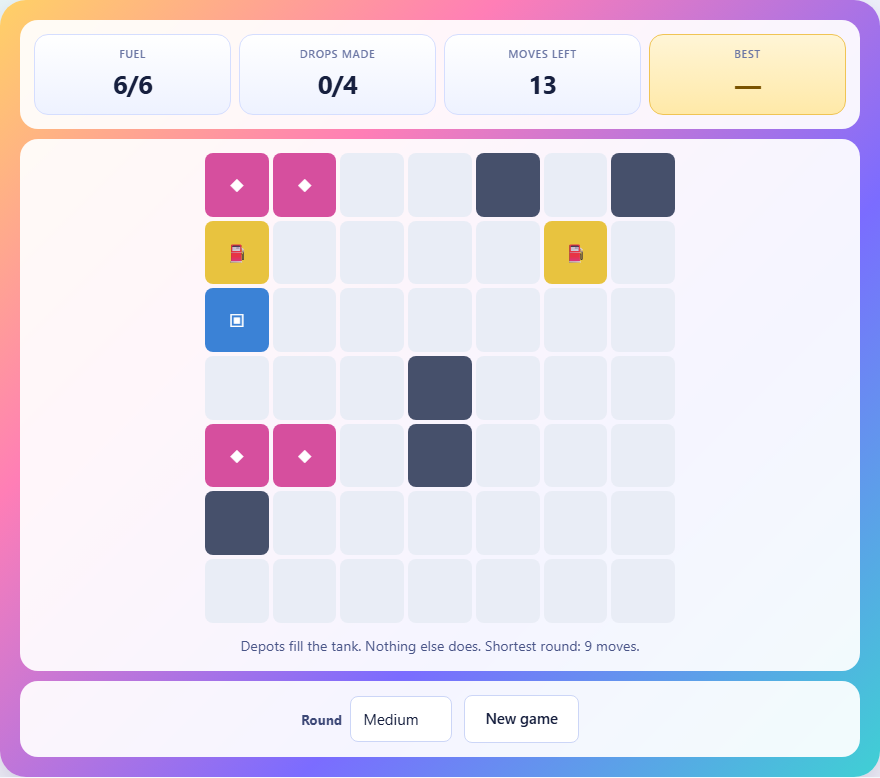
The problem on the board
A van sits on a grid. Some squares are pink drops that need a delivery. Some squares are yellow depots that fill the tank. The rest are open road or walls. Every move the van makes costs one unit of fuel, except a move onto a depot, which fills the tank back to its full capacity. The round ends when every drop has been visited, or when the fuel runs out, or when the move budget is spent.
The tank is small. On the medium board it holds six moves. That means three squares out and three squares back if there is no depot at the far end. The constraint is not distance on its own. It is distance measured against a gauge that keeps falling.
Controls and board layout
Tap any square next to the van to move there, or use the arrow keys on a keyboard. The W, A, S, D keys also work. Walls block movement. You cannot move diagonally.
The scoreboard at the top shows three numbers. Fuel is the current level against the tank capacity, such as four out of six. Drops made counts how many deliveries you have completed out of the total. Moves left counts down from the budget. When that counter reaches zero and drops remain, the round is lost.
The Round dropdown sets the board size. Small is a six by six grid with three drops and two depots. Medium is seven by seven with four drops and two depots. Large is eight by eight with five drops and three depots. The tank capacity stays at five or six across all three sizes, so the larger boards are harder because the distances grow while the fuel does not.
Why fuel makes this different from a maze
A maze without fuel is a simple path problem. Find the shortest route through every target and you win. Add a fuel gauge and the problem changes shape entirely. The shortest path through every drop might pass through a long stretch with no depot, and the van runs dry halfway. That route looks perfect scored on a sheet of paper. The van cannot actually drive it.
The game solves this before you ever see the board. It runs a search that tracks three things at once: where the van is, how much fuel is in the tank, and which drops are done. A position on square twelve with a full tank and that same square with one move of fuel left are treated as completely different states. Only routes that survive that check count, and the shortest of them sets the par.
The budget and what par means
The move budget is not the par. It is the par plus a fixed slack of four moves. That slack is generous enough that you do not need to find the best route, but tight enough that you cannot wander without a plan.
The par number is shown when the round starts. On a medium board it is often around twelve to fifteen moves. Your budget is then sixteen to nineteen. That means you can afford a few extra moves, but not ten. A detour that takes five extra steps is already dangerous. Two detours like that blow the budget.
Planning the refuel before the drop
The single most important habit is to think about the depot before you think about the drop. A drop you can reach but cannot leave is a trap. You arrive, the delivery counts, but the tank is empty and you are stuck at a dead end with no depot in range. The drop is done, but the round is not, and you cannot move.
Before driving towards a drop, look at the fuel gauge and count the steps. How many moves to the drop? How many from the drop to the nearest depot? If the total is more than what the tank holds, you need to refuel first. This is the question that makes the puzzle a puzzle.
Here is a concrete example. The tank holds six. You have four fuel left. The drop is three moves away. The nearest depot after the drop is five moves from it. Three plus five is eight, which is more than six even if you arrived at the drop on a full tank. So fill up first. Drive to a depot, top off, then head for the drop. The detour costs two or three moves but keeps you alive.
Grouping drops by geography
Two drops close together should be taken on the same tankful. Drive to one, then straight to the other, then to a depot. The cost of reaching the area is paid once instead of twice.
The opposite pattern kills rounds. Driving to a drop in the top right corner, refuelling in the middle, then driving all the way to the bottom left for one drop, refuelling again, then heading to the top left, is three round trips through the centre. Each one costs fuel both ways. If each trip burns four fuel, that is twelve moves on travel alone. Group the nearby drops into a single loop and the round closes far more easily.
On the large board with three depots, the depots divide the grid into zones. Each zone has its own group of drops. Clearing one zone at a time and refuelling at the border depot before crossing into the next zone is the cleanest approach.
Using depots as safe squares
A depot is more than a refuelling stop. It is a base. Standing on a depot means you can reach anything within a full tank in every direction. That makes it a good place to pause and survey the board.
When you are not sure which drop to chase next, drive to the nearest depot first. The refuel is never wasted because the tank fills to the brim regardless of how much was already in it. Arriving on one fuel or arriving on five, you leave with a full tank either way. There is no penalty for topping off when you happen to pass a depot, and a very large cost to needing one later from the far side of the map.
Think of each depot as the start of a fresh search. You are full, you have maximum range, and every drop within that range is now reachable. The puzzle is really a chain of these short searches stitched together.
Mistakes that end rounds early
- Chasing the nearest drop without checking fuel. The nearest drop is only useful if you can also reach a depot from it.
- Ignoring a depot you are passing. A detour of one step to fill up while the tank is half full is cheap. That same depot from six steps away later is expensive or impossible.
- Treating the budget like a clock. The budget is generous, but it is not infinite. Two wasted round trips through the middle of the board eat it up.
- Forgetting that walls block movement. A drop three squares away as a bird flies might be seven steps away around the walls. Count the actual path, not the straight line.
- Not reading the par. The par is shown at the start of every round. It tells you how tight the puzzle really is. A par of twelve with a budget of sixteen gives four spare moves, which is comfortable. A par of eighteen with a budget of twenty-two also gives four, but the route itself is longer and more complex, so any wrong turn eats into that margin faster.
Everything stays on your device
The board is built in your browser using a random generator and a search that proves a valid route exists before showing you the puzzle. Nothing is sent to a server. There is no account, no login, and no connection needed after the page loads. Your move history and any best scores live in this browser on this device. The van drives on your own machine and nowhere else. You can verify this by loading the page, going offline, and starting a new round. Everything still works.