
Playing 501 and finishing on a double
How the crosshair works, why the bust rule exists, what the three steadiness levels change, and a full breakdown of the maths behind setting up a checkout.
What 501 actually asks of you
Both players start on 501. You throw three darts each turn and subtract what you score. The first player to reach exactly zero wins, but the last dart of the game must land in a double or the bullseye. That final rule is everything. Without it the game would be a race to hit treble twenty over and over. With it the game has two halves: a scoring half where big numbers matter, and a finishing half where knowing your doubles matters more.
Going below zero is a bust. Landing on exactly one is a bust too, because no double can bring you from one to zero. Landing on zero with a dart that was not a double is also a bust. In every bust case the entire turn is scrubbed and your score goes back to where it was at the start of the turn. You do not lose just the one dart. You lose all three.
How the board is laid out
The board has twenty numbered segments arranged in a circle. The order is not random and it is not sequential. High numbers sit next to low ones so that a dart aimed at twenty and slightly off lands in one or five, not nineteen. That layout punishes inaccuracy.
Each segment has four scoring zones. The large areas between the rings score the face value. The thin outer ring doubles it. The thin band about two thirds out from the centre triples it. The outer bullseye in the middle is worth twenty-five, and the inner red bullseye is worth fifty and counts as a double. A treble twenty is sixty, so three of them score a hundred and eighty, the maximum possible turn.
Throwing with the crosshair
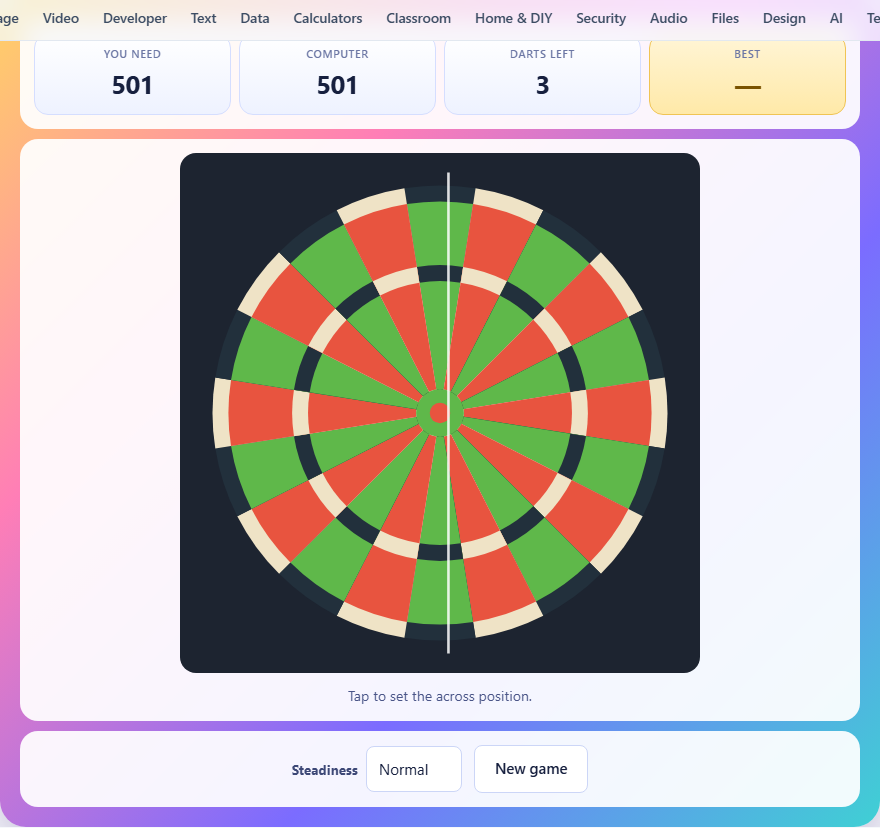
A vertical line sweeps left and right across the board. Tap or click to lock it. That sets the horizontal position of your dart. A second line then sweeps up and down, and a second tap locks the vertical position. The dart lands near where the two lines crossed, but there is always a wobble. That wobble is the game. You can aim perfectly and still miss, just like a real throw.
On a phone, tap anywhere on the board. On a keyboard, the spacebar does the same thing. Two taps per dart, three darts per turn, so a full turn is six taps. The rhythm becomes natural after a few throws.
The three steadiness levels
The dropdown labelled Steadiness controls how much your darts scatter. On Easy the wobble is large, so both you and the computer miss often. On Normal the wobble tightens and grouping around treble twenty becomes possible. On Hard the wobble is small and the computer rarely misses a double when it gets to a checkout.
The computer uses the same wobble you do, scaled up slightly. It aims at treble twenty while its score is high, then switches to aiming at the double it needs once a checkout is within reach. On Hard it lands those doubles most of the time, so you need to be ahead before it gets there.
Setting up a finish
The most important number in finishing is thirty-two. That is double sixteen. If you miss double sixteen on the inside, you score sixteen and leave yourself on sixteen, which is double eight. Miss double eight inside and you leave yourself on eight, which is double four. The number keeps halving, so one bad dart does not ruin the leg.
Compare that to a finish on thirty-four. That is double seventeen. Miss inside and you leave yourself on seventeen, which is odd, and now you need a single one before you can aim at double eight. An odd number always costs an extra dart to fix. The lesson is simple: leave yourself an even number whenever you can, and leave yourself thirty-two or forty if you have the choice.
Here is a worked example. You are on ninety-seven. Three darts left. A treble nineteen scores fifty-seven and leaves you on forty, which is double twenty. That is a clean two-dart finish. A treble twenty scores sixty and leaves you on thirty-seven, which is odd and needs three darts. The lower treble is the better dart.
Scoring quickly in the early turns
While your score is above a hundred and seventy, finishing in one turn is impossible, so every dart should chase the biggest number it can reach. Treble twenty is the target. Three of them score a hundred and eighty and take you from five hundred and one to three hundred and twenty-one in a single turn.
If your grouping is loose, treble nineteen at fifty-seven per dart is sometimes safer. The numbers surrounding twenty on the board are one and five, both low. The numbers surrounding nineteen are three and seven, which are higher. A dart that misses treble nineteen still scores decently. A dart that misses treble twenty can score one.
Keep an eye on the darts-left counter in the scoreboard. It tells you how many throws remain this turn. When all three have been thrown the computer takes over, and after its three darts the crosshair reappears for your next round.
The bust rule and how to use it
The bust rule scrubs the entire turn, not just the last dart. That means a risky third dart costs you nothing beyond the turn itself. If you are on forty and you have one dart left, go for double twenty. Miss it and you go back to forty, not to some awkward odd number.
It also means the first dart of a turn is the most important. A bust on the first dart wastes two more throws. Late in the game, when your score is close to a finish, throwing a safe single with your first dart to leave a clean double for the second is often the right play. Getting to the double matters more than getting there fast.
Common mistakes new players make
- Always aiming at treble twenty even when a finish is within reach. Once your score drops below a hundred and seventy, start planning the checkout rather than chasing sixty.
- Leaving an odd number at the end of a turn. An odd remainder always needs at least two darts to finish. Keep it even.
- Ignoring the doubles until the very end. The best players think about which double they want to finish on several turns before they get there.
- Throwing too quickly. Each tap locks the crosshair for one axis. Waiting a moment until the line is near the treble band or the double ring is worth the patience.
- Forgetting that the bullseye is a double. Fifty is double twenty-five and counts as a valid checkout. On a score of fifty, the bull wins the leg.
What the computer does differently
The computer follows a fixed plan. It throws at treble twenty until its score is low enough to finish, then switches to aiming at the correct double. It does not get nervous and it does not change its mind. That consistency is exactly what makes it hard to beat on the higher steadiness levels.
One thing it does not do is set up a preferred double. A strong human player will steer towards thirty-two or forty several turns early. The computer simply takes whatever checkout its current score allows. That is a gap you can exploit. If you plan your finishes two turns ahead, you will reach a clean double more often than it does.
You can switch the steadiness level at any time using the dropdown. Picking a new level starts a fresh game, so change it before the leg matters rather than halfway through.
Your game stays on your machine
The board, the throws, and your best score all live inside this page on your own device. Nothing is uploaded and there is no account to create. The game works after the page has loaded even if you disconnect from the network, because there is nothing on the other end that it needs. Close the tab and the session is gone.