
Throwing stones on digital ice
How to aim and control the weight of a throw, why only one side scores in an end, when to draw and when to take out, and how the physics of the ice decides everything after you let go.
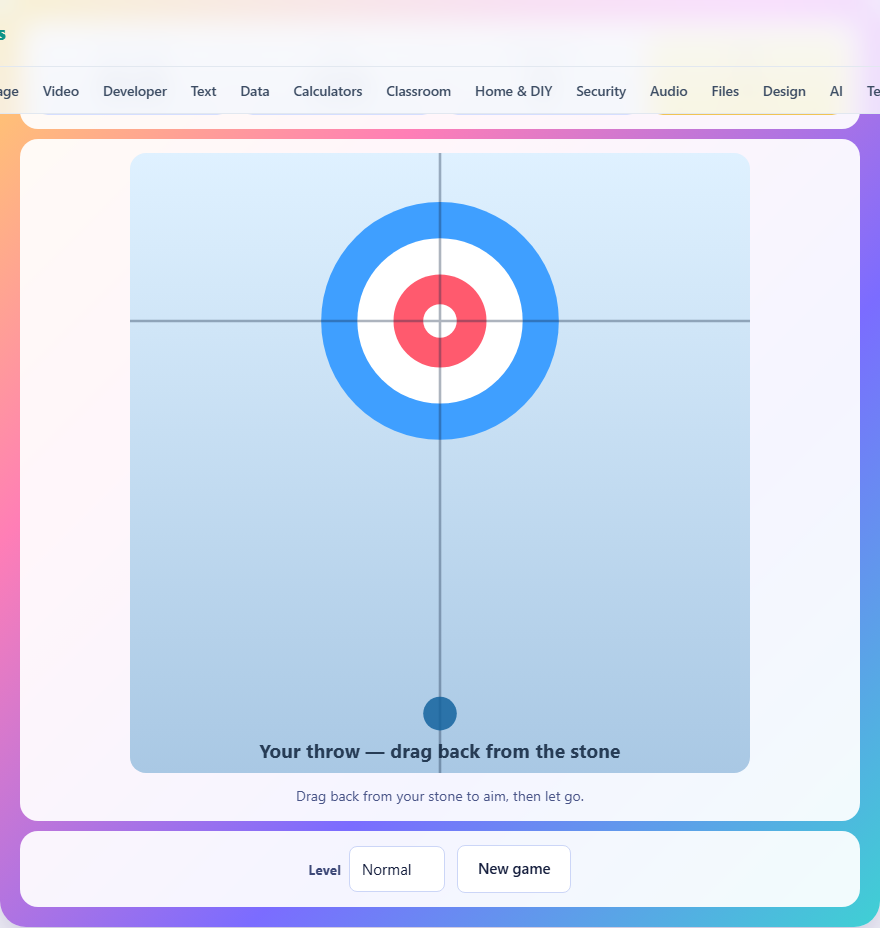
The ice and the rings
The playing area is a sheet of ice with a set of rings near the top. The rings are called the house. The centre of the rings is the button. Your stones are blue and the computer's stones are gold.
You throw from the bottom of the screen toward the top. The computer throws from the same spot. Each side takes turns throwing one stone at a time. Once both sides have thrown all their stones, the end is scored.
A game is made up of a set number of ends. On easy that is two ends with three stones each. On normal it is three ends with three stones. On hard it is three ends with four stones each.
How to throw: the drag and release
Your stone sits at the bottom of the screen waiting. To throw it, press and drag backward, away from the rings. The further you drag, the harder the throw. The direction you drag decides the angle.
Think of it like pulling back a catapult. Drag down and to the right, and the stone flies up and to the left. A short drag gives a gentle weight that barely reaches the rings. A long drag sends the stone hard enough to blow past the house and off the far end.
On a touch device, drag back with your finger and lift off to release. On a mouse, press and drag. The game shows a dotted line pointing in the throw direction so you can see where the stone will go before you let go.
Once the stone is released, you cannot steer it. There is no sweeping. The ice slows it at a fixed rate and the stone goes where the physics takes it. That is what makes the weight of the drag the entire skill.
How scoring works
Only one side scores in each end, and it is the side whose stone is closest to the button. That side earns one point for every stone it has closer to the button than the other side's nearest stone. The losing side gets nothing.
An example makes it clearer. Suppose after all throws the closest stone is one of yours, sitting right on the button. The next closest is also yours, a bit further out. The third closest is one of theirs. You score two points, because two of your stones are nearer than their best. They score zero.
If the closest stone is theirs, it does not matter how many of yours are nearby. Their stone cancels all of yours behind it. Only stones closer than the other side's best count.
Drawing to the button
A draw is a throw that slides the stone gently into the house and leaves it sitting near the button. No contact with any other stone. Just a clean placement.
The key is weight. The ice slows every stone at a steady rate. A throw that is twice as fast covers roughly four times the distance before stopping. That means small changes in drag length make a big difference at the far end.
Your first throw in a game should almost always be a draw to the button. There is nothing to hit yet, so aiming for the centre is the safest play. Once you have a stone sitting in the house, the situation changes.
Taking out the other side's stones
A takeout is a throw aimed at one of their stones. The goal is to knock it out of the house and leave yours in its place. Because the stones have equal weight, a direct hit passes the speed from yours to theirs. Your stone stops where theirs was, and theirs flies off.
Takeouts are worth more than draws when their stone is sitting on the button. That single stone of theirs cancels every stone of yours behind it, so removing it is often better than adding another of your own.
Aim is everything on a takeout. A glancing hit sends both stones sideways and neither ends up where you wanted. A square hit is the one that works: yours stops, theirs goes. The dotted aiming line helps, but the angle still takes practice.
Using guards to protect your position
A guard is a stone that stops short of the rings on purpose. It sits between the bottom of the screen and the house, blocking the line to whatever you have placed behind it.
Guards are useful when you already have a stone near the button. The computer cannot take it out easily if a guard is sitting in the way. The guard absorbs the hit instead.
The risk is that a guard costs you a stone. You have a limited number per end. Spending one on a guard means one fewer chance to draw another stone to the button or take out one of theirs. Guards work best when you are already ahead in the end and want to protect your lead.
How collisions work on the ice
The physics model is real. Stones have equal mass. When one hits another square on, the moving stone stops and the stationary one picks up all the speed. It is the same thing that happens on a pool table.
An off-centre hit splits the speed between the two stones. Both roll away at angles, and neither goes where a square hit would have sent it. The further off centre the contact, the less speed passes to the target and the more your stone keeps.
Stones that go past the edges of the screen or off the far end are out of play. They take no part in the scoring. A throw that is too hard sends your own stone off the back, which is the same as throwing it away.
The computer opponent and difficulty levels
The computer aims at the button or at your nearest stone, depending on the situation. It adds a random wobble to its throw, and the wobble shrinks as the difficulty rises.
On easy, the wobble is large. The computer often misses its target by a wide margin, so your own inaccuracy is forgiven. On normal the wobble is moderate and the computer lands most of its throws close to its target. On hard the wobble is tiny and the computer plays almost perfectly.
The number of ends and stones also changes. Hard mode gives each side four stones per end instead of three, which means more chances for the computer to fix its mistakes and more pressure on you to hold a lead.
Mistakes that cost you ends
- Throwing too hard on your first draw. If the stone flies past the rings, you have wasted a throw and given the computer an empty house to fill.
- Ignoring the scoring rule. Only the closest side scores. If their stone is on the button, adding a second stone of yours behind it earns nothing. Take theirs out first.
- Aiming at the centre when a takeout is needed. A new stone near the button does nothing if theirs is closer. The right play is to remove theirs, not to crowd the house.
- Wasting all your stones on guards. Guards protect, but they do not score. If you spend every throw on guards you will have nothing in the house when the end is counted.
- Dragging too short and leaving the stone in front of the rings. A stone that does not reach the house cannot score and only serves as a guard if it happens to block a useful line.
Adjusting weight after your first throw
Your first throw teaches you the ice. Watch where the stone stops. If it fell short, drag further on the next throw. If it went off the back, drag less.
The friction is constant, so the relationship between drag length and stopping distance is predictable. Once you know the drag length that reaches the button, you can repeat it with small adjustments for angle. The learning curve is short.
On a takeout, aim a little harder than a draw. You want your stone to still be moving when it makes contact, so it pushes theirs out. A draw that stops right next to theirs does nothing. Add about ten percent more drag length for a clean takeout.
All of it runs in your browser
The ice, the physics and the scoring all happen on your own machine. Nothing is sent to a server. There is no account and no sign-up. Your best score is stored in this browser only, and the game works offline once the page has loaded.