
Solving the flat pocket cube step by step
How the unfolded net works, what each button does, why only three faces need turning, and the backwards trick that cracks every scramble the game can throw at you.
What the net shows you
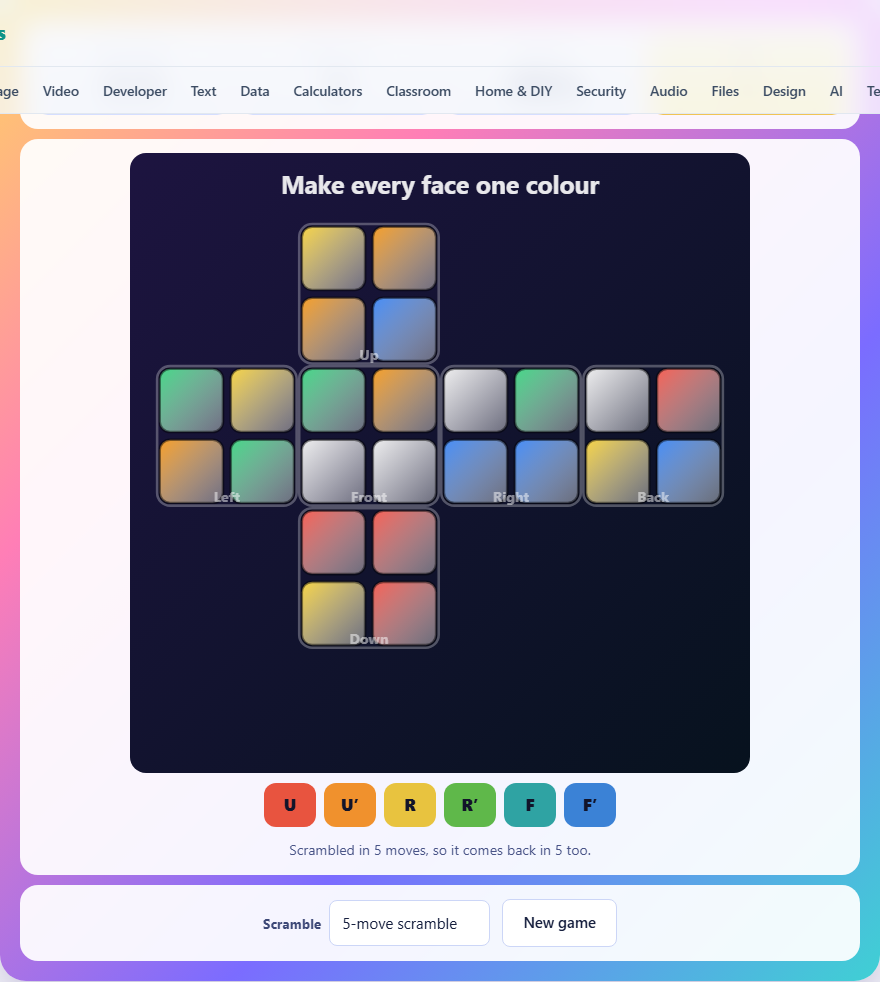
A normal cube hides three of its six faces behind itself. That means half the puzzle is invisible and you have to hold it in your head. This version sidesteps the problem by unfolding the cube into a flat cross shape, so all twenty-four stickers sit in front of you at once.
The layout is a cross. Up sits on top. Down hangs below. Left, Front, Right and Back run across the middle row. Each face holds four coloured stickers arranged in a two by two grid. The goal is simple: make every face one solid colour.
Because nothing is hidden, the game is a pure logic exercise. You never have to guess what a turn did to the back. You can see it.
The six buttons and what they do
Six buttons line up below the net. They come in three pairs: U and U prime, R and R prime, F and F prime. The letter names the face that turns. The prime mark means anticlockwise instead of clockwise.
U turns the Up face. Seen from above, a plain U goes clockwise and U prime goes back the other way. R turns the Right face. F turns the Front face. Each button spins its face one quarter turn and drags a ring of stickers on the neighbouring faces along with it.
There are no buttons for Down, Left or Back. On a full three by three cube those would matter, but on a two by two they are not needed. Turning the bottom is the same as turning the top and tilting the whole cube, so these six buttons already reach every position.
Corners travel as one piece
A two by two cube has eight corner pieces and nothing else. Each corner carries three stickers, one on each of the three faces it touches. When you press a button, the turn moves whole corners. It never peels a single sticker off and sends it somewhere alone.
This is worth knowing because it limits what can happen. If a red sticker on the Front face moves to the Right face, the two stickers that share its corner move with it. Follow one corner through a sequence of turns and you will always find its three colours staying together.
Once you see corners instead of stickers, the puzzle shrinks. There are only eight pieces to place, and the three stickers on each one are locked together forever.
Scramble levels and move limits
The difficulty selector offers three scrambles. A three-move scramble is gentle. A five-move scramble is the default. A seven-move scramble is the hardest the game goes.
Your move budget is always the scramble length plus four extra. So a three-move scramble gives you seven moves. A five-move scramble gives you nine. A seven-move scramble gives you eleven. That is generous but not infinite. Random clicking will eat the budget fast.
There is also a clock. Easy gives you two minutes. Normal gives a hundred and ten seconds. Hard gives a hundred seconds. If either the moves or the time runs out, the game is over.
The backwards trick
Every scramble is built by taking a solved cube and applying random turns to it. That means it can always be undone by repeating the same turns in reverse order, each one flipped. If the scramble was R then U, the answer is U prime then R prime.
The game tells you how many moves the scramble used. It does not tell you which moves they were. But the idea still helps. When you are stuck near the end, think about which single turn would finish it. Then ask what position would lead to that one. Working backwards is often faster than pushing forward.
On a three-move scramble you can sometimes spot the whole reversal just by staring at the net. On a seven-move scramble it takes real work, but the principle is the same.
Reading the stat panel
Three numbers sit above the net while you play. Faces done counts how many of the six faces are already one solid colour. Moves left counts down from your budget. Time left counts down from your clock.
Faces done is the most useful one for judging progress. Going from zero to three is usually fast. Going from three to six is where the puzzle lives, because fixing one face often breaks another.
When a face turns solid, the counter goes up immediately. When a turn breaks a completed face, it goes back down. Watching it bounce is normal. The puzzle is not done until all six read complete at the same time.
Strategy for short scrambles
On a three-move scramble, look at the net and ask: which face is closest to being done? Often two or three faces are already solid. The scramble only moved three corners out of place, so the damage is small.
Try one turn and check what happened. If it fixed one face without breaking two others, you are on the right track. If it made things worse, press the prime version of the same button to undo it. That costs a move, but you get four to spare.
Most three-move scrambles come apart in three or four turns if you look before you press. Patience beats speed at this level.
Strategy for longer scrambles
A seven-move scramble leaves most of the cube in the wrong place. Random tries will burn through your eleven moves and leave you nowhere.
Start by picking one face and getting it solid. The Up face is a good first target because the U button only moves its four stickers and the ring around them. Once Up is done, shift your attention to Front or Right.
Be willing to break a solved face if it fixes two others. The game counts the final state, not the path you took. A temporary mess that leads to a clean finish is worth more than a tidy partial solve that runs out of moves.
Look at the corners that are already in the right place and leave them alone. Every correct corner you preserve is one fewer you need to fix. If you find two corners on the same face that belong there, protect that face and work on the others instead. Solving a cube is as much about what you leave alone as what you move.
Common beginner mistakes
- Pressing buttons without reading the net first. Each turn changes twelve of the twenty-four stickers. Look at what will move before you press.
- Using the same button twice in a row. Two identical clockwise turns are the same as two anticlockwise turns, and they leave fewer options than one of each.
- Ignoring the clock. The time limit is generous but real. If you spend a minute staring and then rush, the rush is where mistakes happen.
- Treating it as a memory puzzle. The whole point of the flat net is that nothing is hidden. If you are trying to remember what is behind a face, you are solving a harder puzzle than the one in front of you.
- Forgetting that undo exists in your head. If a turn made things worse, the prime version of the same button takes it back. One move spent undoing is cheaper than three moves spent recovering.
Why the flat view changes everything
Cube puzzles in most places show a three dimensional object that you rotate to inspect. That adds a skill that has nothing to do with the logic: holding invisible faces in your head while you figure out what to do next.
The flat net removes that overhead completely. You can see every sticker at once, trace every turn with your eyes, and check your plan before you commit. The puzzle becomes about the logic of the permutations, not about spatial memory.
That makes it a better teaching tool for the cube itself. Once you understand how corners move and how turns interact on the flat version, that knowledge carries over to a real cube in your hands.
Everything stays on your own device
The game runs entirely inside your browser. No data leaves your machine, no account is needed, and your best score is saved in local storage on this device only. You can disconnect from the internet after loading the page and it will keep working. Closing the tab is all the cleanup there is.