
Breaking a substitution cipher one letter at a time
How the cryptogram puzzle encodes a quotation, why letter frequency is the way in, how to use word shapes and apostrophes to crack the rest, and the habits that turn a slow guesser into someone who reads coded text almost as fast as plain English.
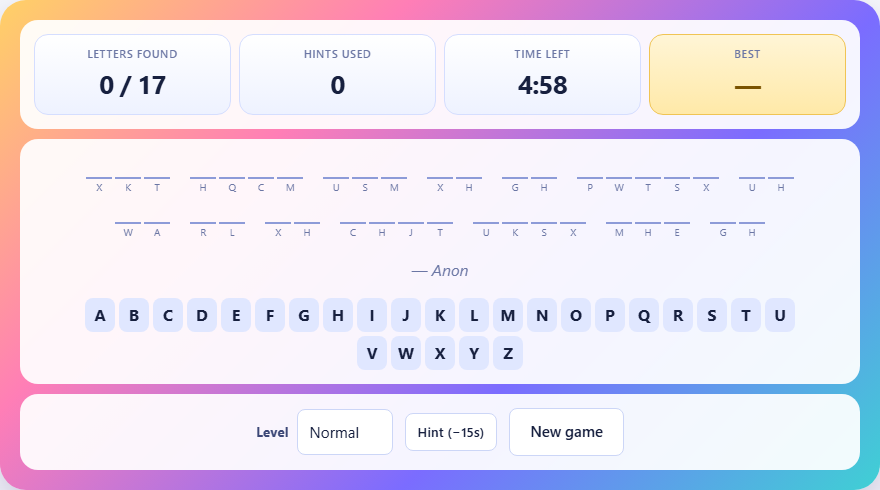
What the cipher does to the text
The game takes a quotation and swaps every letter for a different one. If A becomes G in this puzzle, then every A in the entire text becomes G. Spaces, punctuation, and capitalization stay the same. Only the letters change.
The cipher is a derangement, which means no letter is ever left standing for itself. A is never A. B is never B. You can rule that out for every letter before you start, and it matters more than it sounds.
Your job is to work out the full substitution table and read the original quotation. You do this by tapping a coded letter to select it, then typing or tapping the letter you think it really is. Every copy of that coded letter fills in across the whole text at once.
Controls and the hint button
Tap any coded letter on the board to select it. The selected letter gets a highlight. Then tap a letter on the alphabet strip below, or press a key on your keyboard. The coded letter is now mapped to the plain letter you chose, and every instance in the text updates.
If you change your mind, select the coded letter again and press a different key, or press Backspace to clear it. A plain letter can only be assigned to one coded letter at a time. If you assign it to a second coded letter, the first assignment is removed.
The Hint button reveals one correct letter and fills it in everywhere it appears. Each hint costs fifteen seconds off the clock. On a hard puzzle with a short timer, hints are expensive. On easy mode with a generous timer, they can get you past a wall without much pain.
Difficulty levels
Easy mode gives you seven minutes and starts with three letters already solved for you: E, T, and A. Those are the three most common letters in English, so you begin with a large chunk of the text already readable.
Normal mode gives you five minutes with no free letters. You start from nothing and rely on the techniques described below.
Hard mode gives you four minutes, also with no free letters. The quotations are the same length, so the pressure comes entirely from the shorter clock. Speed matters here, and hesitation costs you.
Starting with one-letter words
In English, the only common one-letter words are A and I. If you see a coded letter sitting alone between two spaces, it is almost certainly one of those two. Try A first, since it appears far more often in quotations than I does.
Once you know A, every A in the text lights up. That may reveal the start of words like AND, ARE, AT, or ALL, which gives you the next few letters. A single correct guess here can unlock a cascade of deductions.
Letter frequency as a compass
E is the most common letter in English by a wide margin. After E, the next most frequent are T, A, O, I, N, S, and H. The coded letter that appears most often in the text is usually E. The second most common is usually T or A.
This is not a guaranteed rule. A short quotation might have more T than E if the quote happens to use the word THE five times. But as a first guess it is right far more often than it is wrong, and being wrong costs you nothing except time.
Count the coded letters by scanning the text quickly. The one that appears eight or ten times in a forty-word quotation is your best candidate for E. Assign it and look at the result. If words start to look like English, you are right. If the text looks worse, undo and try the second most common letter.
Short words and word shapes
After one-letter words, look at two-letter and three-letter words. The most common three-letter word in English is THE. If you see a three-letter word whose first letter appears often in the text, try reading it as THE. That gives you T, H, and E in one move.
Two-letter words are also revealing. OF, TO, IN, IS, IT, and ON are the most common. If you already know a letter or two, a two-letter word may have only one possible reading.
Word shape matters as well. A five-letter word with the pattern X-Y-X-Z-X has a repeated letter in positions one, three, and five. That is a very unusual shape and narrows the options to a small list. Repeated letters inside a word are powerful clues because they reduce the number of English words that could possibly fit.
Apostrophes and double letters
An apostrophe followed by a single letter is almost always S or T. That comes from contractions like it's, that's, don't, and can't, and from possessives like Newton's. If you see an apostrophe in the text, the letter after it is one of your easiest wins.
A doubled letter pair narrows things dramatically. The most common doubles in English are LL, SS, EE, and OO. If you see two identical coded letters next to each other, try those four in turn. Combined with the word around them, the right choice usually becomes obvious.
Double letters at the end of a word are especially telling. A word ending in a doubled letter is very likely to end in LL, SS, or FF. A doubled letter in the middle of a word points to EE, OO, or TT.
Building momentum once you have five or six letters
The hardest part of a cryptogram is the first three or four letters. After that, the puzzle gets easier with every letter you solve, because more and more words become partly visible.
Once you can read fragments like _HE or TH_, your brain starts filling in the blanks automatically. A word showing as TH_S is almost certainly THIS or THUS. A word showing as _OULD is COULD, WOULD, or SHOULD. You stop reasoning about letter frequency and start reading.
At this stage, focus on the words that are almost complete. A six-letter word with five letters already showing has only one missing. Try each vowel or consonant until it clicks, then move on. The late game is fast if you let your reading instinct take over.
Mistakes that slow you down
- Guessing rare letters first. Start with E, T, A, and the short words. Do not try to figure out Q or Z until the rest of the text is mostly solved.
- Forgetting that no letter stands for itself. If a coded letter is G, the answer is never G. This rule is built into the cipher and saves you from a dead end every time you remember it.
- Using hints too early. Each hint costs fifteen seconds. If you use three hints in the first minute, you have lost forty-five seconds and probably could have deduced those letters yourself. Save hints for the last few stubborn letters where frequency analysis does not help.
- Staring at one word too long. If a word resists you, move to another part of the text. Letters you solve elsewhere may fill in the stubborn word on their own.
- Ignoring the author name. The author is shown under the quotation. It is not encoded and does not help directly, but knowing the author can sometimes remind you of a famous quotation, which gives away the entire text.
Your text never leaves your browser
The quotation is picked from a built-in list and encoded entirely on your device. No part of the puzzle, your guesses, or your score is sent anywhere. There is no account, no server, and no data to clean up.
The game works offline once the page has loaded. Your best time is stored in your browser on this device and does not follow you to another machine or another browser. Close the tab and the session is over.