
Cracking an addition where every digit hides behind a letter
How letter sum puzzles work, what the rules about repeats and leading zeros mean in practice, how to reason from the rightmost column leftward, and the specific deductions that cut through what looks like an impossible number of possibilities.
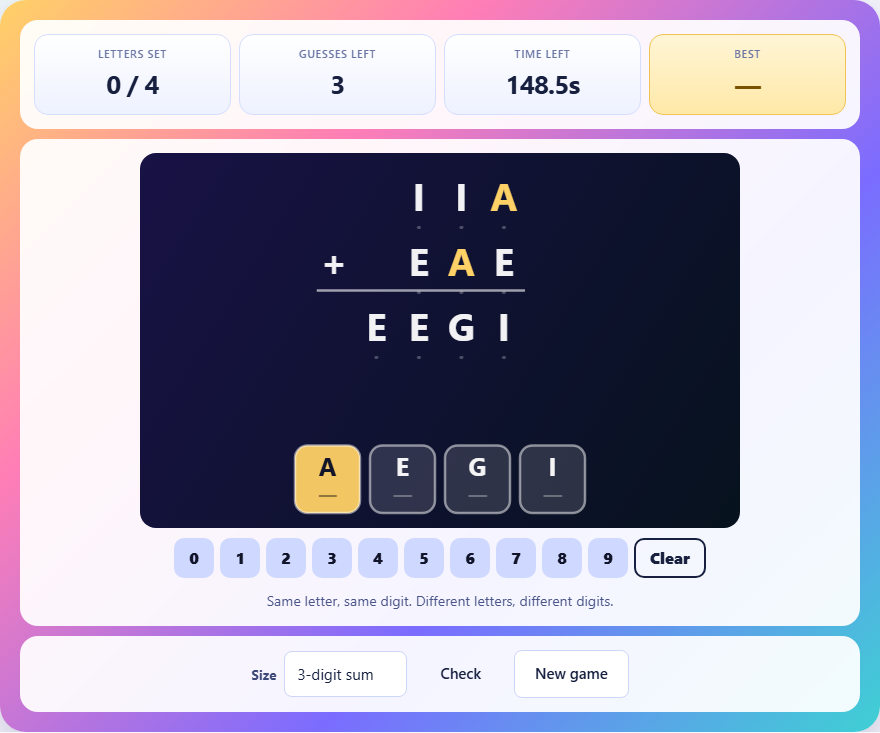
An addition problem in disguise
A letter sum shows you a column addition: two numbers on top, a line underneath, and their total below. But every digit has been replaced by a letter. The same letter always stands for the same digit. Different letters always stand for different digits. No number starts with a zero.
Your job is to figure out which digit each letter represents. There is exactly one assignment that makes the addition correct. The puzzle is built by starting with a real sum, encoding it, and then checking by brute force that no other assignment works. If more than one does, the puzzle is thrown away and a new one is made.
This type of puzzle is sometimes called a cryptarithm or an alphametic. The rules are the same everywhere: one letter, one digit, no sharing, no leading zeros, one answer.
How to assign letters
Tap a letter tile at the bottom of the board, or tap the letter directly in the sum. It highlights to show it is selected. Then tap a digit on the number pad. The digit appears under every copy of that letter in the sum.
If a digit is already assigned to another letter, it gets freed from that letter first. Two letters cannot share the same digit, so the pad greys out digits that are already in use. You can also tap Clear to remove a letter's digit and try again.
Once every letter has a digit, press the Check button. If the sum is correct, you win. If not, the game shows you what your numbers actually add up to, which helps you spot which column is wrong. Each failed check costs one of your limited guesses.
Size levels and what changes
The dropdown labeled Size offers three options. A two-digit sum uses numbers like 34 plus 52 equals 86, encoded with up to five letters. You get four guesses and two and a half minutes. These are short enough that you can sometimes solve them by trying a few values.
A three-digit sum uses numbers like 247 plus 385 equals 632, encoded with up to six letters. You get three guesses and two and a half minutes. The extra column adds a carry that makes simple guessing less useful.
A four-digit sum stretches the numbers further and allows up to seven letters. You still get three guesses but only two minutes and twenty seconds. With seven letters, there are over six hundred thousand ways to assign digits. You need reasoning, not luck.
Start from the rightmost column
The last column on the right has no carry coming into it. Two letters add up to a third letter, and the result is either their plain sum or their plain sum minus ten with a carry of one going left. That gives you a clean equation with three unknowns and no hidden carry to worry about.
Say the rightmost column reads A plus B equals C. If A plus B is less than ten, then C is just A plus B. If A plus B is ten or more, then C is A plus B minus ten and the next column gets a carry of one. Either way, the equation holds.
This is the only column where you can reason without wondering about a carry from the right. Once you settle it, move one column to the left and repeat. Now you know whether there was a carry, so the next column has the same clean shape.
The leading digit of a longer total
Sometimes the total is one digit longer than the two numbers being added. If both numbers are three digits long but their total is four digits, the leading letter of the total can only stand for one. Two three-digit numbers can never add up to two thousand or more, so the carry into that final column is always exactly one.
This is a free digit that the puzzle hands you before you have done any work. Place it immediately. It removes one letter from the problem and may grey out a digit on the pad that another letter was considering.
Even when the total is the same length as the addends, the leading letters cannot be zero. That rules out at least one digit for each of them, which is less dramatic but still narrows the field.
Letters that appear twice are the strongest clues
When the same letter shows up in two different columns, it must satisfy the arithmetic of both. Each column gives you one equation. Two equations sharing a variable usually pin it down.
For example, if the letter D appears in the rightmost column and also in the second column, you can write out both column equations with D as the unknown. The first column tells you what D plus some other letter equals. The second column tells you what D plus a different letter, plus a possible carry, equals. Those two constraints often leave only one or two possible values for D.
When you spot a repeated letter, solve its columns before the others. It is almost always the fastest path through the puzzle.
Each column is only ever off by one
A column adds two single digits plus at most a carry of one. The smallest possible result is zero plus zero, which is zero. The largest is nine plus nine plus one, which is nineteen. The digit at the bottom of the column is either the sum itself or the sum minus ten.
This means the digit below is never far from the digit above. If the top two letters add to twelve (plus a carry, maybe thirteen), the bottom digit is two or three. That is a very short list to check against the remaining free digits.
People who try values at random often miss this constraint. Column arithmetic in these puzzles is tight. Work it out on paper and you will see that most columns have only two or three candidate assignments.
A worked example with a two-digit sum
The board shows AB plus CD equals EF. Six letters, meaning six different digits. Start at the right: B plus D equals F, possibly with a carry. Start by assuming no carry. Then B plus D equals F, and all three must be different.
If B is three and D is five, then F is eight. That uses three digits: three, five, eight. Move left. A plus C, plus whatever carry came from the right column, equals E. We said no carry, so A plus C equals E. If A is one and C is six, E is seven. Check: 13 plus 65 equals 78. That works.
Now imagine B plus D is twelve instead. Then F is two and a carry goes left. A plus C plus one equals E. The numbers shift, but the method is the same: one column at a time, left to right, carrying when the sum passes ten.
Mistakes that burn your limited guesses
- Pressing Check before you have tested all the columns yourself. The game tells you the actual total your letters produce, which is useful feedback, but each wrong check costs you a guess. With only three guesses on normal and hard, you cannot afford to use Check as a trial tool.
- Forgetting the no-leading-zero rule. If you assign zero to the first letter of any of the three numbers, the game refuses the attempt but does not count it as a wrong guess. It does waste your time and break your train of thought.
- Ignoring a repeated letter. When a letter appears in two columns, solving those columns first cuts the problem down faster than anything else.
- Working left to right. The leftmost column depends on a carry from the column to its right, which depends on a carry from the column to its right. Start at the right end where there is no incoming carry.
- Assigning a digit that is already taken. The pad greys out used digits, but if you are reasoning on paper you may forget which digits are still free. Glance at the pad before you commit.
Everything runs on your own device
The puzzle is generated, checked, and played entirely inside your browser. No part of the sum, your guesses, or your score is sent to a server. Your best result is stored locally and stays on this machine.
Once the page has loaded, the game works offline. There is no account, no login, and nothing to clean up. Close the tab and the session ends.