
Solving cross sums by working what has to be true
How cross sum puzzles are structured, what the clue numbers mean, the forced sums you should memorize, how crossings pin down a digit from two directions, and the reasoning that replaces guesswork with certainty.
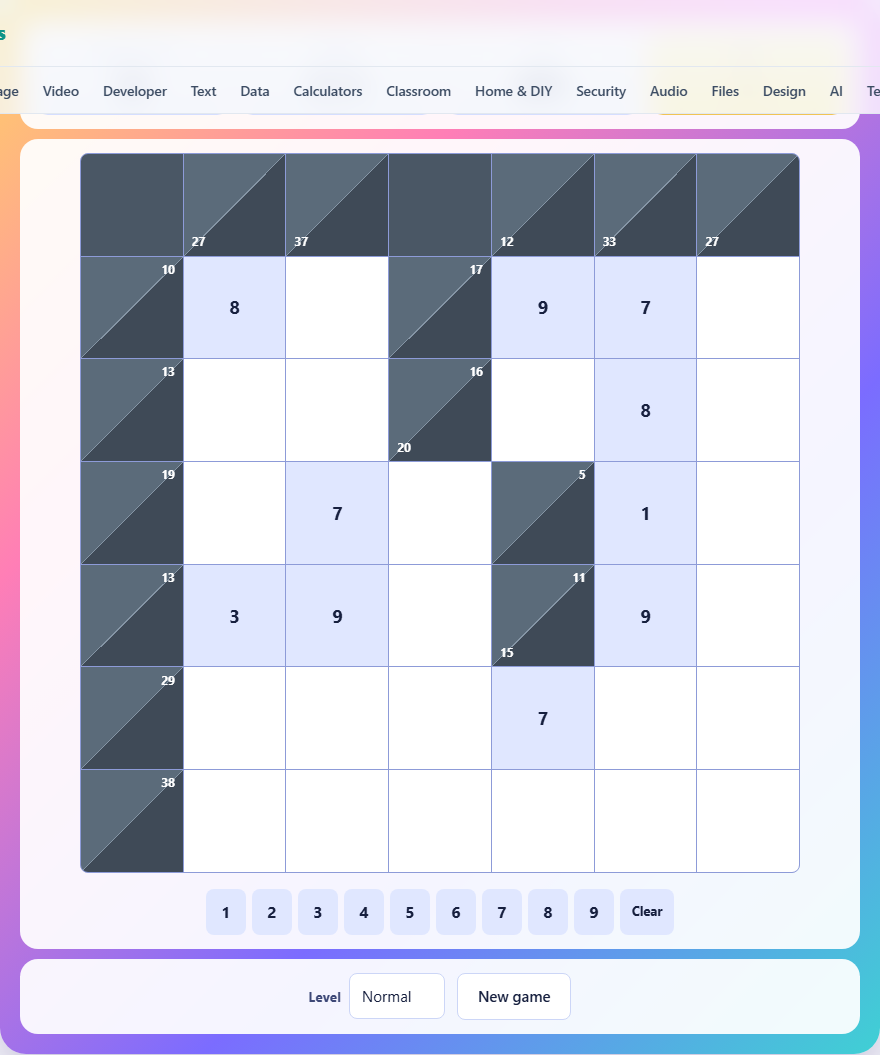
A crossword built from arithmetic
A cross sums grid looks like a crossword, but the white squares hold digits instead of letters. Black squares carry clue numbers. A number in the top-right corner of a black square tells you the total for the run of white squares going across to its right. A number in the bottom-left corner tells you the total for the run going down below it.
Only the digits one through nine are used. Zero never appears. Inside any single run, no digit may repeat. A run of three that totals six must be one, two, and three in some order, because one plus two plus three is six and nothing else works without repeating.
The grid is finished when every white square holds a digit, every run adds up to its clue, and no run contains a repeated digit. Five wrong entries will end the puzzle early.
How to enter digits
Tap or click a white square to select it. It gets a highlight to show it is active. Then tap a digit on the keypad at the bottom, or type a number on your keyboard. The digit appears in the square right away.
If the digit is wrong, it counts as a mistake. The stat bar shows your running total of wrong entries out of five. Pressing zero or the Clear button on the keypad removes a digit you have placed, which lets you reconsider without penalty.
Some squares start with a grey digit already in place. Those are given digits that you cannot change. They are there to make sure the puzzle has only one answer.
The forced sums worth memorizing
Certain clues leave no room for choice. A run of two that totals three can only be one and two. A run of two that totals four can only be one and three. A run of two that totals seventeen can only be eight and nine. These are the forced sums, and they are your best way into any grid.
At the other end, a run of two that totals sixteen can only be seven and nine. A run of three that totals six can only be one, two, three. A run of three that totals twenty-four can only be seven, eight, nine. The more extreme the total, the fewer ways it can be made.
Learn these by heart. When you see a run of two adding to three, you can write down both digits immediately. All that remains is which square gets the one and which gets the two, and the crossing clues will settle that.
Using the crossing points
Every white square sits at the crossing of two runs: one going across and one going down. A digit must satisfy both runs at the same time. This is the engine that makes cross sums solvable without guessing.
Say a square belongs to an across run of two totaling three and a down run of two totaling four. The across run must be one and two. The down run must be one and three. The only digit that fits both is one, so this square is one.
The same logic works even when the runs are longer. If the across run limits a square to one, two, or three, and the down run limits it to two, four, or six, the only overlap is two. That is your digit.
Working from what is left over
Once you have filled in part of a run, the remaining squares have to reach the clue with whatever digits are still available. This leftover arithmetic narrows your choices fast.
For example, a run of four with a clue of twenty. You have already placed a nine and a five in two of the four squares. The remaining two squares must add up to six using digits from one through eight, but nine and five are already taken. The only pair that adds to six without using nine or five is two and four. That settles both squares down to two options each, and the crossing clues will pin them.
Always do this subtraction before trying digits one at a time. It rules out more values at once and saves you from wrong entries that eat into your five allowed mistakes.
Difficulty levels and grid sizes
Easy mode gives you a six-by-six grid where no run is longer than three squares. Runs of two and three are the most constrained, so easy grids have lots of forced sums and few real decisions. Most squares can be settled by looking at one or two clues.
Normal mode uses a seven-by-seven grid with runs up to four squares long. The extra length means more possible combinations per run, so you rely more on crossings and less on forced sums. Expect to hold three or four candidates in your head for a square before the crossing run narrows it down.
Hard mode is eight-by-eight with runs up to four. The grid is bigger and the number of blank squares grows, but the principles are the same. Start from the forced sums, use crossings, subtract what you know. The timer counts upward, so there is no rush, but wrong guesses still cost you.
A walkthrough of a small grid
You see a run of two going across with a clue of three. That has to be one and two. Below the left square is a down run of two with a clue of four, which has to be one and three. The left square belongs to both runs. The across run says it is one or two. The down run says it is one or three. The overlap is one. Place it.
Now the across run's other square must be two, because one plus two equals three. The down run's other square must be three, because one plus three equals four. Two digits placed, and two more settled by simple subtraction.
That chain of logic is the whole game. No single step is hard. The challenge is keeping several runs in your head at once and spotting where two constraints meet.
Mistakes that waste your five chances
- Guessing when you are not sure. Every wrong digit costs one of your five allowed mistakes. If you are down to two possible digits for a square, check the crossing run before you pick one.
- Forgetting the no-repeat rule. A run of three adding to fifteen might look like it could hold a five, a five, and a five. It cannot. Each digit appears at most once per run.
- Ignoring the given digits. The grey squares are free information. Check what they force in their runs before you look at anything else.
- Trying big runs first. Long runs have many possible digit sets. Short runs have few. Always start with the shortest runs and the most extreme totals.
- Placing a digit that fits one run but not the other. Every square belongs to two runs. A digit that fits the across sum but breaks the down sum is still wrong.
Why every puzzle has one answer
The generator builds a complete grid first, reads the sums off the finished grid, and then solves the puzzle from scratch using only those sums. If the solver finds two valid grids, the puzzle is thrown away or patched by filling in a square whose value differs between the two solutions.
This is why some squares start pre-filled. Those are the squares that would allow a second answer if left blank. Filling them in removes the ambiguity. The result is a puzzle you can always solve by reasoning, with no point where you are forced to flip a coin.
Building a mental checklist
Fast solvers run the same routine on every square. First, list the possible digits for the across run. Second, list the possible digits for the down run. Third, find the overlap. If the overlap is one digit, place it. If it is two or three, move on and come back later when one of the crossing runs has more squares filled in.
This routine turns a confusing grid into a series of small, repeatable tasks. After a few puzzles it becomes automatic, and you spend your attention on the tricky squares instead of on remembering what to check.
No data leaves your machine
The grid is built and solved inside your browser. Nothing is sent to a server. Your timer, your mistake count, and your best time are all stored locally on this device. There is no account, no login, and no data to delete.
You can verify this by disconnecting from the internet after the page loads. The game continues without interruption, because it was never talking to anything outside your browser in the first place.