
Counting cribbage hands without the table
How the five scoring rules in cribbage actually work, how to count a hand quickly and correctly, what the game tracks and how the clock pressures you, and the specific mistakes that cost points at the table and on screen.
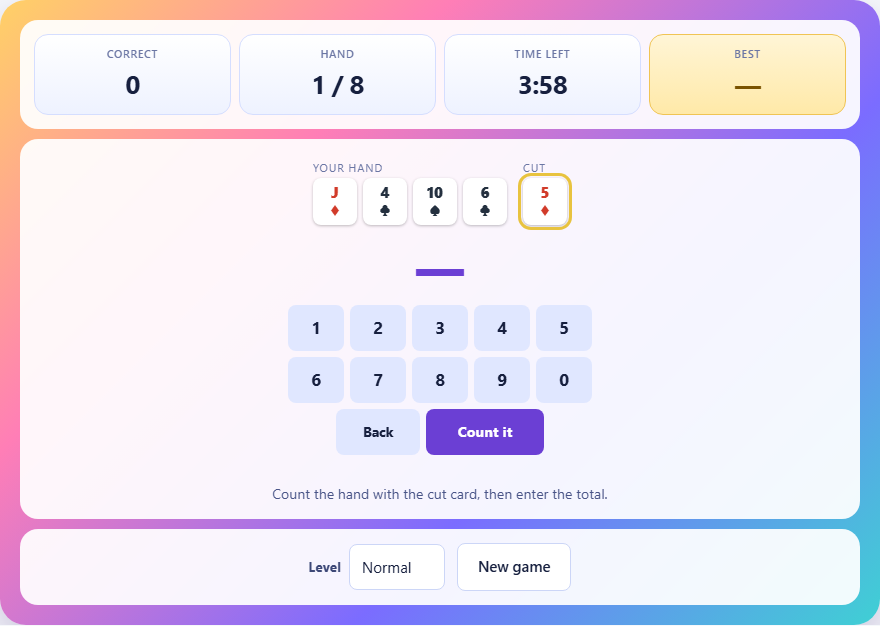
What the game asks you to do
You are shown four cards in your hand and one cut card. Your job is to add up the total score of that hand under cribbage rules and type the number before the clock runs out. Then you get a new hand, and another, and another.
The game is not a full round of cribbage. There is no pegging, no crib, and no opponent. It strips the game down to the one skill that separates good players from average ones: counting what the hand is worth, quickly and without mistakes.
Get enough hands right before time runs out and you win. Get too many wrong and the round ends early. The threshold is sixty percent, so on Normal difficulty you need at least five out of eight.
The five scoring rules
Every score in cribbage comes from one of five rules. They all apply to the same five cards: your four plus the cut. Go through them in order and you will not miss anything.
- Fifteens. Every combination of cards that adds up to fifteen scores two points. A five and a ten is two points. A seven and an eight is two points. A three, a five, and a seven is also two points. Count every combination, not just pairs.
- Pairs. Every pair of cards with the same rank scores two points. Two kings is two points. Three kings is three separate pairs, so six points. Four of a kind is six pairs and twelve points.
- Runs. Three or more cards in sequence score points equal to the length of the run. A three, four, five is three points. A three, four, five, six is four. If a rank appears twice, the run counts once for each way it can be made.
- Flush. If all four cards in your hand share a suit, that is four points. If the cut card matches the same suit, it is five. A flush that depends on the cut card alone does not count.
- His nobs. If your hand contains a jack whose suit matches the cut card, that is one point. It is easy to forget.
Court cards and the ten trap
A jack, queen, and king each count as ten when you are adding toward fifteen. A five and a king is fifteen, just like a five and a ten. But for pairs and runs, court cards keep their own rank. A jack and a queen are not a pair. A ten, jack, and queen do form a run.
This is the single most common counting error in cribbage. People treat all face cards as ten for everything, then wonder why their runs are wrong. The rule is simple: ten for adding, rank for matching.
Double runs and how to count them
When a rank appears twice inside a run, the run counts once for every distinct way it can be made. Three, four, four, five is a run of three that can be made two ways: three-four-five using the first four, and three-four-five using the second four. That is six points for the runs, plus two for the pair of fours, giving eight.
Three, three, four, five is the same idea the other way round. Two runs of three and a pair, eight points total. It does not matter which end has the duplicate.
Three fours with a three and a five is a triple run. The run of three can be made three ways, so that is nine points for the runs plus six for the three pairs, giving fifteen. These hands are rare but worth a lot, and they are exactly where people lose count.
The trick is to say the full name out loud. Double run of three is eight. Triple run of three is fifteen. Double run of four is ten plus the pair. Get those numbers into your memory and the arithmetic shrinks to addition.
Controls and difficulty levels
Type the total using the number buttons on screen or your keyboard. Press Count It or Enter to submit. The Back button or Backspace clears the last digit. You can enter any number from zero to ninety-nine.
Easy mode gives you six hands in four minutes and allows a margin of two points either way. Normal mode gives you eight hands in four minutes with no margin. Hard mode gives you ten hands in three and a half minutes, also with no margin.
The stat bar shows how many hands you have counted correctly, which hand you are on, and how much time remains. After you submit, the game tells you the correct answer whether you were right or wrong, then moves on to the next hand after a short pause.
A worked example
Your hand is seven of hearts, seven of spades, eight of clubs, and nine of diamonds. The cut card is six of hearts. Walk through the five rules.
Fifteens first. Seven plus eight is fifteen, and you have two sevens, so that is two fifteens for four points. Six plus nine is fifteen for two more. Six plus two equals eight, not fifteen, so no luck there. Seven plus eight is already counted. Total so far: six points.
Pairs next. The two sevens make one pair for two points. Total: eight.
Runs next. Six, seven, eight, nine is a run of four. The seven appears twice, so the run can be made two ways. That is eight points. Total: sixteen.
Flush. The four hand cards are in four different suits, so no flush. His nobs: no jack in the hand. Final answer: sixteen.
Strategy for speed
Count fifteens first and count them by starting with the fives. Every five pairs with every face card and every ten to make fifteen. Every pair of fives adds to ten, and any face card or ten completes the fifteen to thirty, which is not useful, but a five plus a five plus a five is fifteen on its own.
After fives, look for pairs of cards that add to fifteen: six and nine, seven and eight. Then look for three-card combinations. If nothing obvious appears, move on to pairs and runs instead of hunting for rare fifteens.
Runs are the fastest to spot. Sort the cards by rank in your head. If three or more sit next to each other, you have a run. Count the duplicates inside the run and multiply.
Save flush and nobs for last. Flush is a quick glance at the suits. Nobs is a quick check for a jack.
Mistakes that cost the most points
- Missing a fifteen that uses three cards. A two, a six, and a seven is fifteen. People who only check pairs of cards miss these every time.
- Treating jack, queen, king as a run. Jack-queen-king is a run. Ten-jack-queen is a run. But a nine, jack, queen is not a run because it skips the ten.
- Counting a flush when the four hand cards do not match. The cut card cannot rescue a flush. All four cards in your hand must share a suit first.
- Forgetting his nobs. One point for a jack in your hand that matches the cut card's suit. It is the smallest score and the easiest to leave on the table.
- Double-counting fifteens. A seven and an eight make fifteen once, not twice. Count each distinct set of cards only once.
The perfect hand and the impossible score
The highest possible score in a cribbage hand is twenty-nine. It takes three fives and a jack in your hand, with the fourth five cut from the deck in the same suit as the jack. That gives you eight fifteens for sixteen, six pairs for twelve, and one nob for one. Total: twenty-nine.
Nineteen is the joke score. No combination of five cards under the cribbage rules can ever add up to exactly nineteen. If someone at the table says their hand is worth nineteen, they mean it is worth nothing and they are being polite about it.
Everything stays in your browser
The cards are dealt on your own machine using your browser's random number generator. No data leaves the page. Your best score is saved in local storage on this device only and is not sent anywhere.
The page works offline once it has loaded. There is no account, no sign-up, and nothing to delete afterward. Close the tab and you are done.