
Folding paper flat with logic alone
How the crease puzzle works, what mountain and valley folds mean, how to read the colored circles, and the chain of reasoning that gets you from a blank grid to a sheet that lies flat - all grounded in a real theorem about origami.
Paper that folds flat, and what stops it
Take a sheet of paper and score it with a grid of lines. Each line is a crease. Fold the paper along one crease and it bends toward you or away from you. A fold that bends away is called a mountain. A fold that bends toward you is called a valley. Those two words are all the vocabulary you need.
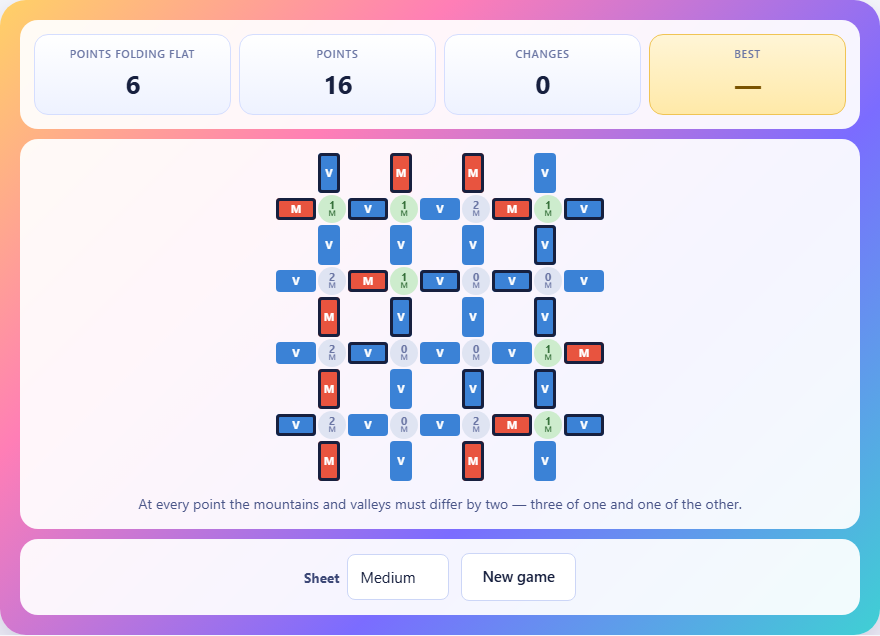
Now look at a point where four creases meet. If you want the paper to fold flat at that point, the mountains and valleys around it cannot be split evenly. Two mountains and two valleys will not lie down no matter how hard you press. The split must be three of one kind and one of the other. That is the rule for every single point on the sheet.
This is not a rule made up for the puzzle. It is a proven fact about paper, known in mathematics as Maekawa's theorem. The puzzle simply asks you to find the assignment that makes every point on the grid obey that rule at the same time.
What you see on the board
The board is a grid of creases with circles at the points where they cross. Each crease is colored. Red means it is currently marked as a mountain. Blue means it is currently marked as a valley. Some creases have a dark border around them. Those are fixed and cannot be changed.
Each circle sits at the meeting point of four creases. The number inside it tells you how many of those four are currently mountains. The circle turns green when the count is right, meaning one or three. It stays grey when the count is wrong, meaning zero, two, or four.
The goal is to turn every circle green. When that happens the sheet folds flat and the puzzle is finished.
Controls and how to play
Tap or click any crease that is not fixed to swap it. A red mountain becomes a blue valley, and a blue valley becomes a red mountain. That is the only action you can take.
The stats bar tracks three things: how many points are currently folding flat, the total number of points on the grid, and how many changes you have made so far. The game measures your skill by counting those changes. Fewer is better.
A dropdown labeled Sheet lets you pick the grid size. Small gives you a three-by-three grid of interior points. Medium gives you four-by-four. Large gives you five-by-five. The number of creases and points grows quickly, so the jump from medium to large is a real step up in difficulty.
Starting from the edges
The creases along the outside edge of the sheet each belong to only one point. A crease in the middle belongs to two points at once, so changing it affects two circles. But an edge crease affects only one. That makes edge creases the safest place to start.
Look at a corner point. It has four creases, but two of them sit on the edge and two sit inside the grid. If the two inside creases are both fixed, the edge ones are completely determined. You need three of one kind and one of the other, so count the fixed ones and fill in whatever makes the total work.
Even when the inside creases are not fixed, the edges give you more freedom because you can change them without disturbing a neighbor. Save the interior creases for later, when you have more information.
Following the chain
The most powerful move in this puzzle is not a guess. It is a deduction. When a point has three of its four creases already settled, the fourth is forced. There is only one value that will bring the mountain count to one or three.
That forced crease belongs to a second point as well. Fixing it may give that second point three decided creases, which forces its fourth. That forces a third point, and so on. One settled crease can cascade across the whole grid.
This is the chain. Chase it as far as it goes before you look anywhere else. On a small grid the chain from a single edge crease often solves the whole puzzle. On a large grid you may need to start two or three chains before they meet in the middle.
Why two and two never works
Two mountains and two valleys is the most natural-looking split. It feels balanced and tidy. It is also the one arrangement that paper refuses to accept. The layers of paper need to come back to where they started as you trace around the point, and an even split leaves them one layer out of step.
If you see a grey circle with the number two inside it, something around that point needs to change. You need to push it to three mountains and one valley, or to one mountain and three valleys. Both are valid. The puzzle always has a unique answer, so only one of those options will be consistent with the rest of the grid.
A circle showing zero or four is wrong for the same reason. Zero means all four creases are valleys. Four means all four are mountains. Neither of those can fold flat.
Interior creases affect two points
Every crease inside the grid touches two points. Swapping it to fix one point can break the other. This is the tension that makes the puzzle interesting.
Before you tap an interior crease, count both of its circles. If one circle is at two and the other is at three, swapping the crease will fix the first circle but may break the second. You need to check whether the second circle will land on one or on four. One is fine. Four means you just created a new problem.
The safest interior moves are the ones where both circles benefit. If both are at two and the crease is a mountain, swapping it to a valley drops both by one, giving you a one and a one. That is a clean move that fixes two points at once.
Common mistakes and how to avoid them
- Tapping at random when stuck. Every random swap has roughly a fifty percent chance of making things worse. Count the circles, find the forced crease, and move there instead.
- Ignoring the fixed creases. The dark-bordered creases are the puzzle's anchors. Start every new game by reading them and working out what they force at their points.
- Fixing one circle without looking at its neighbor. An interior crease always touches two circles. Check both before you tap.
- Trying to get all circles to two. Two is always wrong. The goal is one or three, never two.
- Starting in the middle of the grid. The middle is where every crease affects two points. Start at the edges, where creases affect only one, and work inward.
Thinking in parity
Once you are comfortable with the basic chain, try thinking in terms of parity. Each point wants an odd number of mountains: one or three. If a point currently has an even number, exactly one of its free creases must change. If it has an odd number already, either zero or two of its free creases must change.
On a medium or large grid this kind of counting lets you plan two or three moves ahead. You can trace a path through the grid and know before you start tapping that the sequence of swaps will leave every point along the way in a valid state.
This is the difference between solving the puzzle and solving it in few moves. The puzzle accepts any valid answer, but the move counter keeps score, and a player who plans a path will finish in half the moves of a player who reacts one circle at a time.
Your sheet stays on your own device
The puzzle is generated and checked entirely in your browser. No part of the grid, your moves, or your score is sent to a server. There is no account and no login. Your best score is stored in the browser on this device and stays there.
You can prove it by turning off your internet connection after the page loads. The game keeps working exactly as before, because there is nothing on the other end of the wire.