
Winning at the original wild card game
This guide covers the rules, scoring, and strategy behind a card game where matching the suit or rank is the only move, eights are wild, and the loser pays for what is left in their hand. You will learn when to hold an eight, when to dump a king, and how to read what the opponent draws.
The sort that picks the opponent's card
The other side is not playing the first thing it can. Every turn it gathers the cards it may legally put down, sorts that short list, and lays down whichever card ends up first. The legal test is three questions asked in a row: is this card an eight, does its suit equal the suit in force, or does its rank equal the rank of the card showing? One yes is enough.
Watch that middle question. It compares against the suit in force, not the suit printed on the card lying face up. The two are different once an eight has been played, because the eight sits on the pile in its own suit while a different suit is in force.
Eights come out of the list before any sorting happens. The legal cards are split in two: the eights, and everything else. As long as one ordinary card is playable, the eights stay put. Only an empty ordinary list sends an eight down, and then it is simply the first eight the hand happens to hold.
The ordinary cards are ordered by two keys. Key one is how many cards of that suit sit in its hand, counted across the whole hand with eights skipped. A bigger count comes first. Key two only settles ties, and it is the pip value of the card itself. The bigger value comes first, so the dearer card leaves the hand sooner.
Here is a real hand run through it. The pile shows the six of diamonds and diamonds are in force. The other side holds the queen of diamonds, the three of diamonds, the king of spades and the eight of clubs. Three cards pass the legal test: both diamonds by suit, and the eight because it is an eight. The king of spades fails all three questions, since it is not a diamond and not a six. Setting the eight aside leaves two candidates. The suit counts, with eights skipped, are diamonds 2, spades 1, hearts 0, clubs 0. Both candidates are diamonds, so key one ties at 2. Key two settles it: the queen is worth 10 and the three is worth 3, so the queen goes down and diamonds stay in force.
Now move the same hand a few turns on. Hearts are in force, the card showing is a four, and all that is left is the king of spades and the eight of clubs. Nothing ordinary is legal, so the eight finally goes down. The suit it calls comes from a fresh count of the cards still in hand, and this second count does include eights, which the first one did not. One card remains, the king of spades, so spades score 1 and every other suit scores 0. It calls spades. When two suits are level on that count, the winner is whichever comes first in the fixed order spades, hearts, diamonds, clubs.
If nothing at all is legal, it draws in a loop until something is, with a hard stop at 30 draws so the loop can never spin forever. Should the stock be gone and the hand still frozen, it says it cannot go and passes the turn straight back to you. The reply lands 620 milliseconds after your own card, which is a pause for the eye, not thinking time.
- Any ordinary card legal? Then no eight is played this turn, however tempting it looks.
- Among ordinary cards, the longest suit in its hand goes first, with eights left out of that count.
- Level on suit length, the pricier card wins: a queen at 10 points beats a three at 3.
- An eight goes down only when the ordinary list is empty, and it is the first eight in hand order.
- The suit it calls is the commonest suit in what is left over, eights counted this time, ties going to spades ahead of hearts, hearts ahead of diamonds, diamonds ahead of clubs.
What the loser pays, and where this version stops
The moment a hand runs empty, the cards left on the other side are added up on a fixed table. An eight is worth 50. The ten, the jack, the queen and the king are worth 10 apiece. An ace is worth 1. Anything else is worth the number printed on it, so a two is 2 and a nine is 9. Notice that the ten sits in the ten point group, which comes to the same figure as its face value anyway.
Put five real cards through that. You are caught holding the king of spades, the eight of hearts, the ten of diamonds, the three of clubs and the ace of spades. That is 10 for the king, 50 for the eight, 10 for the ten, 3 for the three and 1 for the ace. Add them: 10 + 50 + 10 + 3 + 1 = 74. The closing panel tells you that you were left holding 74 points.
That total becomes a score only when you are the one who went out. Lose, and nothing at all is handed to the scoreboard, so a defeat can never touch your Best figure. This also means the number beside Best is always a total the other side was holding, never one of yours.
One detail catches people out: on this page a smaller score is the better one. The Best chip keeps the lowest total you have ever won by. Go out while the other side still clutches a king, an eight and a ten and you score 70. Go out while they hold a lone two and you score 2, and that is the better entry here. The smallest a win can score is 1, because the cheapest card in the pack is the ace, and the code swaps in 1 anyway should a total ever come out as zero.
The hand size menu offers five, seven or nine cards, with seven picked to begin with, and both sides always get the same number. Out of 52 cards a seven card deal leaves 52 - 14 - 1 = 37 sitting in the stock once the starting card is turned. Five cards leaves 41 and nine leaves 33. Those are the figures the Stock counter opens on.
There is a quirk in how the pile is started. The starting card is never allowed to be an eight, because an eight with nobody to name a suit makes no sense. So cards are turned until one is not an eight, and any eight turned over on the way is thrown out of the game rather than put back. Two things follow. The Stock counter can open a card or two below the figures above, and those missing eights never turn up all game. It happens on roughly one deal in thirteen, since 4 of the 52 cards are eights.
The refill has a condition worth knowing. When the stock empties, the card showing is lifted off, the rest of the pile is shuffled and becomes the new stock, and the lifted card goes back down alone. If the pile is only that one card, there is nothing to shuffle and the refill quietly does nothing, which is when the turn just passes.
- No rank does anything special except the eight. There is no draw two on a two, no skip on a jack, no reversal and no stacking of penalties.
- Nothing carries between deals. Each game is scored on its own, so there is no long race up to 100 or 500 points across many hands.
- Two hands only, yours and one opponent. Three and four player variants, and the passing order that goes with them, are not here.
- You cannot take a card while you hold a playable one. The draw button refuses and tells you so, which rules out drawing on purpose to keep an eight back for later.
- The other side reads only its own cards and the pile. It keeps no note of which suits you drew on, so steering the game into a suit it once struggled with does not trap it a second time, and it cannot be bluffed.
The basic rule of play
Two players are dealt a hand of cards from a standard 52-card deck. One card is placed face up to start the discard pile. Players take turns playing one card from their hand onto the pile.
A card can be played if it matches the suit of the card showing on the pile, or if it matches its rank. If the pile shows the five of hearts, you can play any heart or any five. That is the only matching rule for ordinary cards.
Eights are wild. An eight can be played on any card regardless of suit or rank. When you play an eight, you choose the suit that the next player must follow. The eight's own suit no longer matters once it is on the pile.
Drawing and the stock pile
If you have no legal card to play - nothing that matches the suit and nothing that matches the rank - you must draw from the stock pile. The draw button becomes available only when you are truly stuck. If you have a card you could play, the game will not let you draw instead.
You keep drawing until you find a card you can play or the stock runs out. When the stock runs out, the discard pile is shuffled and becomes the new stock, minus the card currently showing on top. This recycling ensures the game always finishes. If after recycling the stock is still empty and neither player can move, the turn simply passes.
Drawing is painful. Every card you add to your hand is a card the opponent does not have to deal with, and if you lose, every card left counts against you.
Controls and the suit picker
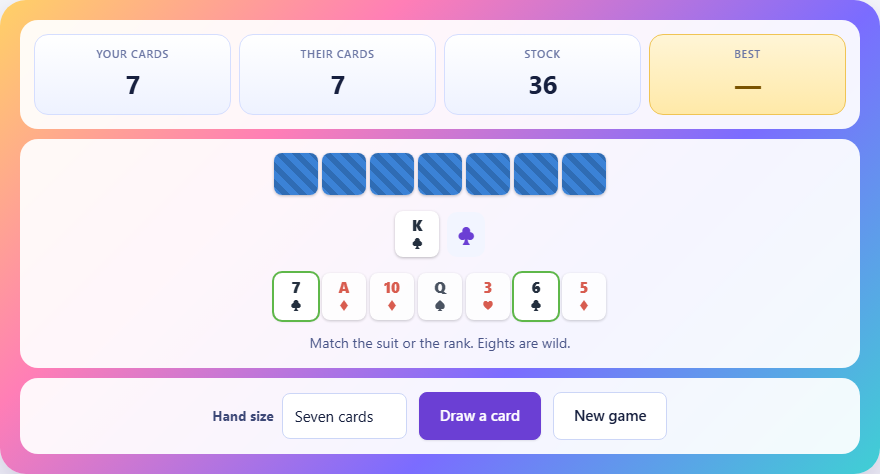
Your hand appears at the bottom of the screen. The opponent's cards show face-down at the top. The discard pile sits in the middle with the current suit marked next to it.
Tap any card in your hand that is legal to play it. Legal cards are highlighted. Cards that cannot be played are dimmed. Tap the Draw a card button when nothing in your hand matches.
When you play an eight, four suit buttons appear - spades, hearts, diamonds and clubs. Tap the suit you want the next play to follow. The opponent must then match that suit, play a card of any rank if it happens to match the rank of the eight, or play their own eight and call a new suit.
The New game button starts a fresh hand. The Hand size dropdown lets you choose five, seven or nine starting cards. More cards means a longer game with more decisions.
How scoring works
The first player to empty their hand wins the round. The loser is then charged for every card still in their hand. Each eight counts fifty points because it is the most powerful card in the game and should never be left unused. Face cards - jack, queen and king - count ten each. An ace counts one. Every other card counts its face value, so a seven costs seven and a three costs three.
The winner's score is the total points the loser was holding. A big loss means the loser was sitting on expensive cards - eights and face cards - and did not get rid of them in time.
Hold your eights as long as possible
An eight is a lifeline, not an opening move. It lets you play on anything and steer the suit wherever you want. Using it early means you will not have it later when you are stuck with no legal plays and facing a growing hand.
The ideal moment to play an eight is when you would otherwise be drawing. You are stuck, the suit is against you, and an eight saves you from adding cards. The second ideal moment is when it is your last card. Going out on an eight is almost impossible to block because it plays on anything.
If you play an eight in the first few turns just because you can, you have thrown away the strongest card in the deck for no reason. Keep it until it matters.
Shedding expensive cards early
If you lose with a king and an eight in hand, you are charged sixty points - ten for the king and fifty for the eight. If you lose with a two and a three, you are charged five. The difference is enormous.
When you have a choice between two equally legal plays, get rid of the more expensive card. Play the queen instead of the four. Play the jack instead of the six. Over many games, this habit cuts your losing scores in half.
There is one exception: do not shed an eight early just because it is expensive. The fifty-point penalty only matters if you lose, and keeping the eight helps you avoid losing in the first place. It is the one card worth the risk.
Controlling the suit
The suit on the pile is the single most important thing in the game. When the suit matches your hand, you can play freely. When it does not, you are stuck drawing. Managing which suit sits on the pile is how you gain control of the game.
Always prefer to play into the suit you hold the most of. If you have three diamonds and one spade, play a diamond rather than the spade. After your diamond is played, the suit is diamonds, and you still have two more diamonds ready for your next turns. Play the spade and the suit changes to spades, where you have nothing - and the opponent might.
Playing your only card of a suit is especially dangerous. If you play your single club, the suit becomes clubs and you have no follow-up. The opponent now controls the suit until you draw into it or play an eight.
Reading what the opponent draws
When the opponent draws, they are telling you something. They have no card matching the current suit and no card matching the current rank. If the suit is hearts and they draw three times before playing, they almost certainly have no hearts.
This information is gold. If you can steer the suit back to hearts later, the opponent will be stuck drawing again. Watching their draw patterns and targeting their weak suits is worth more than any single card in your hand.
The computer opponent does the same thing in reverse. It tracks suits, saves eights, and sheds expensive cards first. It is not a random player. Beating it consistently means playing the strategy, not just the cards.
When to call which suit on an eight
When you play an eight, you choose the suit that follows. The right choice is almost always the suit you hold the most of. Count your cards by suit, ignoring eights, and call the suit with the highest count. That gives you the longest run of playable turns before you might get stuck again.
If you have equal counts in two suits, call the suit with the more expensive cards. You want to shed those first, and having the suit set in your favour is the easiest way to play them out.
Calling a suit you have none of is almost never correct. It hands the advantage to the opponent for no gain. The only scenario where it makes sense is if you know the opponent also has nothing in that suit, which is hard to know unless they drew heavily when it was last called.
Common mistakes new players make
- Playing eights early for no reason. Save them for when you are stuck or when they are your last card.
- Holding face cards too long. They cost ten points each if you lose. Play them before the twos and threes.
- Ignoring the opponent's draws. If they draw three times on a suit, steer the game back to that suit whenever you can.
- Playing your only card of a suit. This sets the pile to a suit you cannot follow up on. Prefer the suit you have the most of.
- Not counting suits. Glance at your hand before each turn and note which suit you have the most of. That should be your target suit.
- Drawing when you have a legal play. The game prevents this, but some players look at their hand too quickly and miss a match. Check both suit and rank before reaching for the draw button.
The deck stays on your device
The entire game runs in your browser. No cards, no scores, and no game state leave the page. The deck is shuffled locally and the computer opponent makes its decisions right there on your machine. There is no server to connect to, no account to make, and nothing to clean up when you close the tab.
Once the page loads, it works with no internet connection. Your best score stays in your browser's local storage on this device and is never sent anywhere else.