
Reaching a target with arithmetic and six numbers
This guide covers the rules, controls, and strategy behind a game that deals you six numbers and a three-digit target. You will learn how to combine tiles step by step, why division is the most restricted operation, and how to work backwards from the target to find a path through the numbers.
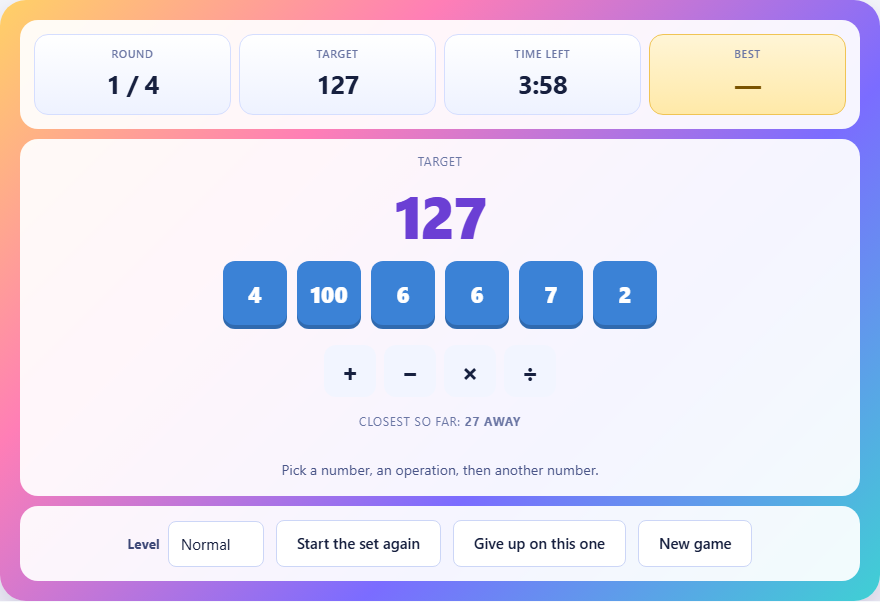
The setup and what you are given
Each round deals six number tiles and a target between 101 and 999. Your job is to combine the tiles with addition, subtraction, multiplication and division until you reach the target exactly. You do not have to use all six tiles. If you can hit the target with just two or three, that is a perfectly good answer.
The tiles come from two pools. Big numbers are drawn from 25, 50, 75 and 100. Small numbers are drawn randomly from 1 through 10. The difficulty level controls how many big numbers appear. Easy gives you two big numbers, normal gives you one, and hard gives you none at all - just six small numbers, which makes reaching a high target much harder.
Two rules that change everything
Two constraints separate this from plain arithmetic. First, every intermediate step must produce a whole number. You cannot divide 7 by 3 and get a fraction to use later. If the division does not come out even, the game blocks it. Second, every intermediate step must stay positive. You cannot subtract a larger number from a smaller one to get a negative result.
These two rules sound minor but they eliminate most of the paths through the numbers. They are why the last step in a solution is so often a subtraction - you build up to something near the target with multiplication, then adjust downward with whatever small number is left. They are also why some targets are genuinely impossible with a given set of tiles.
Controls and how combining works
Tap a number tile to select it. It highlights. Tap an operation - plus, minus, times or divide. Tap a second number tile. The two tiles merge into a single new tile showing the result. The original two are gone and the result takes their place.
If the combination is not allowed - a fraction from division, or a negative from subtraction - the game tells you and resets the selection. Nothing is lost. You still have the same tiles you started with.
The order of selection matters for subtraction and division. If you pick 100 first, then minus, then 75, you get 25. If you pick 75 first, then minus, then 100, the result would be negative and the game blocks it. The game always subtracts the smaller from the larger and divides the larger by the smaller, so the order of tile selection does not actually matter - it handles it for you.
If you get stuck or make a wrong turn, the Start the set again button puts all six original tiles back. You do not lose time on the clock for resetting.
Scoring and winning the game
A game consists of several rounds - three on easy, four on normal, five on hard. Each round deals fresh tiles and a new target. A countdown timer runs across all rounds. Easy and normal give you four minutes. Hard gives you three and a half minutes for five rounds, which is tighter per round.
You win by solving more than half the rounds exactly before time runs out. On easy, that means two out of three. On normal, three out of four. On hard, three out of five. Close does not count. Only an exact hit on the target scores a round.
The Give up on this one button skips to the next round. When you skip, the game tells you whether the target was actually reachable with those tiles. If it was not, nobody could have solved it and you lost nothing by moving on.
Working backwards from the target
The strongest general strategy is to look at the target and ask what multiplies or divides into it. If the target is 456 and one of your tiles is 6, then 456 divided by 6 is 76. Now you have a smaller problem: make 76 from the remaining five tiles. That is much easier.
If the target is 837 and you have a 75, notice that 75 times 11 is 825, which is only 12 away. Can you make 11 from two small tiles? Can you make 12 from what is left? This kind of backward reasoning - starting from the target and working toward the tiles - finds paths that forward guessing misses.
Division is the most powerful tool here because it collapses large targets into small ones in a single step. But it only works when the division comes out whole, so check the arithmetic before you commit the tiles.
The big-number-first approach
Most solutions follow the same general shape. Start with the biggest numbers and get within a hundred of the target. Then use the small numbers to close the gap.
For example, suppose the target is 743 and your tiles are 100, 75, 7, 4, 3, 2. Start with 100 times 7, which gives 700. You are 43 away. Now 75 minus 4 times 3 would give you a fraction, so try another path: 75 minus 2 is 73, and 73 minus something? That does not help either. Instead try 4 times 3 which is 12. Then 75 minus 12 is 63. That is too far. Try 75 minus 3 times 2 - but remember, you can only do one operation at a time. So: 3 times 2 is 6. Then 75 minus 6 is 69. Still not 43.
This is where resetting and trying a different approach pays off. Maybe 100 times 7 was the wrong starting point. Try 75 times 10 instead - but you do not have a 10. However, 7 plus 3 gives 10, and 75 times 10 gives 750. Now you are only 7 away, but you already used the 7. These dead ends are normal. The game rewards flexible thinking, not a fixed method.
When the target cannot be reached
Some combinations of tiles simply cannot produce certain targets no matter what you do. The game solves every board itself before dealing it. Most boards it deals are solvable, because it keeps generating until it finds one that is. But on rare occasions, especially on hard difficulty with no big numbers, a target may be out of reach.
When you press Give up, the game tells you honestly whether the target was reachable. If it says the target could not be reached, you have not failed - the puzzle was impossible and you correctly recognised that it was time to move on. This feedback is one of the best features, because the worst feeling in a numbers game is giving up on something that had a beautiful solution you missed.
Common mistakes and traps
- Burning big numbers early on addition. Adding 100 and 75 gives 175, which is rarely useful. Multiplication with big numbers covers far more of the target range.
- Forgetting you can reset. If you have combined four tiles and the remaining two cannot close the gap, do not stare at them. Reset and try a completely different path. The clock is the only cost.
- Ignoring factors of the target. Before combining anything, spend five seconds checking whether the target divides evenly by any of your tiles. A clean division solves half the puzzle in one step.
- Using all six tiles when three would do. A shorter path is usually easier to find and leaves spare tiles as insurance. You do not get a bonus for using everything.
- Spending too long on one round. If a minute has passed and you have no progress, give up and move on. Three quick solves beat one slow one when the clock is shared across all rounds.
Differences between the three difficulty levels
Easy deals two big numbers out of 25, 50, 75 and 100. Having two big numbers makes it much easier to get close to the target in one or two steps. You get three rounds and four minutes.
Normal deals one big number and five small ones. This is the standard challenge. The single big number anchors your approach, and the small numbers do the fine adjustment. Four rounds in four minutes.
Hard deals no big numbers at all - six tiles from 1 to 10. Reaching a target like 937 from single-digit numbers requires long chains of multiplication, and the margin for error is tiny. Five rounds in three and a half minutes. This is where the game really tests both arithmetic skill and clock management.
Everything runs in your browser
The entire game, including the solver that checks whether each target is reachable, runs on your own device. No tiles, no answers, and no scores leave the page. There is no account and no data to clean up. Once the page loads, it works without an internet connection.
Your best score is kept in your browser's local storage on this device only. It is never uploaded and will not appear on a different computer.