
Training spatial memory with a block sequence task
This guide covers the rules, scoring, and strategy behind the block-tapping memory test - a task that measures how long a spatial sequence you can hold in your head. You will learn what the span number means, how to push past the five-block plateau, and why naming positions out loud is the worst thing you can do.
What the task measures
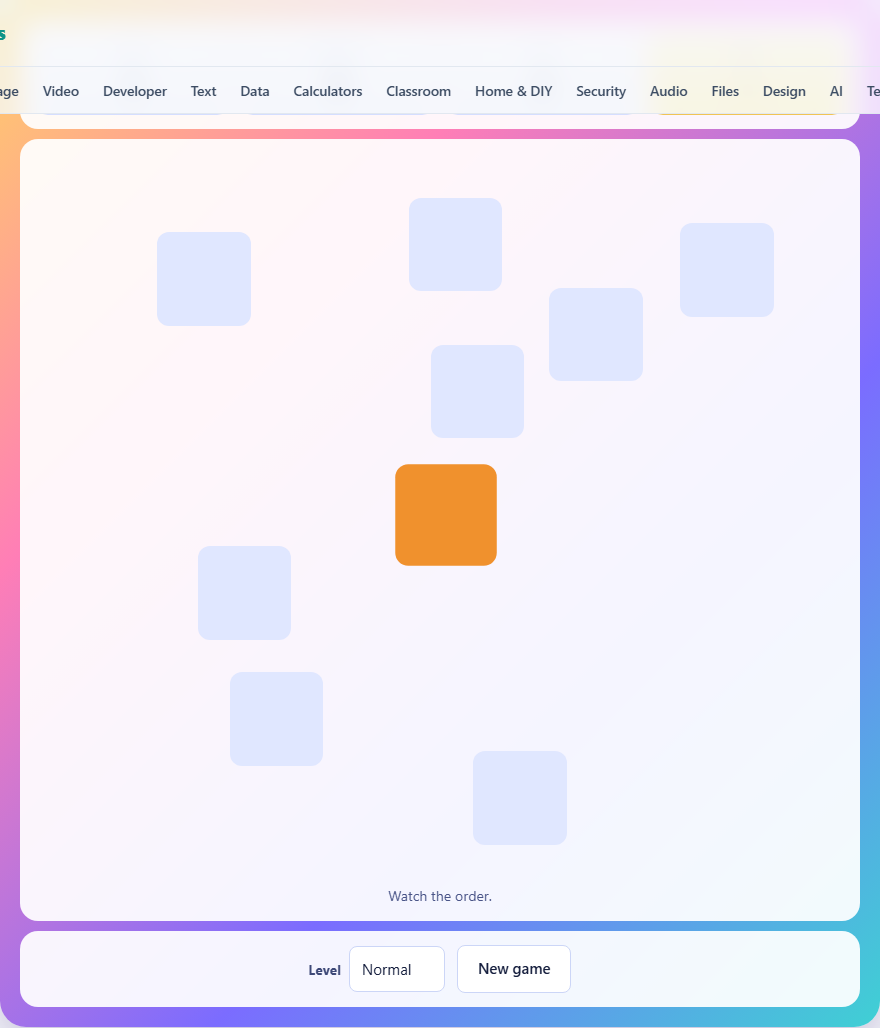
The test is based on a well-known psychology task for visual and spatial short-term memory, used in research since the nineteen seventies. The idea is straightforward: blocks light up one at a time in a scattered layout, and you tap them back in the same order.
What it measures is your visuospatial sketchpad - the part of working memory that holds positions and routes rather than words and numbers. A digit span test measures verbal memory. This measures the other kind. Most adults can hold about five or six positions in sequence. Nine is near the top of the published range.
The score is not how many rounds you complete. It is the longest sequence you managed to repeat correctly. That single number is your span, and it is what the research literature reports.
How a round works
Each round begins with the blocks lighting up one after another. A short tone plays with each flash so you know the pace. You cannot tap anything during the demonstration - any clicks are ignored until the sequence finishes.
Once the last block has flashed, the prompt changes and you tap the blocks back in the same order. Not the reverse order - the same order you saw them. Each correct tap lights the block briefly to confirm it. A wrong tap ends the round immediately.
If you get the whole sequence right, the next round adds one more block. The sequence grows until you slip up. When you run out of lives, the game ends and your span is recorded.
Controls and difficulty levels
Tap or click a block to select it. That is the only control. There are no keyboard shortcuts and no way to undo a tap once it is made.
The Level dropdown offers three settings. Easy starts the sequence at two blocks and gives you three lives, so you can afford two mistakes before the run ends. Normal starts at three blocks with two lives. Hard starts at four blocks and gives you only one life - a single mistake finishes the game.
On easy and normal, the board shows nine scattered blocks. On hard, it expands to twelve, which increases the visual field you need to scan and makes each position harder to distinguish from its neighbours.
Why the blocks are scattered
The blocks are not arranged in a neat grid. They are placed at random positions across the board, with enough spacing that you can tap each one cleanly. This is deliberate and it is the whole point of the original task.
A tidy grid can be memorised with words. You could say top-left, middle, bottom-right and convert the spatial task into a verbal one. Irregular positions force you to hold the actual route in visual memory rather than translating it into labels. People who rely on verbal labels stall at about four blocks. People who trace the path with their eyes reach six or seven.
Each new game generates a fresh layout, so you cannot memorise a fixed board and reuse the same labels across rounds.
Tracing the path instead of naming positions
The single most effective strategy is to watch the sequence as a movement through space rather than a list of locations. As each block lights up, follow it with your eyes. Let the path form a shape - a triangle, a zigzag, a loop - and hold that shape in your mind.
When it is your turn to tap, retrace the shape. Your hand follows the path your eyes drew. This is spatial memory working the way it was designed to, and it scales to longer sequences far better than naming does.
If you catch yourself thinking words like top block or the one near the corner, you have shifted into verbal mode. That shift feels natural but it costs you. The verbal buffer holds about four items, which is one less than the spatial buffer. Let the shape do the work.
Chunking longer sequences
Once sequences reach seven or eight blocks, even spatial tracing gets difficult. This is where chunking helps. Instead of holding eight individual positions, break the sequence into two or three groups and remember each group as a single shape.
For example, the first four blocks might form a rough square. Hold that as one shape. The next three might form a line going downward. Hold that as a second shape. Now you are remembering two shapes instead of seven positions, and two shapes fits comfortably in working memory.
People who score nine or above are almost always chunking. They are not remembering nine separate blocks. They are remembering three small shapes that happen to contain nine blocks when laid end to end. This technique takes practice but it is the only reliable way past eight.
Do not rush the reply
There is no timer running while you tap back the sequence. The game waits as long as you need. This is important because hurrying is how a remembered path turns into a guess.
After the sequence finishes playing, take a breath. Let the whole shape settle in your mind before you start tapping. If you begin immediately, the last block is fresh and the first block is already fading. A short pause gives the entire sequence equal footing in memory.
Speed matters during the watching phase - you need to keep up with the flashes. But the tapping phase is yours to pace however you like.
Common mistakes and how to fix them
- Naming positions out loud. Verbal labels cap your memory at about four blocks. Switch to tracing the path with your eyes and holding the shape silently.
- Tapping before the sequence finishes. Clicks during the demonstration are ignored, but they break your concentration. Keep your hands still until the prompt changes.
- Looking away during the demonstration. Every glance elsewhere drops a block from the path. Keep your eyes on the board from the first flash to the last.
- Rushing the first tap. The most common error is getting the first block wrong because you started before the full path had settled. Pause briefly after the last flash.
- Ignoring the shape of the path. Long sequences become impossible if you try to remember each block as a separate fact. Group them into two or three shapes.
What a score of five or six actually means
The published average for adults is around five. That does not mean five is bad. It means most healthy adults with normal working memory land there. A span of six is above average. A span of seven or eight is well above it. Reaching nine puts you near the ceiling of the published range.
The test is sensitive to fatigue, distraction, and practice. Your first attempt of the day is usually a block or two shorter than your best attempt after a few warm-up rounds. If you score a four on your first try, play three more games before judging your span. Most people improve by one or two blocks over their first five games simply from learning how the sequence flows.
The best score you reach is stored in your browser and shown in the stats bar. It stays between sessions on the same device but is never sent anywhere. It is a personal benchmark, not a leaderboard. Comparing your score across days can be interesting - a tired evening might produce a four, and a fresh morning might produce a seven from the same person.
Your data stays on your machine
The whole game runs inside your browser. No sequence data, no score, and no personal information is sent to any server. There is no account, no login, and nothing to delete when you are done.
Your best score is saved in your browser's local storage so it appears the next time you open the page on the same device. It does not follow you to a different computer or a different browser. If you clear your browser data, the score goes with it. That is the only record, and you control it.