
Sorting colours, not fitting shapes
How Gem Columns differs from other falling-block games, what cycling does, why cascades are worth far more than single clears, and the habits that keep the well tidy long enough to set one off.
A different kind of falling-block game
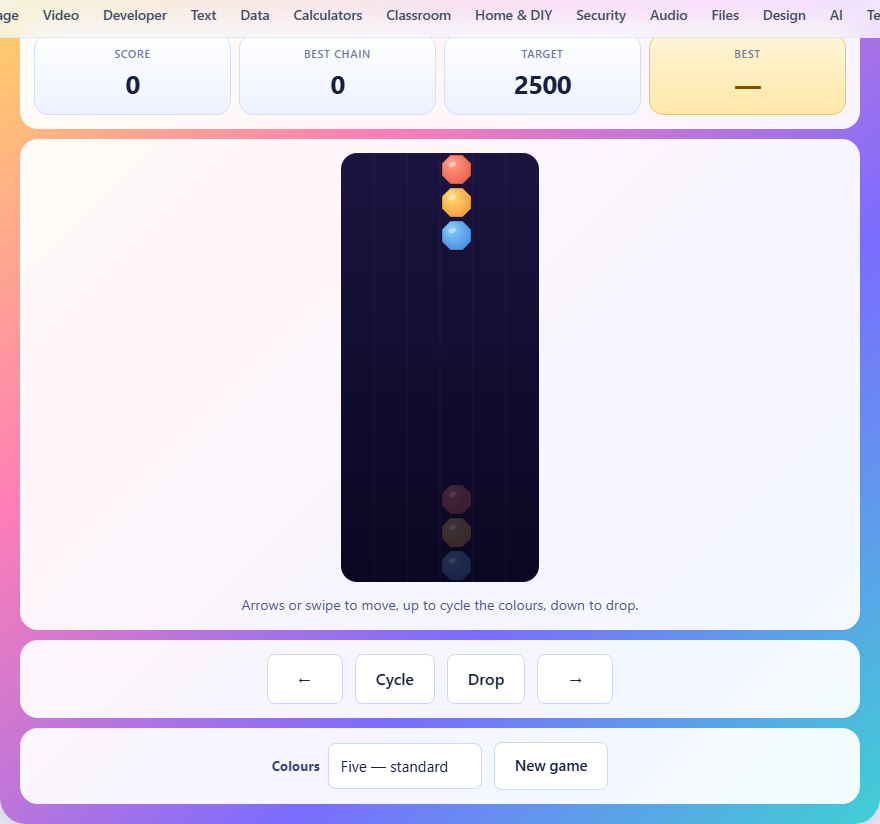
A column of three coloured gems falls down a well that is six cells wide and thirteen rows tall. You cannot rotate it. The piece is always vertical, always three gems high, and always one cell wide. What you can do is rearrange the colours inside it.
That single change moves the game away from shape packing and into colour sorting. You are not hunting for a gap that fits a specific outline. You are looking for a column where a particular colour needs to go. The piece always fits. The question is whether the colours land in the right places.
Controls on keyboard and touch
The left and right arrow keys slide the column one cell in that direction. On a phone, swipe left or right. On-screen buttons do the same thing.
The up arrow or the Cycle button rotates the colours within the column. The bottom gem moves to the top, and the other two shift down. Three taps bring you back to the starting order. This is the only way to rearrange the piece, and it is worth planning before you drop.
The down arrow moves the column one row lower. A downward swipe or the Drop button sends it all the way to the bottom in one go. Use the slow drop to fine-tune the landing and the fast drop when you are sure of the position.
Making a match
Three or more gems of the same colour in a straight line will clear. The line can run across a row, down a column, or along either diagonal. Both diagonals count, which is the detail beginners forget most often.
When a line clears, the gems vanish and everything above them drops down to fill the gap. If that drop creates another line of three, that clears too, and the process repeats. Each clear in the chain is called a link in the cascade, and each link scores more than the last.
How scoring works
Each gem in a cleared line is worth ten base points. That base is then multiplied by the square of the chain number. The first clear in a cascade scores ten points per gem, multiplied by one. The second clear scores ten per gem multiplied by four. The third multiplies by nine, the fourth by sixteen, the fifth by twenty-five.
The arithmetic is steep. A five-gem line in the first clear of a cascade scores fifty points. The same five-gem line as the fifth clear in a cascade scores twelve hundred and fifty. Almost every high score comes from one well-built cascade rather than from a long run of single clears.
The three colour settings
Four colours is gentle. Fewer colours mean more matches happen by accident, and the well stays clear for a long time. The target score is 1,500. This is the place to learn the controls and get a feel for how cascades form.
Five colours is the standard game. The target rises to 2,500 and the column falls faster. Matches are harder to arrange because each colour appears less often, so you need to be more deliberate about where you stack things.
Six colours is hard. The target is 4,000, the fall speed is the fastest, and the well fills up quickly if you scatter colours at random. Keeping a tidy stack matters more here than on any other setting.
Keep one colour in one place
The single most useful habit is to assign colours to regions of the well. Blue goes on the left, red in the middle, green on the right, and so on. You do not need to be strict about it. The goal is to keep gems of the same colour close together so that a third one can finish the line from almost anywhere.
Scattering a colour across the whole well wastes it. Three reds spread across six columns will never form a line. Three reds stacked in two neighbouring columns are one drop away from clearing.
When a column arrives with colours you cannot use in your preferred spots, cycle it until the least harmful arrangement faces down and place it in the column that does the least damage. Not every piece helps. Some just need a safe place to land.
Setting up a cascade
A cascade happens when clearing one line makes gems drop into a new line. To set one up, you need a stack where one colour sits above another, with a third colour blocking the lower match. When the blocker clears as part of a different line, the upper gems fall into position and trigger the next link.
The simplest cascade uses two colours. Build a horizontal line of colour A across the bottom, then stack a few gems of colour B on top. When colour A clears, colour B falls. If three or more of B now sit in a line, it clears too. Two links, four times the base score on the second one.
Longer cascades need more layers. Each layer is a colour that becomes a line only after the layer below it clears. Planning three or four layers in advance is hard, but even an accidental two-link cascade is worth far more than two separate clears.
Watch the diagonals
Diagonal matches count in both directions. A line running from the bottom-left to the top-right clears, and so does a line from the bottom-right to the top-left. This catches players in two ways.
First, a diagonal match can fire when you did not intend it, clearing gems you were saving for a cascade. Before you drop a column, glance at both diagonals to make sure you are not about to break your setup.
Second, a diagonal you did plan can be one of the most effective clears in the game. Diagonal lines are harder to spot, which means fewer players use them on purpose. If you train yourself to look for them, you gain a tool that most beginners miss.
The ghost column
A faint copy of the falling column appears at the bottom of the well, marking exactly where the piece will land. It shows which cells the three gems will occupy, so you can confirm a diagonal or check whether a stack is about to trigger before you commit.
The ghost is especially useful when the well is deep. Without it, you would have to count rows by eye to judge whether the column will reach a gap or sit on top of a stack. Use it every time you are about to drop.
When the game ends
There are two endings. If you reach the target score, you win. If a new column has no room to appear because the stack has reached the top of the well, you lose.
The lose condition checks the top three rows. When the column in the centre is blocked at row three, the next piece cannot spawn and the game is over. A tall stack in the middle of the well is more dangerous than one at the edge, because the piece always spawns in the centre.
Mistakes that end games early
- Dropping fast without checking. The ghost column shows where things land. A second of thought prevents a misplaced piece that takes five moves to fix.
- Letting the centre column grow tall. The piece spawns in the middle. If that column is the tallest, you run out of room sooner.
- Ignoring the cycle button. Many players slide the column into position and drop without ever cycling. That wastes two thirds of the piece, because only the bottom gem is placed where you want it.
- Chasing single clears instead of building cascades. Ten points for three gems is a slow way to reach a target of 2,500.
- Scattering colours. Every gem placed away from its colour group is a gem that can never help form a line.
Everything runs on your own device
The well, the gems and the score are all handled inside your browser. No move is sent to a server, no account is needed, and no data is collected about how you play. The game works offline once the page has loaded. Your best score lives in this browser on this device and does not follow you to another machine.