
How voice leading works, one tap at a time
What the twelve-note wheel means, how major, minor and diminished chords differ, why neighbours need a shared note and a short leap, and the tactics that turn a row of blanks into a finished progression.
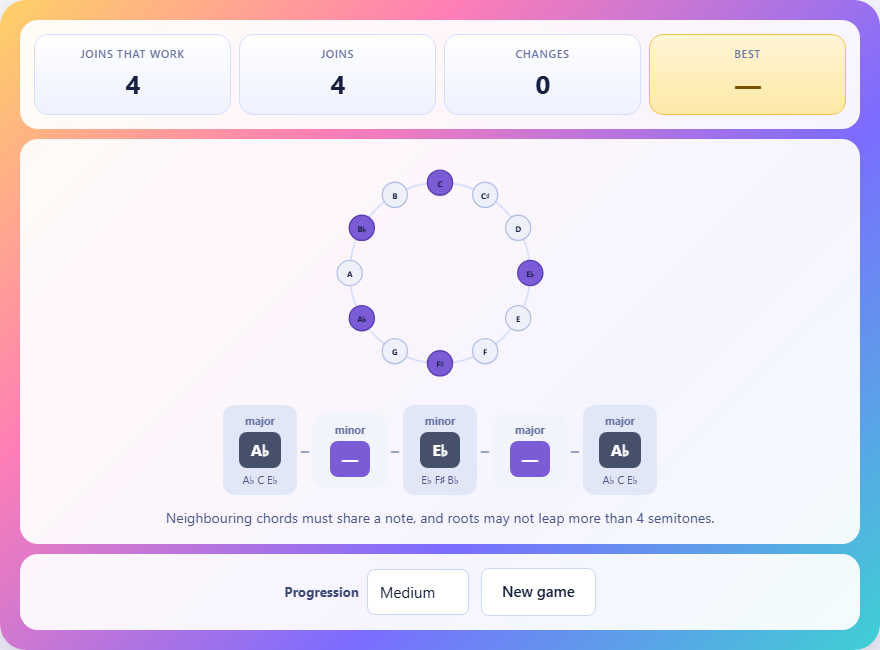
The idea behind the puzzle
When one chord moves to the next in a song, the smoothest changes keep at least one note the same. A pianist calls that a common tone. The other notes shift by a step or two, and the ear hears a gentle move rather than a sudden jump. That principle sits at the heart of Chord.
You are given a row of slots. Each slot has a quality printed on it - major, minor or diminished - but no root. Your job is to pick a root for every slot so that each pair of neighbours shares at least one note and the roots stay close together on the wheel. Fill every slot, satisfy every join, and the progression is complete.
The wheel and the twelve notes
A circle of twelve notes sits beside the slots. These are the twelve semitones of Western music, starting at C and running through all the sharps and flats until they loop back round. The wheel is not decoration. It shows the distance between any two notes at a glance.
C and C sharp are one step apart. C and D are two. C and F sharp are six, which is as far apart as two notes can be because the wheel wraps. That wrap is the single fact most players forget. B to C is one semitone, not eleven. If your mental arithmetic treats them as far apart, you will miss legal roots that sit right next to each other.
Building a chord from a root
Once you know the root, the quality tells you which three notes the chord contains. A major chord takes the root, the note four semitones above it, and the note seven above. For a root of C that gives you C, E and G. A minor chord uses three and seven instead, so C minor is C, E flat and G. A diminished chord uses three and six, giving C, E flat and F sharp.
The game shows the three notes under each slot as soon as you set a root. That list is the one you compare with the neighbour. If any single note appears in both lists, the shared-note rule is met.
The two rules that join slots together
Between every pair of neighbouring slots sits a small marker. It shows a tick when both rules pass and a cross when either one fails.
Rule one is the common tone. The two chords must share at least one of their three notes. Rule two is the leap limit. The roots of the two chords must not be more than a stated number of semitones apart on the wheel. On a Small board that limit is three. On Medium and Large it is four.
Both rules must hold at the same time. Two chords can share a note but have roots that are too far apart, and two roots can be neighbours on the wheel but produce chords with no note in common. The tick only appears when both conditions are true.
Controls and how a turn works
Tap or click a slot to move its root one step round the wheel. The root advances from C to C sharp to D and so on. After B it wraps to empty, and the next tap brings it back to C. Each tap counts as one change.
Grey slots are given. They are locked in place and cannot be moved. They anchor the puzzle so that exactly one arrangement of roots satisfies every join. Without them, you could shift the whole progression to a different key and it would still work.
The stats bar tracks how many joins currently pass, how many there are in total, and how many changes you have made. When every join shows a tick, the puzzle is solved and your change count is recorded.
The three board sizes
Small gives you four chords and a leap limit of three semitones. The tight limit cuts the possibilities down sharply, and the short chain means fewer joins to satisfy. This is the place to start if you have never thought about which notes sit inside a chord.
Medium adds a fifth chord and widens the leap to four. More slots mean more blanks to fill, and the wider leap gives each slot more legal roots. The puzzle feels more open, but the joins still pin things down.
Large stretches to six chords with the same four-semitone leap. The chain is long enough that a mistake at one end can ripple through and break a join you thought was settled. Work outward from the given slots rather than guessing from one end.
Why a third apart is your best friend
A major chord and a minor chord whose roots are three semitones apart share two of their three notes. Take C major, which contains C, E and G. Now take A minor, whose root is three below C. A minor contains A, C and E. Two notes in common out of three.
That pair solves more slots in this game than any other. When you see a major slot next to a minor slot, try roots that are three semitones apart. If the leap limit allows it, the shared-note rule almost always passes with room to spare.
Working outward from the fixed slots
A given root is a fact. Its notes are fixed, and the neighbour must share at least one of them. That usually leaves only two or three roots that work.
Start there. Write down or remember the notes of the given chord, then cycle the empty neighbour until you see an overlap. Once that slot is filled, it becomes a new anchor for the next blank. Following the chain from both ends toward the middle is faster than scanning every slot at random.
If two given slots sit next to each other with a blank between them, that blank must satisfy both neighbours at once. Those are the hardest slots, so do them first while the rest of the board is still flexible.
Common mistakes and how to dodge them
Forgetting the wrap is the most expensive error. Players count from B to C as a long leap, but on the wheel it is a single semitone. Whenever a root near B or C seems too far from its neighbour, count the short way round instead.
Another trap is ignoring the diminished chord. Its notes are bunched tighter than a major or minor chord, which means it overlaps with fewer neighbours. Settle diminished slots early, while the surrounding slots still have room to adjust.
Trying to fix one join without looking at its neighbours is a third mistake. Moving a root to satisfy the join on its left can break the join on its right. Always check both sides before moving on.
- Count distances the short way round the wheel. B to C is one, not eleven.
- Handle diminished slots before major or minor ones. They have fewer overlapping partners.
- After setting a root, check the joins on both sides of the slot, not just the one you were aiming at.
- If a slot seems impossible, try roots a third away from its neighbour. That pair shares two notes.
A worked example on a small board
Picture four slots: major, minor, major, minor. The first and last are given as C and A. C major holds C, E and G. A minor holds A, C and E.
Slot two is minor. It needs to share a note with C major and keep its root within three semitones of C. Try A minor at root A, which is three semitones from C. A minor has A, C and E. It shares C and E with C major. The join passes.
Slot three is major. It needs to share a note with A minor and with the given A minor in slot four. Try C major at root C. C major has C, E and G. It shares C and E with the A minor in slot two, and the distance from A to C is three semitones. The join with slot four needs checking too: A minor has A, C and E, C major has C, E and G. They share C and E. Both joins pass, and the board is solved.
No upload, no account, no server
Every progression is built on your own device. The page picks qualities at random, walks a real progression to find a legal answer, then removes roots until the solution is unique. None of that leaves your browser. There is no login, no profile, and no save file on someone else's machine. Close the tab and the puzzle is gone.