
How working memory works and how far yours stretches
What the number recall test measures, how the levels progress, why studying the board before pressing one matters more than speed, and the mental shortcuts that push your ceiling past the point where most people stop.
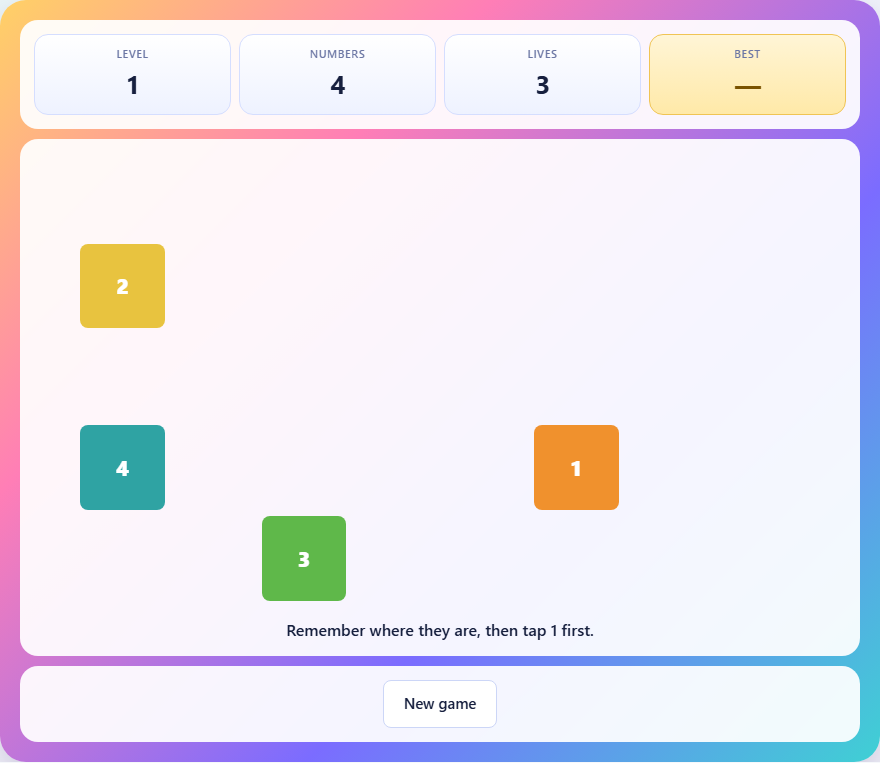
What the game asks you to do
A set of numbers appears in random positions on a grid. Level one shows four numbers. Each level adds one more, so level two has five, level three has six, and so on up to level nine, which puts twelve numbers on the board at once.
The numbers are scattered across the grid in random squares. You study them for as long as you want. Nothing is hidden until you are ready. When you tap the number one, every other number disappears. The squares remain, but their values are covered. You must now tap the remaining squares in order: two, three, four, and so on from memory.
Get the whole sequence right and you move to the next level. Get one wrong and you lose a life. You have three lives. Losing all three ends the game. Reaching level nine means you recalled twelve positions in order, which is well beyond what most people can manage.
Why it measures working memory
Working memory is the part of your mind that holds a few items at once while you use them. It is different from long-term memory. You are not being asked to remember the numbers for an hour. You are being asked to hold their positions for the five or ten seconds it takes to tap them.
Most adults can hold about seven items in working memory at once. Some can hold eight or nine. Very few can hold more than ten. This game finds your limit quickly because each level adds one more number. The level where you start failing is roughly your working memory capacity for spatial positions.
The test is a simplified version of the one used in primate research. Chimpanzees routinely outperform humans at this task. The reason is that chimps appear to take in the entire layout at a glance, while people tend to read the numbers one by one, which is slower.
Controls and how a round works
On a computer, click the numbered squares. On a phone, tap them. The grid scales to your screen, and each square is large enough to press with a finger.
When the numbers are visible, you can study them for any length of time. There is no countdown. Only tapping the number one starts the round. Once you tap one, that square is marked as done and all other numbers are hidden behind blank squares.
A prompt below the grid tells you which number to tap next. If you tap the right square, it is marked done and the prompt moves to the next number. If you tap the wrong square, you lose a life, and the board resets to show you the same layout again with all numbers visible. This is generous because one mistake does not cost you the level. You get to study the same positions again before trying once more.
The levels in detail
Level one starts with four numbers. Most people clear this on the first try without thinking about it. Levels two and three add one number each, bringing the count to five and then six. These are still within the comfort range for most adults.
Level four puts seven numbers on the board. This is where many people start making their first mistakes. Seven items is the common ceiling for working memory, and beyond this point you need a strategy rather than raw recall.
Levels five through seven have eight, nine and ten numbers. Getting past this range requires the mental shortcuts described below. Level eight has eleven numbers and level nine has twelve. Clearing level nine is genuinely difficult and most players will not reach it on their first several attempts.
See the shape, not the numbers
The most effective strategy is to stop reading the numbers and start seeing the path they make. Instead of memorising that three is in the top left and four is in the bottom right, look at the sequence as a shape. One is here, two is there, three is over here, and the line connecting them makes a zigzag or a loop or a diagonal sweep.
Your brain can hold a single complex shape far more easily than it can hold eight separate positions. A zigzag from top-left to bottom-right is one thing to remember. Eight individual coordinates is eight things.
This takes practice because reading numbers is automatic. When you see a three, your brain wants to say the word three rather than note its position. The challenge is to override that habit and treat each number as a dot on a map rather than a label.
Do not read, just look
Reading is automatic and it is slow. When you read a number, your brain turns it into a word, processes the word, and then files the position. Looking skips the word step entirely. You see the square and note where it sits relative to the squares before and after it.
This is the reason chimpanzees beat humans at this exact test. They do not read because they do not have words for the symbols. They see the layout as a pattern of positions and take the whole thing in at once. Humans lose speed to the reading step.
Try this: when the numbers appear, let your eyes sweep across the grid without focusing on any single digit. See the cluster they form. Notice which part of the grid has the low numbers and which part has the high ones. Then trace the path from one to twelve. The path is what you carry into the hidden phase, not a list of coordinates.
Take your time before pressing one
The numbers stay visible until you press one. There is no time limit on the study phase. Rushing to start the round is the most common reason people fail at levels they could otherwise handle.
Spend a full five seconds studying a level-four board. Spend ten seconds on a level-six board. At level eight and beyond, spend as long as you need. Trace the path from one to the last number twice. If you are not confident, trace it a third time. The round does not begin until you choose to begin it.
A useful habit is to tap the table or your knee in the order of the numbers while looking at the board. This adds a physical rehearsal to the visual one and strengthens the memory trace before the numbers disappear.
What happens when you make a mistake
Tapping the wrong square costs one life. You start with three. When a life is lost, the game does not jump to a new layout. It shows you the same board again with all the numbers visible. This means you get a second chance to learn the positions you missed.
If you lost the round because you swapped two positions, the retry is a gift. You already know most of the layout. Focus on the pair you confused and then restart. If you lost because you had no idea where any number past six was, use the retry to study the path more carefully before pressing one again.
Three lives is enough to pass most levels if you learn from each mistake rather than tapping randomly. The game is testing memory, not nerve, and the retry mechanic reflects that.
Chunking to push past your limit
Chunking means grouping several items into one unit. Instead of remembering eight separate positions, you remember three groups: the first three numbers form a triangle in the top left, the next three form a line across the middle, and the last two are in the bottom right corner.
Each chunk is one item in working memory. Three chunks is easy to hold, even if each chunk contains three or four positions. The trick is finding natural groups. Numbers that are close together on the grid make a natural group. A cluster of three numbers in one corner is one chunk.
At high levels, look for clusters before you trace the path. Identify which numbers belong to which cluster, then remember the order of the clusters and the order within each cluster. This turns twelve items into three or four groups, which is well within most people's capacity.
Common mistakes that waste lives
- Pressing one before you are ready. The study phase is free. Use all of it.
- Reading the numbers out loud in your head. This slows you down and adds nothing. See the positions instead.
- Memorising numbers individually instead of as a path or shape. Individual positions overload working memory after six or seven items.
- Rushing through the tapping phase. Once the numbers are hidden, there is no timer on the tapping either. Take a breath between each tap and think about where the next one is.
- Giving up after the first mistake. The retry shows you the same board. Your second attempt starts with partial knowledge of the layout.
What your ceiling tells you
Most people reach a level somewhere between five and seven where they start failing consistently. That level is a rough measure of spatial working memory capacity. It is not a measure of intelligence, and it can improve with practice.
If you hit level six on your first attempt, try again tomorrow. Working memory games show small improvements over the first few sessions as you learn to chunk and trace paths. The gains are real but modest. You might move from level six to level seven or eight.
The game saves your best level in your browser. Coming back a week later and checking whether you match or beat your previous result is a simple way to track whether the strategy changes are helping.
Nothing leaves your browser
The grid, the numbers, and the scoring all run in your browser on your own device. No data is sent anywhere. Your best level is saved in local storage and stays on your machine. You can play offline after the page loads, and closing the tab ends the session without leaving anything behind on a server.