
Winning at draughts by making captures work for you
How the board works, why captures are forced, what kings can do that ordinary pieces cannot, the three computer levels, and the specific positional ideas that turn a game of reactions into a game of planning.
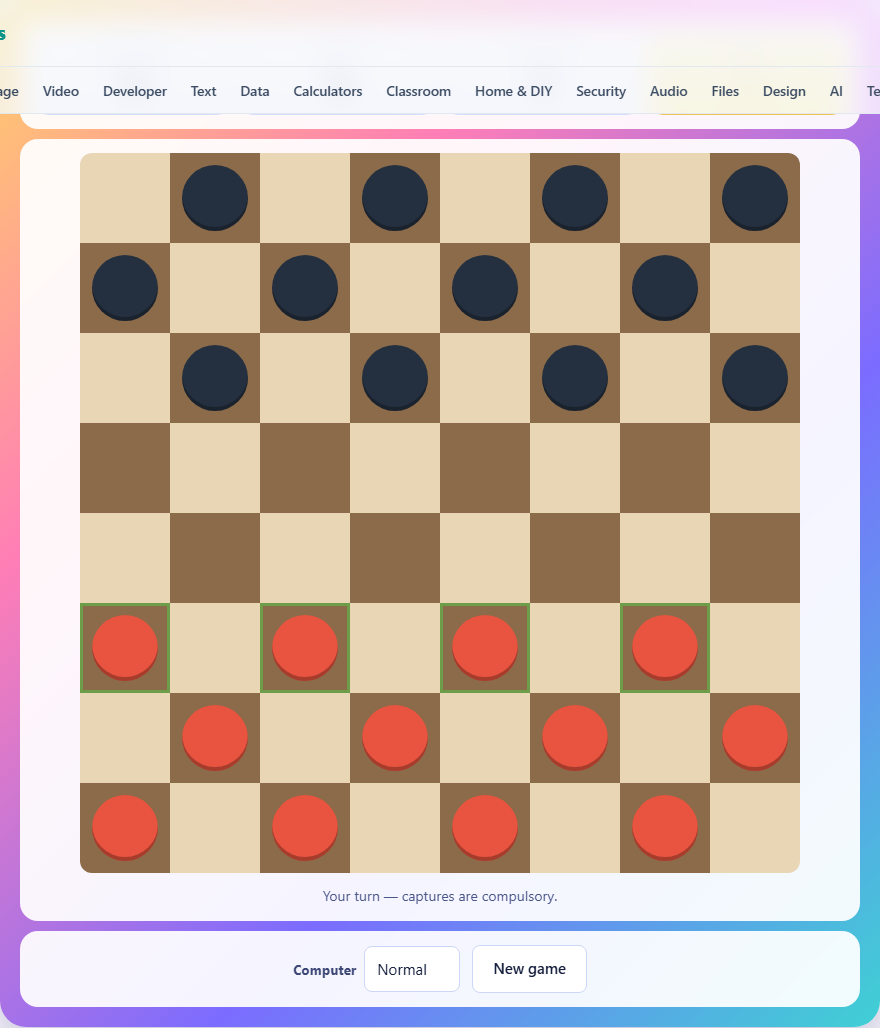
The board and the starting position
Draughts is played on an eight-by-eight board. Only the dark squares are used. Each side starts with twelve pieces arranged in three rows on their own end of the board. Your pieces sit on the three rows closest to you. The computer's twelve pieces sit on the three rows at the far end. The two middle rows start empty.
Pieces move diagonally forward, one square at a time, and only onto dark squares. At the start, you have twenty-four of the thirty-two dark squares occupied. That leaves eight empty dark squares in the middle, and those eight squares are where the opening battle takes place.
Moving and capturing
On your turn, tap one of your pieces. If it has a legal move, the squares it can reach light up. Tap a lit square and the piece moves there. A simple move goes one square diagonally forward into an empty space.
A capture happens when an opponent's piece sits on a diagonal next to yours and the square beyond it is empty. Your piece jumps over the opponent's piece and lands on the far side. The jumped piece is removed from the board. If the landing square puts your piece next to another opponent piece with an empty square beyond that one, your piece must jump again. This chain continues until no more jumps are possible.
The important rule is that captures are compulsory. If any of your pieces can jump, you must jump. You cannot choose a simple move when a capture is available. The game highlights which pieces can legally move, so you always know where the forced jumps are.
Kings and the back row
When one of your pieces reaches the far row of the board, it becomes a king. Kings are marked differently on the board so you can tell them apart from ordinary pieces. A king can move and jump in all four diagonal directions, not just forward.
Crowning ends your turn even if the piece could jump again from the new position. This is the standard rule and it prevents a piece from being crowned and immediately sweeping backward across the board in the same turn.
Kings are powerful. The computer values each king at about three times the worth of an ordinary piece. A game where one side has two kings and the other has none is almost always over, even if the side without kings has more pieces remaining.
Two ways to win
You win by capturing all twelve of the computer's pieces. You also win if the computer has pieces left but none of them can make a legal move. A piece that is boxed in with no empty diagonal square in front of it and no jump available is stuck. If every remaining piece on one side is stuck, that side loses.
The second condition matters more often than people expect. A game can end with the computer still holding three or four pieces, all of them trapped in corners or pinned against the edge.
The three computer levels
A dropdown lets you pick between Easy, Normal and Hard. The difference is how far ahead the computer looks when choosing its move.
Easy looks only one move ahead. It makes legal moves and takes obvious captures but does not plan. Normal looks three moves ahead, enough to set up double jumps and avoid simple traps. Hard looks five moves ahead and plays solid positional draughts. It values kings correctly, protects its back row, and will sacrifice a piece to gain two back.
Changing the level restarts the game. Start on Easy to learn the controls, move to Normal when you can win consistently, and try Hard when you want a genuine challenge.
Controls on any device
On a computer, click a piece and then click the square you want it to move to. On a phone or tablet, tap the piece and then tap the target square. The board scales to fit your screen, and the pieces are large enough to tap with a thumb.
When a capture chain is in progress, the game keeps the jumping piece selected and shows you the next available jumps. You just keep tapping landing squares until the chain is complete. A message below the board tells you when you must keep jumping.
Using forced captures as a weapon
The compulsory capture rule is the engine of all draughts strategy. Because your opponent must take a jump when one is available, you can offer a piece on purpose to force them into a bad position.
The simplest version is the two-for-one trade. You move a piece where the computer must jump it. The jump lands the computer's piece in a spot where you can jump it and then jump another in the same chain. You gave up one piece and took two.
A more advanced version is the positional sacrifice. You offer a piece so that the computer's forced jump pulls one of its pieces out of its back row. Now you have a clear path to crown a piece on that side. The sacrificed piece is worth less than the king you are about to gain.
Before every move, ask yourself: if I go here, does it create a jump for my opponent? If it does, where does that jump land them? If the landing square is worse for them than the piece I gave up, the sacrifice is good.
Protecting your back row
Your back row is valuable because it blocks the computer's pieces from being crowned. A computer piece that reaches your end of the board becomes a king, and kings are devastating. Keeping at least two pieces on your back row throughout the middle of the game is one of the most reliable defensive habits.
The temptation is to send every piece forward as fast as possible. That opens the back row and gives the computer a free path to crowning. Instead, advance pieces from the second and third rows first. Leave the back corners occupied until you have a specific reason to move them.
Once you have a king of your own, the back row becomes less important because your king can patrol that area. But in the opening and middle game, those back-row pieces are your best defence.
Advancing in formation
A piece that pushes forward alone is a target. It has no support and the computer can jump it for free. Two pieces that advance side by side on adjacent diagonals protect each other. Jumping one would land the computer's piece next to the other, where it can be jumped back.
The strongest formation is a diagonal line of two or three pieces, each one square behind and to the side of the one ahead of it. This is sometimes called a bridge. The front piece is protected by the one behind it, and the rear piece is protected by being further from danger.
When you plan a move, look at whether the piece will have a neighbour on the next turn. If it will be isolated, consider moving a different piece first to create support.
Common beginner mistakes
- Moving back-row pieces out early. They guard against crowning. Leave them until you need them forward.
- Sending a single piece deep into enemy territory. Without support, it gets jumped immediately.
- Ignoring which pieces can move. If the game is only letting you tap certain pieces, a capture is forced somewhere. Look for it rather than trying to tap other pieces.
- Trading kings for regular pieces. A king is worth roughly three ordinary pieces. Avoid any trade that gives up a king unless you get at least two pieces back.
- Forgetting about multi-jump chains. After a jump, check whether the same piece can jump again. The game forces you to continue, but planning for multi-jumps before they happen lets you set them up.
The endgame with few pieces
When both sides are down to three or four pieces, the game changes. Open space is everywhere and kings dominate. If you have a king and your opponent does not, use it to chase their pieces into corners where they cannot move.
A common endgame pattern is a king against two regular pieces. The king can dance around them, forcing one to move forward where it can be jumped. The two pieces cannot protect each other because they can only move forward while the king moves in all directions.
If you are behind in the endgame, try to get a piece crowned. Even trading down to one king against two ordinary pieces is often winnable.
The game stays on your machine
Every move, every jump, and every piece of computer thinking happens in your browser. No data is sent to any server. Your win-loss record is stored in your browser's local storage on your own device. You can play offline after the page has loaded, and closing the tab is the only cleanup needed.