
Turning one tap into a chain that clears the board
How the chain reaction mechanic works, why timing beats aim, how the three target levels change what counts as a good tap, and the specific habits that turn a chain of five into a chain of thirty.
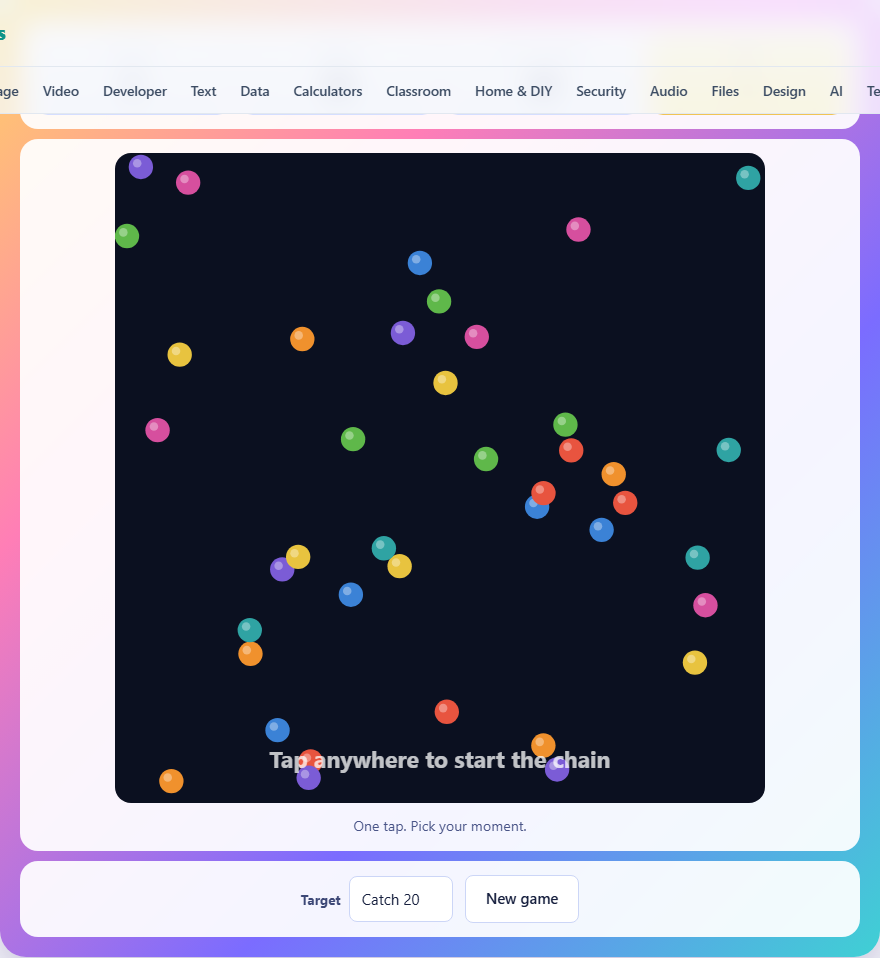
One tap is all you get
Forty coloured balls drift around a dark square field. They bounce off the walls and off nothing else. They never slow down and they never stop. You watch them for as long as you want. There is no clock, no countdown, and no pressure to act.
When you are ready, you tap or click anywhere on the field. A bloom opens at that spot. Any ball that touches the bloom while it is open bursts into a bloom of its own. Each new bloom catches more balls, and each of those opens another bloom. The chain runs until no bloom has anything left to catch. Then the game counts how many you caught and checks it against the target.
You do not get a second tap. The entire game is decided by where and when you placed the first one.
How blooms open and close
A bloom is a growing circle of light. It starts small, expands quickly, holds its size for about a second, and then shrinks back to nothing. A ball is caught only while it touches an open bloom. If a ball passes through the spot after the bloom has closed, nothing happens.
This timing is the reason that aim is less important than patience. A tap into a cluster that is already spreading apart might catch two balls. A tap into an empty gap that three balls are about to drift through might catch all three, and each of them sets off another bloom in a different part of the field.
The rising pitch of the sound effect tells you the chain is growing. Each catch is slightly higher than the last, so you can hear the chain building even without counting.
What the numbers on screen mean
Three stats sit above the game area. Caught shows how many balls your chain has collected so far. Needed shows the target for this difficulty level. Still drifting shows how many uncaught balls remain on the field.
Before you tap, the field also shows a text prompt saying to tap anywhere to start the chain. After you tap, the prompt disappears and the chain plays out. When the last bloom fades, the game reports whether you met the target and offers a short hint about what to try differently.
Three target levels
A dropdown next to the game lets you pick between Catch 12, Catch 20 and Catch 30. All three start with forty balls on the field. The difference is only in how many your chain must collect.
Catch 12 is forgiving. Almost any tap near a group of balls will reach the target. Catch 20 requires a chain that recruits about half the field, which means the initial bloom needs to start a cascade that spreads across most of the area. Catch 30 is demanding. Three quarters of the balls must be caught in a single chain, and that only happens when the initial tap is placed where the chain can reach every corner.
On the hardest setting, the balls also move faster and there are a few extra on the field. The faster movement means clusters form and break apart more quickly, so the window for a good tap is shorter.
Why the middle of the field beats the edges
A bloom is a circle. When it opens at the edge of the field, half of that circle overlaps the wall where no balls can be. Only the half facing inward can catch anything. A bloom in the centre of the field reaches in every direction and has its full area available.
This is the simplest piece of advice in the game: tap near the centre. A centre bloom has roughly twice the useful area of a wall bloom. Even if the centre looks less crowded at the moment you tap, the geometry makes up for it.
The exception is when a large cluster is pressed against one wall with nothing in the middle. In that case, tapping the cluster is better than tapping empty space. But when the balls are spread out, the middle wins.
Tap where the balls will be, not where they are
A bloom takes about a second to reach full size. In that time, balls have moved a meaningful distance. A tight group that is drifting apart will be scattered by the time the bloom is large enough to catch them. A loose group that is drifting together will be bunched up by the time the bloom arrives.
Watch the drift direction before you tap. If three balls are heading toward the same area, place your tap in the space they are about to fill. The bloom will open, grow, and catch them as they arrive. This forward thinking is worth more than perfect aim at the current positions.
The balls bounce off the walls in a predictable way. When a ball hits the right wall, it reflects left. If you see several balls about to bounce off the same wall, the area they will converge on after the bounce is a good target.
Chain links matter more than the first burst
A common instinct is to tap the biggest cluster you can find. That might catch four or five balls in the first bloom. But if none of those blooms reach anything else, the chain stops at five. A tap that only catches two balls, but each of those is near another pair, can cascade to twenty.
Think of the field as a network. What matters is not how many balls are at the tap point but how many connections exist between groups. A ball sitting alone between two clusters is a bridge. When it blooms, it reaches both sides. A ball sitting in a crowd that is far from everything else is a dead end.
Before you tap, trace the chain in your mind. If I catch this one, where does its bloom reach? Does that reach another group? If you can see two or three links ahead, you have found a better spot than the densest cluster.
Patience costs nothing
There is no timer. The balls keep drifting indefinitely until you tap. Watching for five or ten seconds before you commit is free, and the extra observation roughly doubles the quality of your choice.
During that watching time, look for moments when the balls naturally bunch together. Traffic patterns form and dissolve as balls bounce around. A moment will come when two or three clusters are close enough for a single chain to connect them. That is the moment to tap.
Rushing is the most common reason for a low score. The game rewards the player who waits and watches over the player who taps on instinct.
Why chains stop and what you can learn from it
When the game ends, the caught count tells you how far the chain reached. If you caught six out of twenty needed, the chain broke early. Look at where the remaining balls are. If they are all on the far side of the field, your tap was too close to one wall. If they are scattered evenly, your tap caught an isolated group with no links outward.
A chain that stops at eight or nine usually means the first bloom was good but the second wave was in a sparse area. Next time, look for a tap point where the second-wave blooms will land near more traffic, not just where the first bloom catches the most.
Common mistakes that keep scores low
- Tapping the first big cluster you notice. Wait for the traffic to align before committing.
- Tapping against a wall. A wall bloom wastes half its catching area on empty space.
- Chasing a single fast-moving ball. One ball is not worth a tap. Look at the broader pattern instead.
- Tapping immediately after a restart. The balls start in random positions and need a few seconds of bouncing before useful clusters form.
- Ignoring the direction of movement. A cluster heading away from everything else is about to become an island. A cluster heading toward others is about to become a bridge.
A worked example
The target is twenty. Forty balls are drifting. You watch and see a group of six near the bottom centre heading right. Another group of five near the right wall is heading down. A third group of four near the top right is heading left.
In about two seconds, the bottom-centre group and the right-wall group will meet near the bottom-right corner. If you tap there now, the bloom opens in empty space. But if you wait until they converge and tap the meeting point, the first bloom catches four or five. Their blooms spread upward toward the top-right group, catching another three. Those blooms reach a straggler in the centre, who blooms into a pair on the left. The chain reaches eighteen from a single tap that looked like empty space two seconds earlier.
Two more lucky catches along the way and you hit twenty. The whole run was decided by reading the traffic for three seconds before committing.
Your game stays in your browser
The chain reaction runs entirely on your own machine. The balls, the blooms, and the score are all computed in your browser. Nothing is uploaded, no account is needed, and your best score is saved locally. Once the page has loaded, you can disconnect from the internet and keep playing.