
Routing water through a frame of chutes
How the water flows, what splitting does to the numbers, why shared chutes make the puzzle hard, and a step-by-step method for filling every basin to its mark.
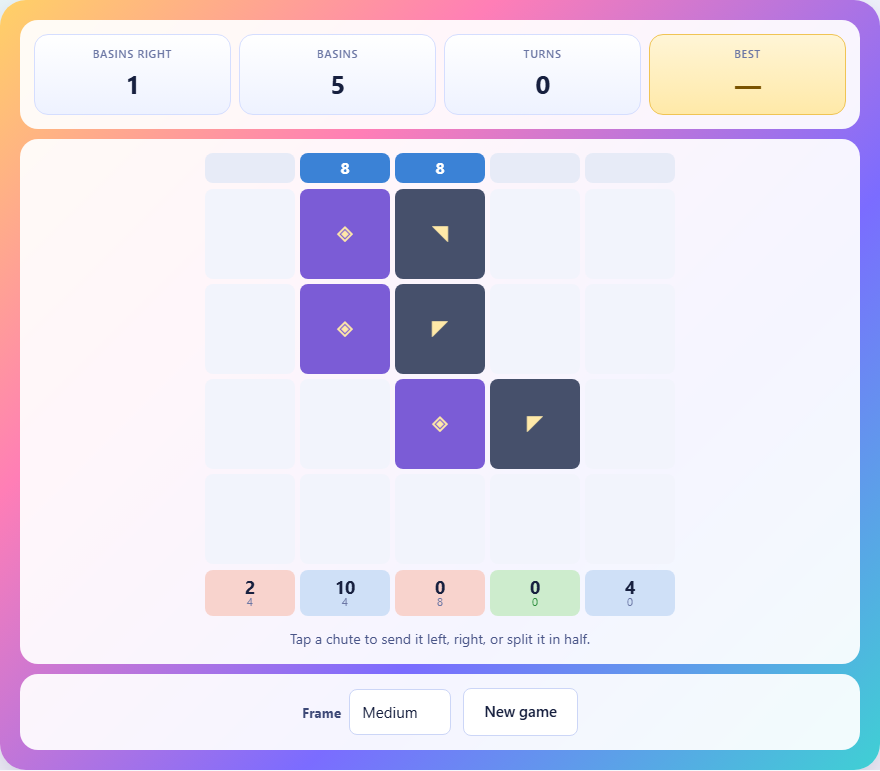
What the puzzle looks like
A frame sits in front of you. Along the top, one or more spouts pour a fixed volume of water straight down. Along the bottom, basins show how much water they need to receive. Between the top and the bottom, a set of chutes can redirect the flow.
Your job is to set every chute so that each basin fills to exactly its target. Not roughly. Exactly. The basin shows the target number in large text and the amount it is currently receiving underneath. Green means the basin is correct. Blue means it is short. Red means it is overflowing.
How water moves through the frame
Water falls straight down from a spout, one row at a time. When it hits a chute, the chute sends it one column to the left, one column to the right, or splits it in half. After being redirected, the water continues falling straight down from its new column.
If a chute points off the edge of the frame, the water stays in the end column. Nothing is ever lost. Every drop that enters from a spout ends up in a basin at the bottom.
A stream can pass through several chutes on its way down. Each one changes the column, so the path through the frame can zigzag from side to side. When the stream finally exits the bottom row, whatever column it lands in determines which basin gets the water.
The three settings on a chute
Tap a chute to cycle through its three settings. The first sends all the water one column to the left. The second sends it one column to the right. The third splits it in half, sending equal parts left and right.
There is no off setting and no straight-through option. Every chute always redirects the water. This means every chute matters. You cannot ignore any of them, because each one changes where at least some water ends up.
The game counts each tap as one turn. Your score is the number of turns it takes to fill every basin. Fewer turns means a better score.
How splitting works and when it does not
When a chute is set to split, it divides the incoming water evenly. A stream of eight becomes four going left and four going right. A stream of four becomes two and two. Each half then continues falling independently and can hit more chutes below.
But splitting only works on even amounts greater than one. If an odd amount of water hits a split chute, it cannot be divided evenly. In that case, all of the water carries on to the left. It is not rounded. It is not shared unevenly. The split simply does not happen.
This rule matters more than it first appears. A spout of eight can be split into four and four, and those fours can be split into two and two. So the reachable amounts from a single spout of eight are 8, 4, 2, and 1. A basin wanting 6 cannot be filled by any single stream from that spout. It needs two separate streams that add up to 6, such as 4 plus 2.
Why shared chutes make it hard
Most chutes sit under more than one spout. Water from different spouts passes through the same chute on different paths. When you change a shared chute to fix one basin, you also change the path for every other stream that passes through it.
This is the core difficulty of the puzzle. You cannot set each chute in isolation. A chute that sends spout A's water to the right basin might send spout B's water to the wrong one. Solving the puzzle means finding the one arrangement where every stream lands in the right place at the same time.
Start by figuring out which chutes are shared and which only affect one stream. A chute that only one spout's water touches is easy to set, because changing it does not break anything else. Set those first.
A method for solving
Begin by adding up the basin targets. They should equal the total water from all the spouts. If your current basin totals do not match the spout totals, water is going somewhere you have not noticed. Check the edges of the frame.
Next, look at the basin targets and figure out which volumes are reachable. From a spout of eight, you can deliver 8, 4, 2, or 1 to a single basin. A basin needing 3 must receive 2 from one stream and 1 from another, or get 1 three separate times. This tells you how many splits you will need.
Then work from the top down. Set the highest chutes first. A chute near the top affects which lower chutes the water will hit, so getting the top right early saves you from changing your mind later. A chute near the bottom decides which basin the water lands in, so those are the finishing touches.
After each change, check all the basins, not just the one you were trying to fix. A chute change that turns one basin green might turn another one red.
Frame sizes and difficulty
Three frame sizes are available. The small frame is four columns wide and three rows tall, with four chutes and two spouts. The medium frame is five columns wide and four rows tall, with six chutes. The large frame is six columns wide with seven chutes and three spouts.
More chutes means more possible arrangements. Each chute has three settings, so four chutes give 81 combinations and seven chutes give 2,187. The generator checks every one of those to make sure the puzzle has exactly one solution. If more than one arrangement fills the basins correctly, the frame is thrown away and a new one is generated.
Why every puzzle has exactly one answer
The generator picks a random valid arrangement of chutes, pours the water, and records what each basin receives. Those amounts become the basin targets. It then walks through every possible arrangement and counts how many fill the basins exactly. Only frames with exactly one solution are kept.
Frames where all the water lands in a single basin are also rejected, because they would be trivial. And the starting position is scrambled so that the puzzle does not begin already solved.
Because there is only one answer, you can be certain that every correct basin is genuinely correct. A green basin is not a coincidence. It is a clue that the chutes above it are probably right.
Common mistakes and how to avoid them
- Fixing one basin and ignoring the rest. Every chute change affects every stream that passes through it. Check all the basins after every tap.
- Forgetting the odd-number rule. If a stream of 3 hits a split, it does not divide. The water all goes left. Plan around this or you will get unexpected results.
- Working from the bottom up. The top chutes determine which lower chutes the water reaches. Set the top ones first, or you will change them later and undo your bottom work.
- Assuming a basin needing a large number must get it from one stream. A basin wanting 6 from a spout of 8 needs two streams, not one. Check what single-stream volumes are possible.
- Not counting the totals. The basin targets always add up to the total spout volume. If your filled basins add up to less, some water is landing in a basin you are not watching.
- Tapping randomly and hoping for the best. With three settings per chute and six chutes, there are 729 arrangements. Random clicking will not find the one that works. Think about the arithmetic.
Reading the colour feedback
Each basin shows two numbers. The large number on top is the target. The small number below is what the basin is currently receiving. The colour tells you the relationship at a glance.
Green means the basin is receiving exactly the right amount. Blue means it is receiving less than the target. Red means it is receiving more. When every basin is green, the puzzle is solved.
A basin that stays red no matter what you do usually means a chute above it is sending two streams into the same place. Look for a chute higher up that could redirect one of those streams elsewhere.
The whole puzzle runs locally
The frame, the water simulation, and the solution check all run inside your browser. No data is sent to a server. The generator builds a new puzzle every time you press New Game, and it does so on your own device. You can play offline after the page loads and nothing about the game changes.