
Learning to capture stones on a Go board
What liberties are and how they decide life and death, why joining stones together is the strongest defensive move, how the ko rule prevents loops, and how this smaller game teaches the fights that decide a full game of Go.
Go without the scoring
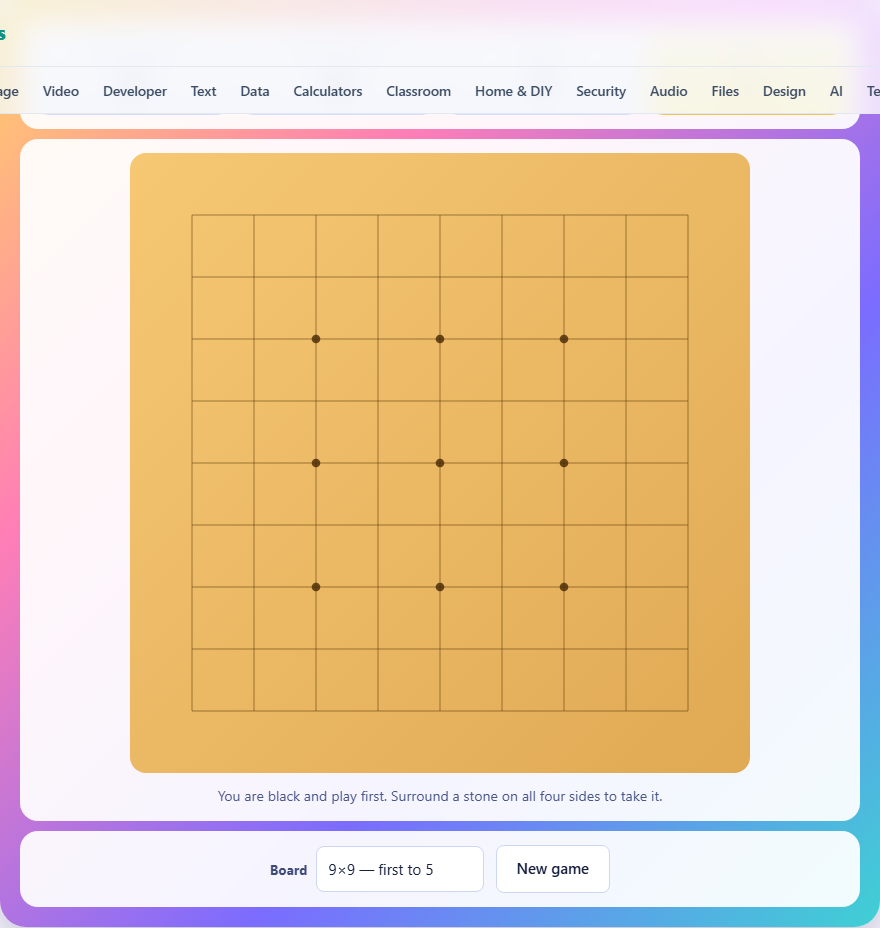
Capture Go uses the same board and the same rules as the full game of Go, but with a simpler goal. Instead of counting territory at the end, you try to capture a fixed number of your opponent's stones. The first player to reach that target wins.
This is how Go has been taught for decades. The capturing rule is the engine that drives every fight in a real game. Territory, dead groups, and the final count can wait. If you understand how stones live and die, the rest of Go opens up by itself.
Placing stones and taking turns
You play black and go first. Tap any empty intersection on the board to place a stone. The computer plays white and replies after a short pause. Stones go on the intersections where lines cross, not in the squares between them.
Once a stone is placed it does not move. It stays until it is captured or the game ends. There is no sliding, jumping, or stacking. The only action is placing one new stone per turn.
Liberties and why they matter
A liberty is an empty point directly next to a stone, along a line. Only up, down, left, and right count. Diagonals do not. A stone in the middle of the board has four liberties. A stone on the edge has three. A stone in the corner has two.
When a stone or a group of connected stones has zero liberties, it is captured. Every stone in that group is removed from the board and added to the capturing player's score. This is the only way stones leave the board.
Counting liberties is the single most important skill in this game. Before every move, look at your weakest group and count its empty neighbours. If a group has two liberties, it is in danger. If it has one, it will die on the next move unless you save it right now.
Groups and how connecting helps
Two stones of the same colour that sit next to each other along a line form a group. They share their liberties. A pair of stones side by side in the middle of the board has six liberties instead of four, because the shared edge no longer counts as a liberty for either stone, but all the other edges do.
This is why connecting your stones is almost always better than scattering them. A single stone has four liberties at most. A chain of three in a row has eight. The longer the group, the harder it is to surround, and surrounding is the only way to kill it.
Conversely, leaving a gap of one empty point between your stones means they are not connected. The opponent can place between them, and each stone must survive on its own.
Board sizes and capture targets
Three board sizes are available. A seven by seven board plays to three captures. A nine by nine board plays to five. A thirteen by thirteen board plays to seven. The small board forces contact immediately, because there is not much room to avoid a fight. The large board gives you space to open in more than one area at a time.
Nine by nine is the best place to start. It is big enough for real tactics but small enough that games finish in a few minutes. Move to thirteen once you can consistently win on nine.
The suicide rule
You may not place a stone that would leave your own group with zero liberties. In other words, you cannot fill in your own last breathing space. The game will reject the move if you try.
There is one exception, and it is important. If placing your stone would capture an opponent's group first, the capture happens before your liberties are counted. The captured stones are removed, which opens up liberties for your stone, so the move is legal after all.
This exception is the source of many clever moves. You can play into what looks like a dead end, as long as the move takes something off the board and gives your stone room to breathe.
The ko rule
Sometimes you can capture a single stone, and the opponent could immediately recapture yours in the same spot. If both players did this forever, the game would never end. The ko rule prevents it.
After a single-stone capture that creates a position identical to the one before the capture, the other player is not allowed to recapture on the very next turn. They must play somewhere else first. After that, the spot is open again.
In practice, ko means you need to find a move elsewhere on the board that is threatening enough to force a response. Then, on your next turn, you can recapture. This back-and-forth is called a ko fight, and it adds a layer of tactics that reaches far beyond the local exchange.
Fighting near the edges
A stone on the edge of the board starts with only three liberties. A stone in the corner starts with two. This means fights near the edge are more dangerous than fights in the centre. It takes fewer moves to surround a group that is pressed against the side.
Use this to your advantage on offense. Push the opponent's stones toward the edge. Their groups lose liberties just by being there, and you need fewer stones to complete the capture.
On defense, be careful about building along the edge early. A line of stones on the first row has a maximum of two liberties per stone on the open side. If the opponent places in front of them, the whole line can collapse quickly.
Extending to save a group
When one of your groups is down to two liberties, you have a decision. You can try to run away by placing a stone one space ahead, or you can extend the group by placing a stone that touches it.
Extending is almost always better. A stone that joins the group brings its own empty neighbours into the group's liberty count. A stone that jumps away does not connect and must survive on its own. Worse, the gap between the old group and the new stone is a weakness the opponent can exploit.
The exception is when the group is completely hemmed in and extending would only add one liberty. In that case, running might create a second group the opponent has to chase, buying time for both.
How the computer plays
The computer follows a simple set of priorities. First, if it can capture any of your stones this turn, it will. Second, if one of its own groups is down to a single liberty, it tries to save it by extending. Third, it looks for moves that reduce your groups to one liberty, setting up a capture on the following turn. Fourth, if none of those apply, it plays a contact move near existing stones and toward the centre.
It does not plan many moves ahead. It plays roughly like a human who has been learning for a few hours. You can beat it by keeping your groups connected and by counting its liberties before your own.
Mistakes that beginners make
- Playing without counting. Before every move, count the liberties on your weakest group and on the opponent's weakest group. Whoever runs out first loses those stones.
- Scattering single stones across the board. Isolated stones are easy to surround. Keep your stones connected.
- Filling in your own liberties. Sometimes a move that looks like it strengthens a group actually reduces its breathing room. Count after you place, not just before.
- Ignoring a group at one liberty. If any of your groups has a single liberty and it is the opponent's turn, that group is dead unless the opponent misses the capture. Save it now or accept the loss.
- Fighting in the corner with a small group. The corner gives you only two starting liberties. Unless you have a plan to escape toward the centre, the corner is a trap.
- Forgetting the ko rule and trying the same recapture immediately. The game will reject it. Play elsewhere first.
Everything runs on your own machine
The board, the rules engine, and the computer opponent all run inside your browser. No moves are sent to a server. No account is needed. You could disconnect from the internet after loading the page and the game would work exactly the same way.