
Playing the Italian trick game where aces and threes win everything
How the forty card deck is scored, why you never have to follow suit, what makes the three the second strongest card, and the habits that separate winning from losing in a game where most tricks are worth nothing.
The number the opponent hangs on each of its three cards
The computer player does not look ahead and it does not peek at your hand. On every turn it does one thing: it gives each of its three cards a number, then picks from the ends of that list. The number is a short sum. Start with the point value of the card. Add 50 if the card belongs to the briscola suit. Then add a little more for where the card sits in the rank order, so that two cards worth zero points do not come out equal.
That 50 is the heart of it. A briscola 2 is worth no points at all, yet the sum gives it 50. A plain ace is worth 11 points, and the sum gives it 11.9. So to this code the feeblest trump is dearer than the finest plain card. The effect is an opponent that clings to its briscole and sheds plain cards first. Here is the full throwaway list for a plain suit, lowest first:
Add 50 to any of those if the card is a briscola. The lowest number on the list is what it throws away, and the highest is what it keeps.
When you have led and it holds a card that can win, it ranks the winners with a slightly different sum: point value, plus 50 for a trump, plus the full rank position, which runs from 0 for a 2 up to 9 for an ace. It then takes the trick with the cheapest winner on that list. Because of the 50, a plain winner is always chosen over a trump.
One test stands between it and a trump. It reads the point value of the card you led, on its own, and asks if that is high enough. On Gentle the test is skipped, so it wins any trick it can. On Normal the led card must be worth 10 or more, which means only a three or an ace. On Sharp the bar drops to 4, so a led king counts too. Fail the test and it does not win the trick at all. It shrugs and drops its cheapest card. If you led a briscola yourself, the test never runs, because beating a trump with a bigger trump is not counted as spending one.
Here is a full trick. The briscola is diamonds and you lead the king of spades, worth 4 points. The opponent holds the 7 of spades, the 5 of diamonds and the queen of clubs. Only one of those beats your king: the 5 of diamonds, because it is a trump. The 7 is a lower spade and the queen is a different plain suit, so neither can touch it. On Normal the test asks whether 4 is at least 10. It is not, so the trump stays put. Now it sorts for a discard: the 7 of spades scores 0.4, the queen of clubs scores 3.6, the 5 of diamonds scores 50.2. It plays the 7. You win, and the trick is worth 4 + 0 = 4 points.
Change the Computer setting and nothing else, and the same trick goes the other way. On Sharp the bar is 4 and the king is worth exactly 4, so the 5 of diamonds comes out and takes it. The 4 points land on their side instead of yours, which moves the gap between the two scores by 8. That is a single menu choice on a trick that held one king and one worthless five.
A second trick shows the 50 earning its keep. Diamonds are trump again and you lead the three of hearts, worth 10. They hold the ace of hearts, the 6 of diamonds and the 2 of spades. Two cards beat your three. The ace of hearts is the same suit and higher. The 6 of diamonds is a trump. Their winner scores are 11 + 9 = 20 for the ace and 0 + 50 + 3 = 53 for the trump. The ace is far cheaper, so the ace takes it and the trump question never arises. That one trick gives them 10 + 11 = 21 points.
- 2 scores 0.0, and 4 scores 0.1
- 5 scores 0.2, 6 scores 0.3, 7 scores 0.4
- Jack scores 2.5 and queen scores 3.6
- King scores 4.7
- Three scores 10.8 and ace scores 11.9
What the computer player never sees
The choosing code is handed four things and no more: its own three cards, the card you have just led, which suit is briscola, and how many cards are still in the stock. It never reads your hand, and it keeps no record of what has already been played. So it cannot know that every trump has gone, and it cannot work out which ace is still loose. If you have been counting, you know more than it does.
It also prices only what is already lying on the table. Lead a worthless 5 while you hold an ace, and the trick may end up worth 11. The code reads that 5 as zero and answers as if the trick were empty. Baiting it costs you nothing.
On Gentle and Normal it always leads the smallest card on its throwaway list, every single time. That is easy to read after a few tricks. And because any briscola scores 50 or more, it will never lead a trump unless every card in its hand is one.
Sharp has exactly one extra rule, and it is worth knowing precisely. Once the stock is empty it leads from the other end of the same list, its largest card. But a briscola 2 scores 50 and a plain ace scores 11.9, so that largest card is its highest trump whenever it holds one, not its biggest point earner. A Sharp endgame lead can therefore be a low trump that wins the trick and collects nothing. Call it a habit rather than a plan.
Some other edges worth knowing before you blame your luck:
- You lead the first trick of every deal. There is no alternating dealer, and separate hands are never added into a match.
- The stock counter starts at 34, not 40. Six cards go into the two hands, and the face up briscola is slipped to the bottom of the stock rather than kept aside, so it is counted and it is drawn last.
- Both players draw after each of the first 17 tricks, so the stock drops by 2 at a time and lands on 0 exactly. The last 3 tricks are played from the hand. That is 20 tricks in all.
- A 60 to 60 result is shown as Sixty all, and it is not recorded as a win.
- The note under the table only announces the size of a trick you won when it is worth 10 or more. Smaller ones pass without comment.
- When you lose, the closing line points out that the four aces and four threes hold 84 of the 120 points. That is 44 from the aces and 40 from the threes.
- The best score kept is your highest point total in one finished hand. It is written to your own browser's storage. Walking away part way through records nothing.
- Changing the Computer dropdown deals a fresh hand at once. You cannot switch level in the middle of a deal.
- The shuffle is a plain swap pass using the browser's own random numbers. It is fine for cards. It is not meant to be secure.
- There is no bonus for the last trick and no special award for any single card. Nothing but the point table decides the hand.
- Card clicks are ignored while the opponent is thinking. Its reply comes 470 milliseconds after your card, or 520 when it starts a trick, and the pair sits face up for 620 more before the points are added. Nothing is timed at your end, so take as long as you want.
A card game built on free choice
Most trick games force you to follow the suit that was led. Briscola does not. You can play any card from your hand on any trick, no matter what the other player put down. That one rule changes everything. It means every trick is a real decision, not a forced response.
The game uses a forty card deck. There are four suits, each with ten cards. At the start, each player gets three cards and one card is turned face up under the remaining stock. The suit of that turned card is the briscola, or trump. That card sits there until it is the very last card drawn.
The rank order and the point values
The rank order is not what you would expect from most card games. From strongest to weakest within a suit, the order runs: ace, three, king, queen, jack, seven, six, five, four, two. Notice that the three sits just below the ace. It is the second most powerful card in its suit, not a low card.
Points are separate from rank. An ace is worth eleven points. A three is worth ten. A king is worth four, a queen three, and a jack two. Every other card is worth zero. Add it all up and one suit holds thirty points. Four suits make a hundred and twenty points in the whole deck.
That split between rank and value is where the game gets interesting. A seven beats a four, but both are worth nothing. Winning that trick gained you zero points. A king beats a jack, and the king is also worth more. But winning a trick that holds only a five and a six is empty, no matter how high the card you spent to take it.
How a trick is won
The first player leads any card. The second player then plays any card. If both cards are the same suit, the higher rank wins. If they are different suits and neither is trump, the card that was led wins, regardless of rank. A trump card always beats a non-trump card.
After the trick is taken, the winner draws a card from the stock, then the loser draws one. Each player always holds three cards until the stock runs out. The turned-up trump card at the bottom is the last card anyone draws. Once the stock is empty, the final three tricks are played from what is left in hand.
Winning the hand
When all twenty tricks have been played, each player counts the points in the tricks they won. There are a hundred and twenty points total. You need sixty-one to win. If both players have exactly sixty, the hand is a draw.
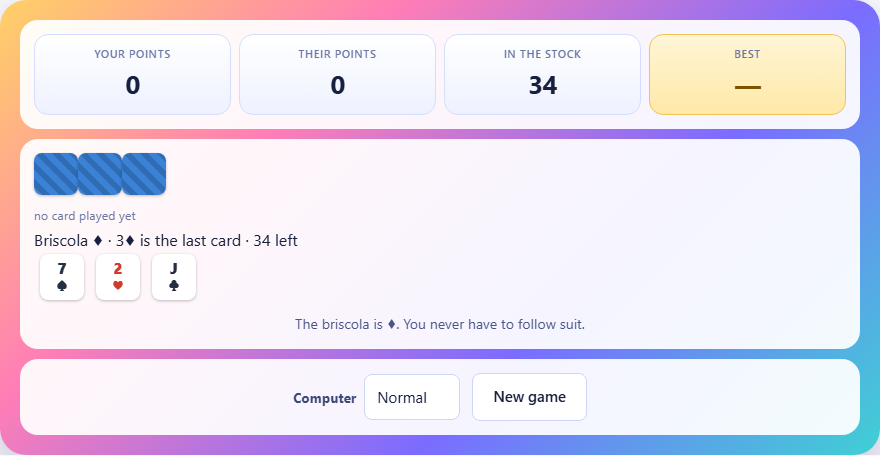
The game shows your point total and theirs in the stats area at the top. It also shows how many cards remain in the stock, which tells you how close the hand is to ending. The trump suit and the identity of the face-up trump card are displayed below the table, along with a note when the stock runs empty. You can always see your three cards and the backs of the opponent's three.
The three difficulty settings
The computer opponent plays at three levels. Gentle is forgiving. It plays its cheapest winner on most tricks and does not guard its trumps carefully. Normal adds more caution. It will not spend a trump on a worthless trick, and it leads low cards to protect its aces. Sharp plays aggressively. It cashes its big cards late in the hand when the stock is empty and the risk of losing them to a trump is gone.
The difference between normal and sharp matters most in the last six tricks, after the stock runs dry. The sharp opponent counts what has been played and leads from strength when it knows the trumps are spent.
When to fight for a trick and when to let it go
Not every trick is worth winning. A trick that holds a five and a four is worth zero points. Spending a king to take it costs you nothing in rank, but it costs you a card that could have won a later trick worth real points. Spending a trump on it is even worse, because trumps are limited and every one you use is gone for good.
The tricks that matter are the ones with aces and threes in them. An ace and a three together are twenty-one points, nearly a fifth of the total. Fight hard for those. The rest of the time, let the trick go if winning it would cost you a card you need later.
A useful rule of thumb is this: if the trick on the table holds fewer than four points, only take it if the card you play is worthless anyway. If the trick holds ten or more, it is worth spending something real. In between, use your judgement.
Leading and responding
When you lead, you control what the trick is about. Leading a low card from a plain suit tells the opponent nothing useful and tempts them to waste a card on nothing. Leading an ace is bold but risky. It is eleven points sitting on the table, and if they have a trump they can take it.
Early in the hand, when the stock is full, lead small. Let the opponent spend their trumps on empty tricks. Late in the hand, when the stock is gone and you know what trumps are left, lead your aces. By then the opponent may have no trumps left, and your ace collects eleven points for free.
When responding, you already know what the trick is worth. If the led card is a five, the trick is worth zero. Play your weakest card and move on. If the led card is an ace, you need to decide whether the eleven points justify spending a trump. Usually they do.
Counting the trumps
There are ten cards in the trump suit. The turned-up card at the bottom of the stock is one of them, so you always know where that one is. As trumps are played, keep a rough count. You do not need to remember every card. Just track how many have appeared.
When all ten trumps have been played, the game changes. No more surprises. The highest card of the suit led always wins. This is when your aces and threes are safest to lead, because nothing can overpower them.
On the sharp difficulty, the computer counts trumps and plays around them. You need to do the same, or you will keep leading aces into trumps you could have waited out.
Beginner mistakes that cost you the hand
- Leading aces in the first few tricks. The stock is full and the opponent has every trump available. Your ace is likely to get taken for nothing.
- Spending a trump on a worthless trick. A trick with a six and a four in it is worth zero. Using a trump to win it is a net loss, because that trump could have taken an ace later.
- Treating the three as a low card. It is the second strongest card in its suit and worth ten points. Throwing it away like a three of nothing is a mistake that costs you dearly.
- Ignoring the stock count. When there are two cards left in the stock, you know you will draw the trump card or the one just above it. Plan your play around what you are about to receive.
- Trying to win every trick. There are twenty tricks and most of them carry fewer than four points. Winning all of them is not the goal. Winning the right ones is.
Your cards stay private
The game runs entirely inside your browser. No cards, no scores, and no play history leave your device. The computer opponent lives in the same page, making its choices from the same code that draws the cards. There is no server, no account, and no login. Once the page has loaded, it keeps working if you turn the network off.