
Connecting islands without crossing a single line
The full rules of the island bridge puzzle, what the numbers mean, why connectivity matters as much as arithmetic, and the logical shortcuts that let you solve harder boards without guessing.
The idea in one sentence
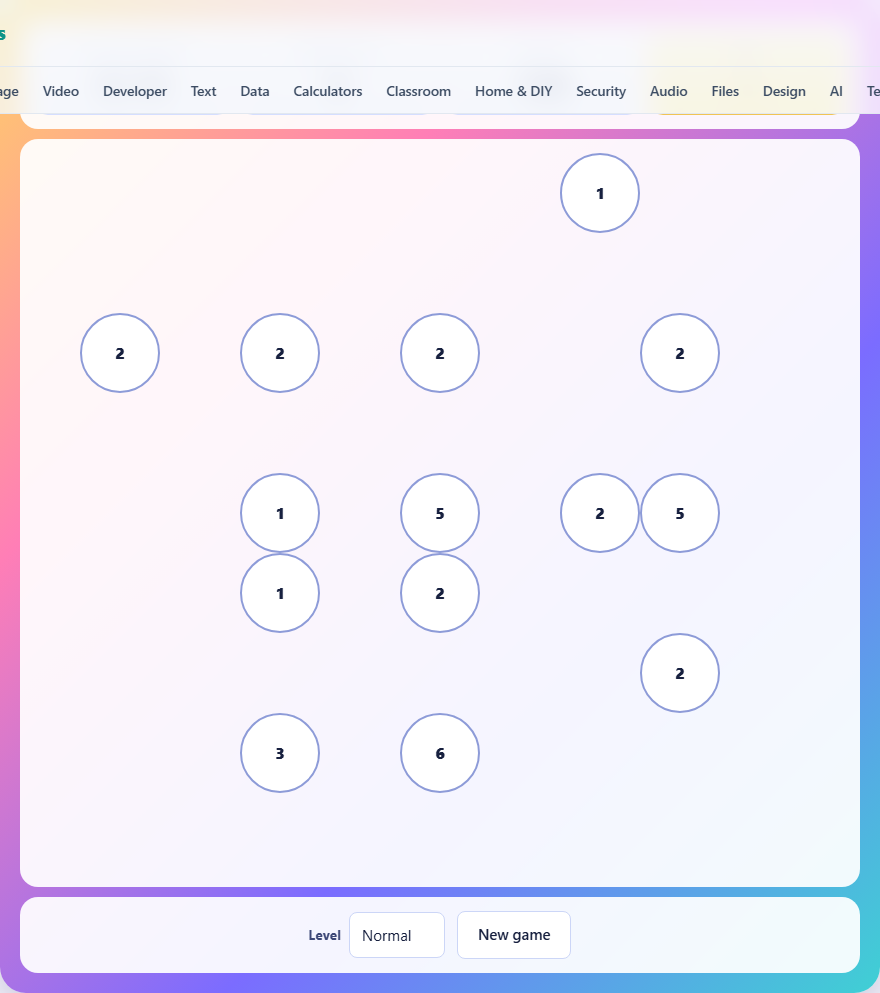
Islands sit on a grid of water. Each island shows a number. Your job is to draw bridges between them so that every island has exactly as many bridge ends touching it as its number says, no bridge crosses another, and every island can reach every other island through the bridges you built.
That last rule is the one that trips people up. You can satisfy every number and still lose, because the map is in two separate groups that are not joined to each other.
How bridges work
A bridge runs in a straight line, either across or down, between two islands. It cannot bend or go at an angle. Two islands can share at most two bridges between them, never three.
Bridges may not cross. Once a bridge is drawn between two islands, no other bridge can pass through the space it covers. This is not just a rule about the endpoints. The entire length of the bridge blocks any bridge that would run through it in the other direction.
A bridge only counts toward the two islands at its ends. Islands it passes by on the way are not touched by it.
Controls on screen
Tap or click one island, then tap another. If the two islands face each other with clear water between them, a single bridge appears. Tap the same pair again and the single bridge becomes a double. Tap the same pair a third time and both bridges are removed.
An island turns green when the number of bridge ends touching it matches its number exactly. If it has too many, it changes to show the error. The game tracks how many islands are finished and how many bridges you have built.
A timer runs in the corner. Easy gives five minutes, normal gives seven and a half, and hard gives ten. Running out of time ends the round.
The three difficulty levels
Easy uses a seven by seven grid with about ten islands. The numbers tend to be small and the layout is open, so there are fewer places where bridges could cross. Normal moves to a nine by nine grid with around fourteen islands. Hard stretches to eleven by eleven with about eighteen islands, and the timer is more generous to match the extra work.
Every puzzle is generated fresh. The generator places islands one at a time, walking outward from the centre, and it checks that bridges between them do not cross. After the map is built, a solver confirms there is only one valid answer. If more than one answer exists, the puzzle is still fair, but it means you might find a different path to the same result.
Starting with the forced moves
Some islands have only one possible outcome. An island labelled four with exactly two neighbours must have two bridges going to each of them. There is no other way to reach four. The same logic applies to a six with three neighbours, or an eight with four.
An island labelled one with only one neighbour must have its single bridge going there. An island labelled three with two neighbours must have at least one bridge to each, because you cannot stack three onto a single pair. That means one neighbour gets one bridge and the other gets two, or vice versa.
Finding these forced moves first fills in a good part of the board for free. On an easy puzzle, forced moves alone can solve half the islands.
Watching for isolation traps
The connectivity rule says every island must be reachable from every other through the bridge network. A group of three islands in one corner can satisfy all their own numbers perfectly and still be wrong, because they form a closed loop that is cut off from the rest of the map.
Before you close a small group, check whether at least one island in that group still has room for a bridge to the outside. If every island in the group is already at its number, the group is sealed and you are stuck. You will have to undo some bridges and route them differently.
The safest habit is to leave at least one outgoing bridge from every cluster until the whole board is nearly done. Close the last gap at the end, not in the middle.
Using bridges to block lanes
When a horizontal bridge is drawn, it blocks any vertical bridge that would need to cross its path. This means placing one bridge can remove options from islands that had nothing to do with it.
You can use this to your advantage. If an island far away has too many possible connections and you cannot tell which one is right, look at bridges near it. Placing a bridge elsewhere might cross one of its lanes and leave it with only one choice. That turns an uncertain island into a forced move.
The same effect can work against you. Placing a bridge carelessly in the middle of the map can cut off a distant island from its only neighbour in that direction. If you notice an island going red or refusing to reach its number, check whether a bridge somewhere else is blocking its path.
Common mistakes and how to avoid them
- Counting bridges but forgetting connectivity. The puzzle is not done until every island can reach every other. A green board split into two groups is not a win.
- Placing two bridges where one is enough. On a tight board, using a double bridge early can starve a neighbour that needed one of those connections. Prefer single bridges until you are sure a double is necessary.
- Ignoring distant islands. A small island in the corner with a number of one might have only one possible bridge, and that bridge might cross a lane you were about to use. Scan the whole board before committing to the middle.
- Closing a loop too early. Three islands satisfying each other is satisfying to look at, but if none of them still has a way out, the rest of the board is unreachable from that group.
- Working from the centre outward. The edges and corners have the fewest options, so they are the easiest to solve. Start at the borders and work inward.
A step by step approach for harder boards
First, scan every island and mark the forced ones. Place all those bridges. Second, look at the islands that are now one bridge short of their number. If they have only one remaining neighbour, that bridge is forced too. Repeat until no more free moves exist.
Third, look for crossing constraints. If two potential bridges would cross each other and both cannot exist, see whether one of the two islands has no other option. That one must be placed, which means the other one cannot.
Fourth, check connectivity. If placing a bridge would complete a small isolated group, try the other option first. Only close a cluster when it is the last piece of the whole puzzle.
On the hard difficulty, the board has eighteen islands and a ten minute timer. That sounds generous, but the eleven by eleven grid means bridges can run long distances, and a single crossing conflict can force you to redo an entire section. Spending the first minute on forced moves before touching anything uncertain saves time in the long run.
Reading the board at a glance
Green islands are done. If an island is not green, it still needs bridges. If it is red or highlighted, it has too many. The count of finished islands and total bridges built sits at the top of the game area, so you always know how far along you are.
When every island is green and the game has not declared a win, the problem is connectivity. Look for the gap. Somewhere on the board there is a group of islands that cannot reach the rest. Find the two islands on opposite sides of that gap and figure out how to route a bridge between them without undoing work you need.
The timer counts down in the stats bar. If it reaches zero, the round ends and you are told to look for islands whose numbers match their neighbour count, since those are the forced moves you should place first next time.
Nothing leaves your browser
The puzzle generator, the solver that confirms a unique answer, and the game itself all run on your own device. No data is sent anywhere. There is no account, no login, and no server involved. Your best result is stored in your browser and stays on this machine. Once the page loads, it works with the network turned off.