
Clearing the board before your three lives run out
How the paddle actually steers the ball, why the top row is worth six times the bottom, the speed-up that catches everyone mid-rally, and the channel strategy that turns one good bounce into a cascade.
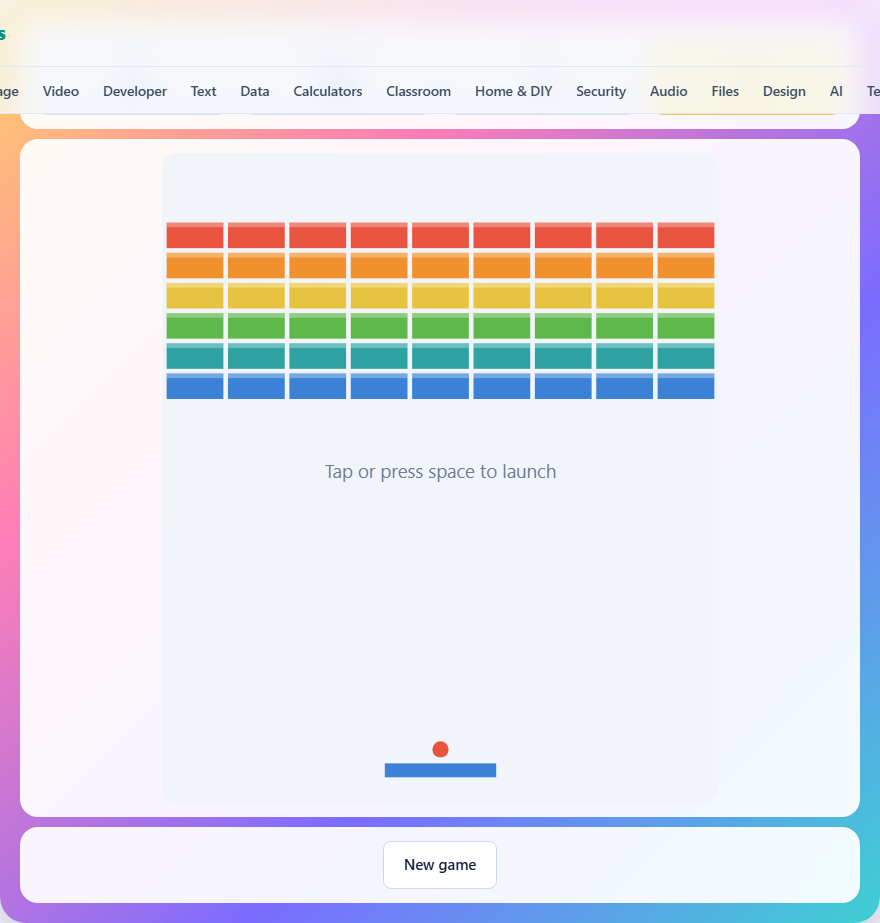
The setup: bricks, paddle, and ball
Fifty-four bricks sit in six rows of nine across the top of the screen. A paddle stretches along the bottom. A ball bounces between them. Every brick the ball touches disappears. Clear all fifty-four and you win. Let the ball fall past the paddle three times and you lose.
The bricks are coloured by row, with different colours marking different point values. The bottom row is worth the least and the top row is worth the most. The numbers are ten points per brick at the bottom, rising by ten for each row above it. That puts the top row at sixty points per brick, which is six times the bottom row. The total across all fifty-four bricks is one thousand eight hundred and ninety points.
Launching and controlling the paddle
The ball starts sitting on the paddle, waiting for you to launch it. Tap the board, click it, or press the spacebar. The ball flies upward at a slight random angle so it does not begin in a straight vertical loop.
Move the paddle with your mouse or finger. The paddle follows your pointer. On a phone, slide your finger across the screen and the paddle tracks it. On a keyboard, the left and right arrow keys nudge the paddle in steps, and the A and D keys do the same thing.
The paddle is wide enough to be forgiving on a normal rally, but not wide enough to cover the whole floor. Keeping it roughly under the ball at all times is the baseline skill. The higher skill is placing it so the ball bounces where you want it to go, not just keeping it alive.
How aiming actually works
The bounce angle is set by where the ball hits the paddle, not by the angle it arrived at. If it lands dead centre, it goes straight up. If it hits the left edge, it flies up and to the left at a sharp angle. If it hits the right edge, it goes up and to the right.
This is the entire steering method. You do not rotate the paddle or add spin. You position it so the ball meets the part that sends it the right way. Want the ball to go left? Let it hit the right half of the paddle. Want it to go straight up? Catch it right on the centre.
The reason this matters is that a ball bouncing straight up and down between the paddle and the ceiling will clear a single column and nothing else. To reach the bricks on the sides, you must deliberately catch the ball off-centre and send it at an angle. Aiming is the whole game.
The point values hiding in each row
The bottom row pays ten points per brick. The next row pays twenty. Then thirty, forty, fifty, and sixty at the top. Nine bricks per row means the top row alone is worth five hundred and forty points, while the bottom row is only ninety.
Most players clear the bottom row first because it is closest. That is safe but low-scoring. The more rewarding approach is to dig through the lower rows quickly and let the ball reach the high-value ones above. One brick from the top row is worth as much as six from the bottom.
A ball that gets above the last row bounces between the ceiling and the top of the remaining bricks, clearing them rapidly without any paddle work from you. That free run is where the big scores come from, and getting the ball up there as early as possible is the fastest path to a clean board.
Why the ball gets faster
Every time the ball touches the paddle, it picks up a small amount of speed. The increase is slight. You will barely notice it for the first ten hits. But it adds up. By the middle of a long rally the ball is moving noticeably faster than when it launched, and toward the end of a full board clear it can approach nearly twice its starting speed.
There is a cap. The ball will not climb forever. But the cap is high enough that a ball near its top speed is genuinely hard to track. The practical lesson is that long rallies are more dangerous than they feel. The ball you caught easily on hit five is the same ball that slips past you on hit thirty.
This speed ramp is what stops the game from becoming routine. Without it, a player who could return the ball ten times could return it a thousand. With it, every rally carries a built-in timer. The longer you keep the ball alive, the harder it gets to keep it alive.
Digging a channel: the strategy that clears boards
Clear a narrow vertical strip up one side of the board. Aim the ball at the same column of bricks repeatedly until a gap opens from the bottom row to the ceiling. Once the channel is through, the ball enters the space behind the bricks and bounces sideways across the back wall. It hits brick after brick from above, clearing entire rows without any effort from you.
The channel does not need to be perfectly straight. A zigzag gap works just as well, because the ball will find its way through any opening. What matters is that there is a continuous path from the paddle level to the ceiling.
Pick one side rather than the middle. A side channel sends the ball behind the bricks at an angle, which means it travels sideways for longer and hits more bricks before coming back down. A centre channel sends it straight up, and it often drops back through the same gap without clearing much on the way.
Recovering from a dropped ball
After losing a life, the ball reappears on the paddle and waits for a fresh launch. Take a moment before tapping. Look at where the remaining bricks are and decide which part of the board to aim for. Sending the ball straight up into an empty gap wastes time and adds speed without clearing anything.
Position the paddle directly under a cluster of bricks before launching. The first hit will land on the closest brick, and if the angle is right, the ball will carve into the cluster rather than bouncing away into open space.
You get three lives in total. Losing the first one early is not a crisis. Losing the second one to the same mistake is. The most common pattern is dropping a ball to a fast rally, then immediately dropping the next one because the launch goes into empty space and the ball returns even faster with nothing cleared.
Mistakes that cost lives
- Catching every ball on the centre of the paddle. This sends it straight up the same column every time. You clear one strip and leave the rest standing.
- Chasing the ball instead of predicting it. Watch where the ball is heading, not where it is now. By the time it reaches the paddle, you need to already be in place. Reacting after the bounce always leaves you a fraction late.
- Ignoring the speed increase. The ball after twenty paddle hits is not the ball you launched. If you are still moving at launch-speed reflexes, you will miss it.
- Launching into empty air after losing a life. Move the paddle under a cluster of bricks first, then tap. A launch into a gap gives you nothing and the ball still speeds up on the return bounce.
- Clearing the bottom row first and ignoring the top. The bottom row pays the least. Break through it quickly and aim for the rows that carry real points.
All of it runs on your device
The physics, the collision detection, and the score counter all run inside your browser. The page does not upload anything and does not need an account. Your best score sits in your browser's local storage on this device alone. Once the page has loaded, it works even without an internet connection. Close the tab and the game is over.