
Winning the race across an eight-by-eight board
The movement rules that look like chess but play nothing like it, how captures open files you may not want opened, the three opponent settings, and the formation that wins more games than any other.
How the pawns move and capture
Every piece on the board is a pawn, and every pawn follows the same rules. It can step one square straight forward into an empty square. It can also step one square diagonally forward, either into an empty square or onto an enemy pawn. Stepping onto an enemy pawn removes it from the board.
The key restriction is direction. Pawns never go backward. Your pawns move up the board, toward the top row. The opponent's pawns move down, toward the bottom row. Once a pawn has advanced, it cannot retreat to cover ground it left behind.
The other restriction is that straight moves cannot capture. If an enemy pawn is directly in front of yours, you cannot take it by walking forward. You can only capture diagonally. This means a pawn sitting directly in front of an enemy is actually safe from that enemy. The threat always comes from the sides, never straight ahead.
Starting position and controls
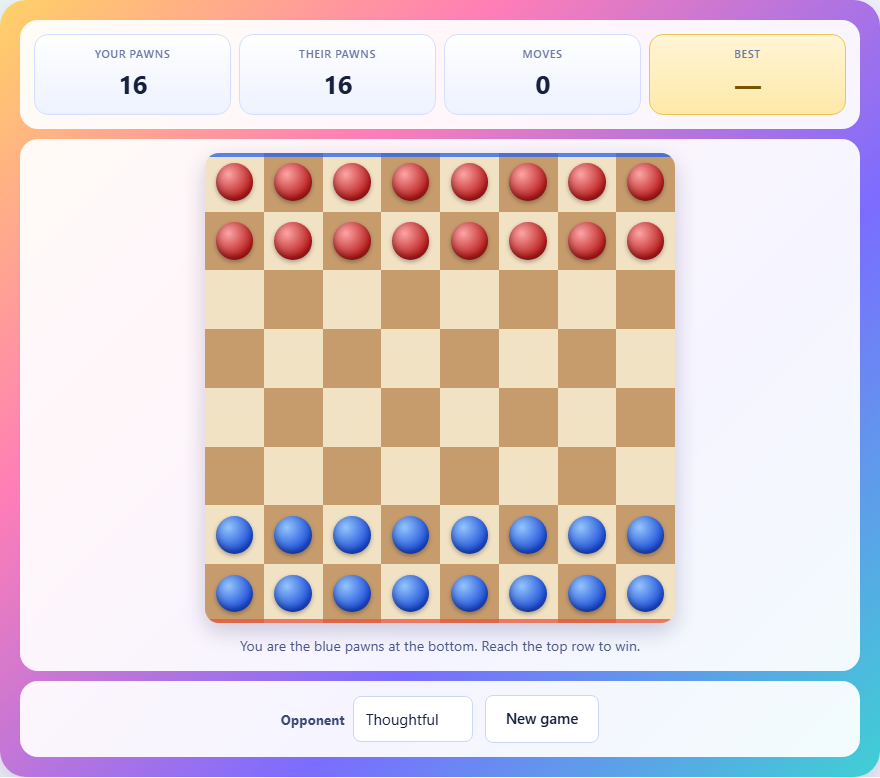
Each side starts with sixteen pawns filling its two nearest rows. The board is eight squares wide and eight squares tall. You play the blue pawns at the bottom. The opponent plays the ones at the top.
Tap one of your pawns to select it. The squares it can reach light up. Green highlights mark empty squares you can move to. Red highlights mark enemy pawns you can capture. Tap one of the lit squares to make the move. Tap somewhere else to cancel the selection.
The game tracks three numbers above the board: your pawn count, the opponent's pawn count, and the total number of moves played so far. There is no time limit and no move limit.
Two ways to win, no way to draw
You win by landing any one of your pawns on the top row. Just one is enough. The game ends the instant a pawn reaches the far side. You also win if every enemy pawn is captured, because an opponent with no pieces has no moves.
The opponent wins in the same way: a pawn on the bottom row, or capturing every one of yours. There are no draws. Every pawn can only move forward, so the board state always changes. Sooner or later, someone reaches the far row or runs out of pieces. This is unusual for abstract strategy games, and it is part of what makes each game feel so decisive. Every position is either winning or losing for one side. The difficulty is figuring out which one you are in before the board makes it obvious.
The three opponent strengths
The dropdown below the board sets the difficulty. Gentle makes the computer look two moves ahead. Thoughtful raises that to four. Sharp goes to five, and on this board five moves of lookahead is enough to play a genuinely strong game.
The computer uses a search method that considers every possible reply to every possible move. It prunes branches that cannot improve on what it has already found, and picks the move with the highest score. The score counts material, how far each pawn has advanced, and whether the back row is still covered.
On Gentle, the computer often walks into captures it could have avoided. On Thoughtful, it defends well but sometimes misses a deep combination. On Sharp, it rarely makes a mistake that a human would notice, and winning it requires a real plan rather than opportunistic captures.
Attack versus defence: the core tension
You win by reaching the top row. The opponent wins by reaching the bottom. Every move forward brings you closer to winning but also leaves one fewer pawn covering your own side. This is the tension at the heart of the game.
Pushing all your pawns forward at once empties your back rows and gives the opponent a clear path straight through. Keeping all your pawns at home means the opponent advances while you wait. The answer is to push some and hold some. Deciding which ones to send forward is where the strategy lives.
The pawns you keep on your second row are the ones that guard the columns the opponent is trying to push through. A single pawn on your second row blocks an entire column, because the opponent cannot capture straight ahead. Going around costs the opponent moves, and moves spent going around are moves not spent advancing.
The diagonal capture trap
Taking an enemy pawn feels like progress, but every capture removes a piece that was blocking a column. The column that pawn was sitting in is now open, and the opponent's pawns behind it can advance freely.
Before you take a pawn, ask what that pawn was doing. If it was blocking two of your own pawns from advancing, taking it helps you. If it was blocking two of the opponent's pawns from pushing forward, taking it helps the opponent more. Not every capture is a good trade, and not every opportunity should be taken.
The strongest captures are the ones on the edges of the board. An edge pawn has fewer neighbours, so removing it opens fewer columns. A capture near the centre opens paths in both directions and is far more dangerous to make without thinking it through.
A related mistake is using a capturing pawn to chase enemy pieces across the board. Each capture moves you diagonally, which may take your pawn away from its own goal and leave a gap behind it. One capture that opens your path is better than three that leave you stranded on the wrong side.
Building a wedge that cannot be stopped
Three pawns arranged in a triangle form a wedge. One pawn sits in front, and two sit behind it on either side, diagonally covering it. The opponent cannot capture the front pawn without first dealing with one of the guards.
Push the whole wedge forward one rank at a time. The guard pawns move up to stand beside the lead pawn, and the lead pawn steps forward again. It takes three moves per rank, but the formation is very difficult to break apart.
A single pawn moving alone is easy to stop. Two pawns moving side by side can be caught by a single diagonal defender. Three in a wedge require the opponent to give up two pawns to stop one, which is a trade that favours you heavily.
When both sides have a clear run toward the far row, count how many moves each side needs. If your wedge reaches the top before the opponent's fastest pawn reaches the bottom, keep running. If not, hold back and set up a block.
Common mistakes and how to fix them
- Emptying the back row to launch an all-out attack. The moment your home rows are clear, the opponent runs a pawn straight through and wins. Always keep at least three or four pawns in your own half of the board.
- Capturing every pawn you can reach. Each capture opens a column. Unless the trade clearly helps your position, leaving the enemy pawn where it is may be better than removing it.
- Moving single pawns forward without support. A lone pawn is stopped by any diagonal defender. Move in pairs or wedges so each pawn covers the others.
- Ignoring the opponent's most advanced pawn. A pawn on the fifth or sixth rank is two or three moves from winning. It must be stopped right away, even if that costs you an attacker on the other side of the board.
- Thinking the game is about material. Having more pawns does not matter if the opponent has one fast pawn with a clear road ahead. Count advancement, not numbers.
Runs entirely on your device
The computer opponent runs inside your browser. The search, the board evaluation, and the move generation all happen on your own machine. Nothing is sent to a server. There is no account, no login, and no data collected. Your best result is stored in your browser's local storage on this device alone. Once the page is loaded, the game works even if you disconnect from the internet. Close the tab and the session ends cleanly.