
Timing, angle, and the scoring that surprises everyone
How to read the sweeping line marker, how the power bar changes your shot, what strike and spare bonuses actually do to the maths, and why aiming slightly off centre is the secret to knocking all ten pins down.
Why ten strikes here add up to 270, not 300
Every ball you throw is stored as a single number: how many pins it took down. The scorer then walks that flat list once, one frame at a time. If a ball took 10, it adds 10 plus the next two numbers in the list, then steps forward by one ball. If two balls in a frame add to 10, it adds 10 plus the single number after them, and steps forward by two. If neither happens, it just adds the two balls together. Those three branches are the whole of the scoring code.
Try it with real numbers. Suppose your first four balls are 10, 7, 3 and 9. Frame 1 is a strike, so it scores 10 plus 7 plus 3, which is 20. Frame 2 is 7 then 3, and those add to 10, so it is a spare worth 10 plus the 9 that follows, which is 19. If the ball after the 9 misses everything, frame 3 scores 9 plus 0, which is 9. Your total after three frames is 48.
One thing to expect on screen: the score is redrawn after every ball, and a bonus that has not been bowled yet is read as zero. So a fresh strike shows up as only 10 at first, then quietly grows as the next two balls land. Nothing is wrong. The list simply has not caught up.
Now the part that differs from a real alley. A real tenth frame hands you extra balls to pay off a closing strike or spare. This game does not. Once the tenth frame is done the game stops, and any bonus ball that never existed counts as zero. A strike in frame 10 is therefore worth exactly 10. Roll all ten strikes and the first eight frames score 30 each, frame 9 scores 20, and frame 10 scores 10. That comes to 270. A perfect 300 cannot happen here.
The same gap trims a tidy spare game. Nine and one in all ten frames gives 19 for each of the first nine frames and 10 for the last, so 181 instead of the 190 a paper scorecard would show. Keep this in mind before you compare a score here with a score from a league night.
- A frame counts as a spare whenever its two balls add to 10, so a frame with no mark can score 9 at most.
- Ten of those unmarked frames therefore cap out at 90. That is below the Normal target of 100 and well below the Hard target of 130.
- In other words, Normal and Hard are unwinnable without spares or strikes. The bonus balls are not a nicety, they are the only route past 90.
- Easy sits at 70, which works out at 7 pins a frame with no bonuses at all. That is why it is the sensible place to learn.
- You beat a level when your final total is equal to or greater than the target, so landing exactly on 100 on Normal counts as a win.
The arithmetic of one roll, from tap to pin count
The lane is drawn on a fixed grid 300 units wide and 560 tall, then scaled up to whatever space your screen has. The gutter edges sit at 40 and 260. The head pin stands at x 150, y 90, and the four back pins sit further away at y 24. Rows are 22 apart, and pins within a row are 26 apart. A ball has a radius of 13 and a pin has 8, so a pin goes down when the two centres come within 21 of each other.
Your first tap freezes the sweeping aim value somewhere between -1 and 1. That single number does two jobs. It shifts the ball's starting spot sideways by 70 times its value, and it gives the ball a sideways speed of 1.6 times its value, which is then held for the whole roll. Your second tap freezes the power between 0 and 1, and the ball's speed up the lane becomes 3 plus 7 times that power. So speed towards the pins runs from 3 to 10 per frame, while sideways speed never goes past 1.6 either way.
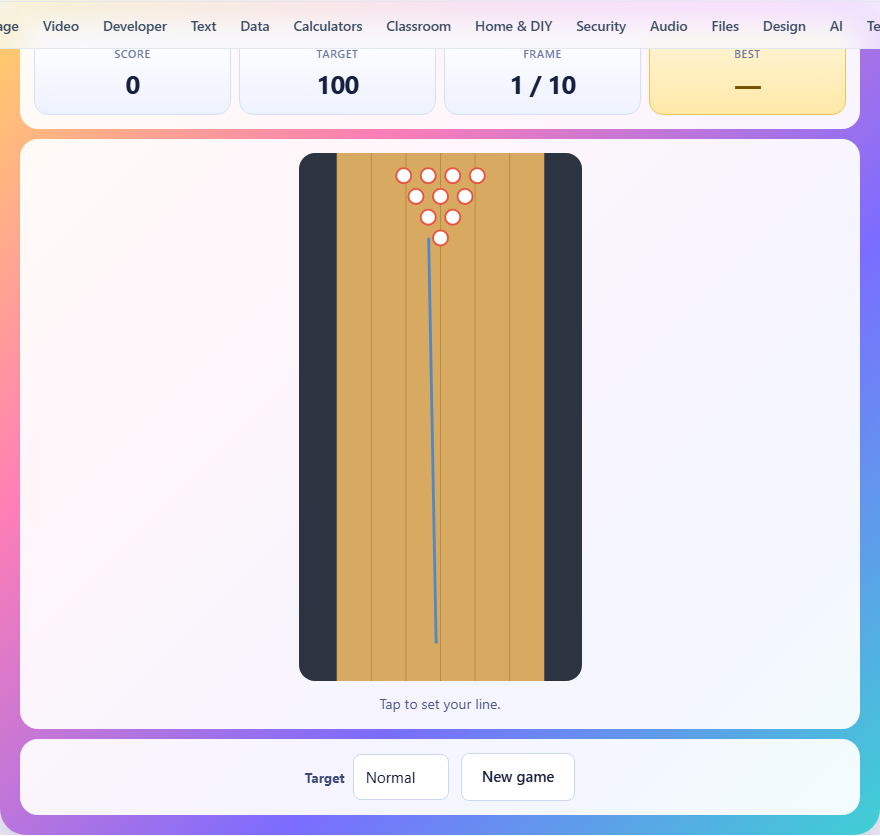
This is where the blue guide line can mislead you. It is drawn during aiming, before you have chosen a power, and it leans by 120 times the aim value over the run up to the head pin. The true lean is 1.6 times 430 divided by the ball's speed, since 430 is the distance from the throwing spot to that pin. The two agree only when speed is 5.73, which is a power of about 0.39. Take an aim of 0.2. The guide points at x 188. A full-power ball really arrives near 178, and a very slow ball, at power 0.1, drifts out to about 201. That spread of 23 units is wider than a whole pin. The line tells you the side, not the exact spot.
Sideways speed never fades, so slow balls have far longer to wander. Push the aim to its full stretch and the ball starts at x 80, needs to shed only 27 to reach the gutter edge at 53, and does that in under 17 frames, whatever the power. Work the safe range out by power and you get roughly this: at full power an aim of about 0.70 still reaches the rack, at half power about 0.55, and at the slowest setting only about 0.32. Once the ball crosses the gutter line its sideways speed is set to zero and it is pinned against the edge, so it can never wander back and can never touch a pin.
Contact itself is short and blunt. A pin the ball reaches is shoved straight away from the ball's centre at 0.55 of the ball's current speed. The ball pays for it by losing 14 percent of its sideways speed and 10 percent of its forward speed. A sliding pin that reaches a standing one passes on 0.7 of its own speed the same way. Every moving pin sheds 6 percent of its speed each frame, so a pin shoved at 3.6 can cover about 60 units before it settles. Its nearest neighbour is only about 25.5 away, and contact needs 16, so it has to close barely 10. Energy is rarely the problem.
Time is. The roll does not end when the pins settle. It ends the instant the ball's centre passes 30 units above the top edge, and whatever is still standing at that moment is what gets counted. The ball has no lane friction, and pin hits only shave its speed, so it never slows enough to stop any other way. From the head pin it still has 120 units to cover. After three pin hits that is about 16 frames at full power and about 37 frames at power 0.2. Easing off the bar buys the rack roughly twice as long to fall over, and that timing, not force, is the real reason a gentler ball often clears more.
- Fallen pins are never swept away. They keep whatever speed was left when the roll ended and start sliding again the moment you send the next ball. A leftover pin can topple a standing one the ball never went near.
- The ball passes straight through fallen pins and is never bent off course by a standing one either. Contact only slows it. There is no hook and no curve, so every path is a straight line.
- Pins have no walls to stop them. A well struck pin can slide off the lane, or off the picture, and it makes no difference to the count. Only the fallen flag matters.
- A pin can only fall once. Nothing ever gets back up, and nothing gets hit twice.
- The clock is measured in drawn frames, not seconds. The aim marker takes about 91 frames to cross the lane and the power bar fills in 50. On a 60 Hz screen that is roughly 1.5 seconds and 0.8 seconds. On a 120 Hz screen both are twice as quick, so the same tap timing will land somewhere else.
- There is no foul line, no lane oil, no ball weight, and no naming of splits. Pins are flat circles here, so nothing tips over a neighbour or bounces back off a wall. Treat it as a game about angle and timing, not as practice for a real lane.
What a frame looks like
A game has ten frames. In each frame you get two chances to knock down ten pins arranged in a triangle. If the first ball clears them all, that is a strike and you skip the second ball. If some are left standing, you throw again at whatever remains. If the second ball gets the rest, that is a spare.
The pins are set up four rows deep, with the single head pin nearest to you and four pins in the back row. The ball rolls from the bottom of the lane toward them. What happens next is not a random lookup. The ball is a moving circle and the pins it touches are pushed along real paths. Those pins then knock over others they bump into. The split you see after a throw is the one the physics produced, not one picked from a table.
Controls: line and power
Every throw has two taps. The first sets your aim. A marker sweeps back and forth across the lane. Tap the board, click it, or press the spacebar when the marker is where you want the ball to go. A line appears on screen showing you the path before you commit.
The second tap sets the power. A bar fills up and drains back down in a loop. Stop it near the top for a fast ball, near the bottom for a slow one. The ball then rolls, and you watch the pins react.
On a phone the taps work the same way. The lane scales to fit your screen, so the controls are big enough to use with a thumb. There are no extra buttons. The canvas itself is the only thing you need to touch.
How the scoring actually works
This is where bowling gets interesting. A normal frame scores the number of pins you knocked down, which is simple enough. But a spare scores ten plus the pins you knock down with your very next ball. A strike scores ten plus the pins from your next two balls.
That means a single frame's score is not settled until one or two frames later. If you throw a strike in frame three, the score for frame three stays blank until you have bowled two more balls. Three strikes in a row give the first of them a score of thirty, because each of the two bonus balls also knocked down ten.
This delayed scoring is why a strike in the early frames is worth far more than a strike near the end. An early strike has many balls left to fill in the bonus. A late one may only get one or two more balls before the game finishes, so the bonus is smaller. The lesson is simple: the first few frames set the ceiling for your entire game.
Reading the pin physics
A ball aimed dead centre at the head pin will punch through the middle and leave the corner pins standing. That is the most common result, and it happens because the ball's energy goes straight back instead of fanning out to the sides.
The trick is to aim between the head pin and the pin next to it. That sends the ball in at a slight angle. The head pin gets knocked sideways into the pins on one side, while the ball carries through to the other. The result is a scatter that reaches every part of the triangle.
Watch what happens to the pins after contact. Some of them are knocked sideways and collide with others. A ball with too much speed punches through without giving the pins time to spread. A slightly slower ball lets each pin do more work on its neighbours, which is why medium power often clears more than full power.
The three targets
The dropdown below the lane sets the score you are trying to beat. Easy is seventy. Normal is one hundred. Hard is one hundred and thirty. The target is what turns ten frames into something you can win or lose, rather than just something you play.
Seventy is forgiving. You can drop a few frames completely and still reach it with a couple of spares. One hundred needs steady play across all ten frames, which is about what a decent club bowler averages in a real game. One hundred and thirty demands strikes. Spares alone will not get there unless nearly every frame is a spare with a strong follow-up ball.
If you are new, play on Easy until you can consistently beat seventy. Then move to Normal and work on your aim. Hard is there for the days when you want a real challenge and have the timing dialled in.
Aiming strategy that pays off
Wait for the marker to reach a spot just off centre before tapping. The exact position depends on the power you plan to use, because a faster ball drifts less on the way up the lane. For a medium-power shot, setting the marker about a quarter of the way from the centre toward the edge puts it in the pocket between the head pin and its neighbour.
On the second ball, the remaining pins are usually on one side. Move the marker further that way. The temptation is to aim straight at the cluster, but the same principle applies. A ball arriving at a slight angle from the side sweeps through more pins than one coming head on.
Do not chase perfect aim on every throw. The marker moves at a steady speed, and trying to land it on a single pixel leads to late taps. Getting it in the right zone is enough. The power bar is where precision pays more, because it controls whether the pins scatter wide or get drilled through the middle.
Power control and when to hold back
Full power sounds like the best idea, but it is not. A very fast ball cuts through the rack and out the back before the pins have time to fall into each other. The ideal power for a first ball is around three quarters of the bar. That gives enough speed to move every pin it touches, but leaves the ball slow enough that the chain reactions spread.
For the second ball, when only a few pins remain, full power is fine. You are not counting on chain reactions any more. You just need the ball to reach the pin and push it down. A slow second ball on a single corner pin can miss if the line is not perfect, because the ball loses momentum before it arrives.
The power bar turns red near the top as a warning. It is not telling you to avoid that zone entirely, but it is a reminder that the hardest throw is also the least forgiving. A red-zone throw with a perfect line is devastating. A red-zone throw with a line two notches off is a gutter ball.
Mistakes that eat your score
- Always aiming straight at the head pin. This is the most common habit and the hardest to break. Dead centre splits the rack and leaves the corners standing every time.
- Using full power on every throw. The speed pushes the ball through the rack before the pins topple into each other. Three-quarter power gives the physics room to work.
- Ignoring the gutter. The ball keeps rolling even after it leaves the lane, but it cannot touch a pin once it crosses the gutter line. If the marker is too far to one side, the ball misses the rack entirely.
- Forgetting that scoring is delayed. After a spare, your next ball counts double because it fills in the spare bonus. That first ball in the new frame is quietly worth twice its face value. Treat it like a bonus shot, not a throwaway.
- Giving up after a poor first ball. Even knocking down a single pin on the second ball counts, and after a spare that pin counts double. Every pin matters when you are chasing a hundred.
Your scores stay local
The whole game runs inside this page. The pin physics, the scoring maths, and the canvas it draws on are all handled by your own browser. Nothing is sent to a server. Your best score lives in your browser's local storage on this device only. It will not follow you to another machine, and closing the tab ends the session cleanly.