
Painting maps with fewer colours than you think
How the three-colour map puzzle works, what the different map sizes change, a reliable method for finding the answer, and the bit of real mathematics behind why three colours is a puzzle at all.
What the puzzle asks of you
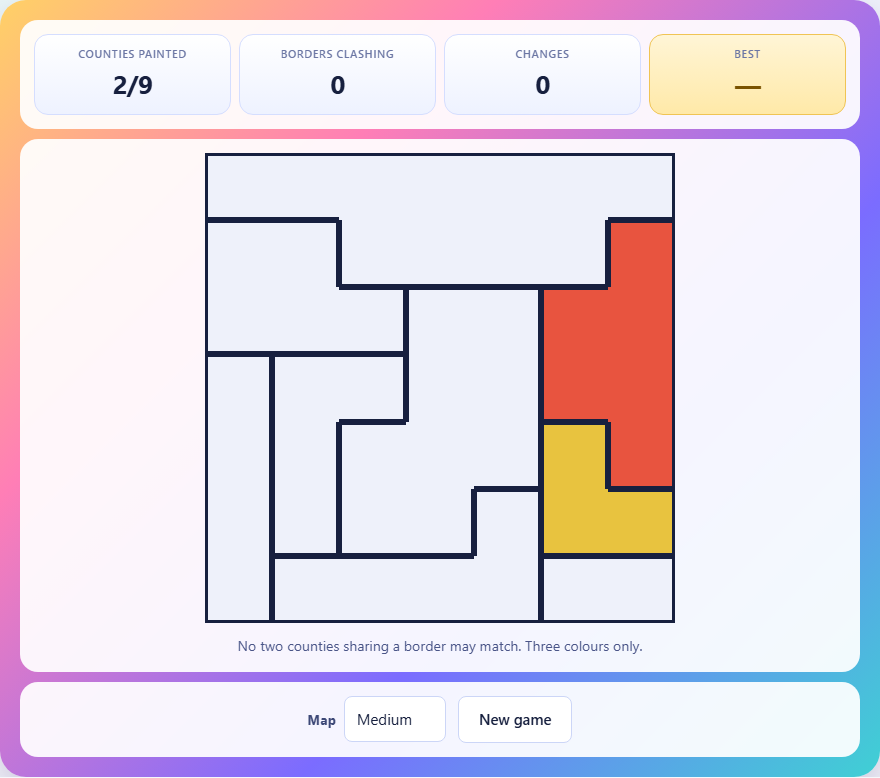
A map sits on the screen, carved into counties. Some of them are already painted. Your job is to fill in the rest so that no two counties sharing a border end up the same colour. You only have three colours to work with.
The important word is border. Two counties that touch at a single point do not clash. They must share an actual stretch of boundary line for the rule to apply. This makes the task a little easier than it first looks, because a county that meets four others at a corner is not really constrained by all four.
Every map on the page has been checked by a solver before it reaches you. Each one can be completed in three colours, and each one has exactly one correct answer. That is not a boast about difficulty. It is a promise that there is no guesswork involved.
How the controls work
Tap or click a county to give it the first colour. Tap it again and it cycles to the second, then the third. One more tap past the third colour clears it back to blank. Counties that were painted for you at the start cannot be changed, and the game makes that clear by disabling them.
Two counters sit above the map. One shows how many counties you have painted out of the total. The other counts how many borders currently have the same colour on both sides. That second number is the one to watch. It must reach zero.
When every county is painted and the clash count hits zero, the puzzle is done. The game records how many changes you made, and fewer is better. A change is any tap that alters a county, including clearing one.
The three map sizes
The dropdown underneath the board lets you pick Small, Medium, or Large. Small maps have six counties. Medium maps have nine counties. Large maps have twelve counties.
The jump from Small to Medium is noticeable but manageable. The jump from Medium to Large is where the puzzle earns its keep. More counties mean more borders, and more borders mean that every colour choice ripples further across the map. A mistake on a Large map can take five or six corrections to untangle, while the same mistake on a Small map is fixed in two taps.
If you are new, start on Small. Six counties and their borders are easy to see at a glance, and the elimination chain is short enough that you can follow it without losing your place. Move to Medium once you can solve Small maps in under ten changes. Large maps are there for the days when you want a puzzle that takes real thought.
The method that solves every board
Start at the counties that are already painted. They cannot change, so everything around them is forced. Look at the neighbours of a painted county. Any neighbour that already touches two different colours has no choice left. The third colour is the only one that avoids a clash.
Once you paint that county, check its own neighbours. Often one of them is now touching two colours as well, and the chain continues. The whole puzzle is a cascade of forced moves flowing outward from the starting clues.
When the chain stalls, look for the county with the most coloured neighbours. A county touching three coloured neighbours where two of the three are the same colour still has two legal options. Pick one and follow the chain again. If the clash count rises, the pick was wrong, so clear it and try the other.
This is not a guess-and-check approach. It is structured elimination. The maps are designed so that the chain from the clues reaches every county if you follow it in the right order.
A worked example
Imagine a Medium map with nine counties. Two of them are already painted: one is red, and one next to it is blue. Start with the red county. Look at each of its neighbours. One of them already borders blue as well as red, which means green is the only colour left. Paint it green.
Now check that green county's own neighbours. One of them borders both green and blue. It must be red. Another one borders green and red. It must be blue. The chain has already painted three counties from a single starting point.
When you hit a county that only borders one colour, it has two legal options. Leave it for now and look for another county with more constraints. Often the chain will come back to it from a different direction and settle the choice for you. The fewer decisions you make yourself, the fewer chances there are for a mistake.
Why three colours instead of four
The four colour theorem, proved in 1976, says that any flat map at all can be coloured with just four colours so that no two bordering regions match. It was the first major theorem to be proved with the help of a computer. With four colours there is almost always slack to spare, and you could paint most maps without thinking very hard.
Three colours is where the constraint bites. Plenty of maps genuinely cannot be done in three. A simple triangle of three mutually bordering counties uses all three colours, so anything touching all three is stuck with no colour left. The puzzle exists because three is tight enough to force real reasoning but loose enough to allow solutions on carefully chosen maps.
The maps you see here have all been run through a solver that confirms a valid three-colouring exists and that it is unique. Maps that fail either test are thrown away during generation. That is why the game can promise a single answer for every board.
Spotting dead ends before they cost you
The most useful skill is counting a county's neighbours before you paint it. A county with only two neighbours can almost always wait. It has at most two constraints, so it will never be the one that causes trouble. A county with four or five neighbours is where the real decisions happen, and getting it wrong sends a ripple through everything around it.
Three counties that all share borders with each other form a triangle. They must use all three colours between them. If you find a fourth county that borders all three of those, it has no legal colour and something earlier is wrong. Recognising this pattern early saves a string of confused corrections.
Another pattern worth watching for is a long border chain. If counties A, B, C, and D each border the next one in a line, the colours must alternate. Painting A and D first can accidentally lock B and C into a clash. Paint from one end of the chain rather than from both ends toward the middle.
Common beginner mistakes
- Painting counties at random instead of starting from the clues. Random painting ignores the constraints and almost always leads to a clash somewhere in the middle of the map.
- Forgetting that corners do not count. Two counties meeting at a point are free to share a colour. Treating every touch as a border makes the puzzle look harder than it is.
- Ignoring the clash counter. It is easy to focus on filling every county and only notice the number when the board is full. Checking it after every two or three taps catches problems early.
- Cycling past blank and accidentally giving a county the wrong colour. The cycle goes through three colours and then blank, so one tap too many starts the cycle over.
- Trying to solve Large maps the same way as Small ones. Small maps forgive a wrong choice because the correction chain is short. On Large maps, a wrong choice near the centre can require clearing half the board.
Everything stays on your device
The map is generated inside your browser. The solver that checks the map runs on your machine. Nothing is uploaded, nothing phones home, and there is no account to create. Your best score sits in your browser's local storage on this device alone. Close the tab and the session is gone. Open a new game and a fresh map is built from scratch, right where you are sitting.